The Conversation I Have Too Often
“We hired an SEO agency six months ago. Spent ₹4 lakhs. Got almost nothing in return.”
I hear this regularly.
Sometimes it’s ₹4 lakhs. Sometimes it’s ₹15 lakhs or ₹40 lakhs. The amount changes, but the story stays the same: disappointed business owners who invested in SEO and got let down.
Here’s what bothers me most about these situations: most of these failures were predictable.
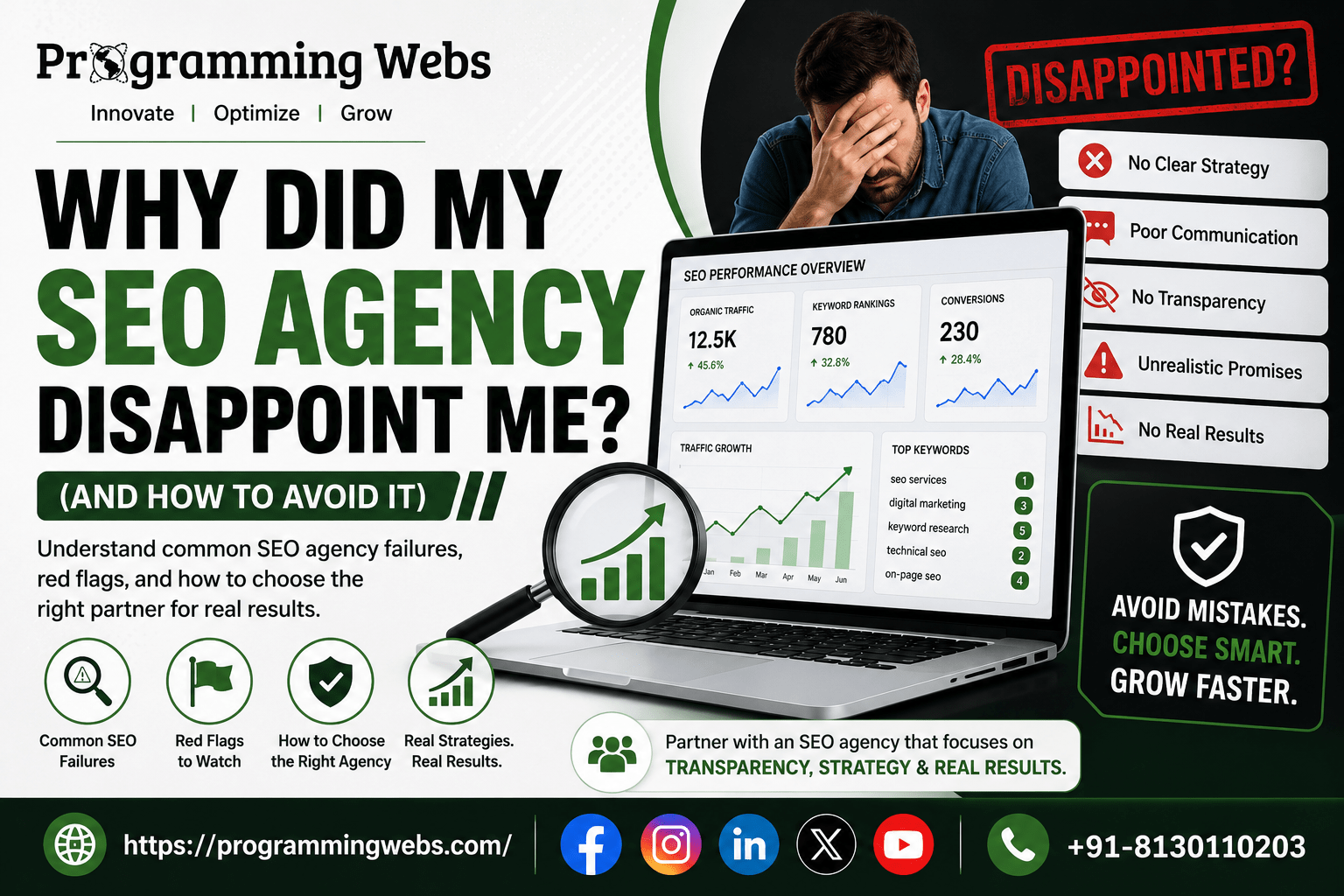
Not because the business owner was foolish. But because they didn’t know the red flags. They didn’t understand how proper SEO Services actually work. And they trusted an agency that was more interested in signing the contract than delivering results.
In this guide, I’m going to show you exactly what goes wrong—based on real client stories, years of industry experience, and honest assessment of where the SEO industry has failed businesses like yours.
More importantly, I’ll show you how to avoid becoming another disappointed statistic.
The Dark Truth: Why Most SEO Agencies Fail
Let me start with uncomfortable honesty.
The SEO agency industry has a fundamental problem: it’s easier to hide results than to deliver them.
Here’s why:
SEO takes time. Unlike paid advertising (where you see results in days), SEO typically takes 3-6 months to show meaningful impact. That’s a long runway to hide mediocrity behind promises and buzzwords.
Results are complex. Did rankings improve because of the agency’s work, or because you got natural links from industry press? Did traffic increase from SEO, or did the agency also run paid ads? The causality is fuzzy enough that agencies can claim credit they don’t deserve.
Most agencies prioritize revenue over results. An agency that signs 50 clients at ₹50K/month generates ₹25 lakhs in monthly revenue. If only 10 of those clients see real results, they still profit massively. They’ve built a business model where client disappointment doesn’t affect their bottom line as long as the contract lasts.
That’s the structural problem.
The 8 Most Common Ways SEO Agencies Disappoint (And How to Spot Them)
Failure #1: Promising Results Before Doing Research
What it looks like: You have a consultation. Within 20 minutes, the agency is already promising you first-page rankings for your target keywords.
Why it’s a red flag: Real SEO starts with analysis, not promises.
A competent agency will spend 1-2 weeks researching before making commitments. They’ll analyze:
- Your competitive landscape (how hard are these keywords to rank for?)
- Your current technical foundation (is your site ready?)
- Your content quality and structure
- Your backlink profile and authority level
- Your conversion optimization potential
An agency that promises results without this research is either clueless or dishonest.
What to ask instead: “Walk me through your analysis process. What data do you need before recommending a strategy? When can you have initial findings and recommendations?”
A good agency will propose a discovery phase (sometimes free) before committing to results.
Failure #2: One-Size-Fits-All SEO Strategies
What it looks like: Whether you’re a local plumber or a national e-commerce brand, the agency recommends the same approach for everyone.
Why it’s a red flag: SEO for a local business targeting 3 cities is completely different from Ecommerce SEO for a Shopify store competing nationally.
Yet many agencies use templates:
- Every client gets “20 blog posts per month”
- Every client needs “50 backlinks”
- Every client should “optimize for 100 keywords”
This is lazy. It’s not tailored. It won’t work.
What to ask instead: “Based on your analysis of my business, competitive landscape, and goals—what specific strategy do you recommend? Why is this approach right for MY situation?”
A good agency will explain their tailored approach and why it’s different from their other clients.
Failure #3: Focusing on Metrics Instead of Revenue
What it looks like: Your SEO agency celebrates a 150% increase in organic traffic.
You check your revenue. It’s unchanged.
Why it’s a red flag: Traffic doesn’t equal revenue. Irrelevant traffic is worthless.
Many agencies optimize for vanity metrics:
- “We increased your monthly visitors from 10K to 25K”
- “We ranked you for 500 keywords”
- “We got your domain authority from 15 to 28”
But they never connect this to actual business outcomes:
- Did those visitors convert to customers?
- Were those keywords actually valuable?
- Does your authority translate to revenue?
The most sophisticated agencies focus on conversion metrics:
- Cost per lead
- Lead quality
- Lead-to-customer rate
- Revenue per visitor
An agency that can’t connect SEO to revenue is wasting your money.
What to ask instead: “How will we measure success? What’s your process for ensuring SEO traffic converts into customers or leads?”
A good agency will discuss Conversion Rate Optimization and how it integrates with SEO.
Failure #4: Neglecting Your Website Foundation
What it happens: The agency starts “doing SEO” without fixing your technical problems first.
Meanwhile, your site has:
- Poor mobile optimization (75% of users are on mobile)
- Slow page load times (hurts rankings significantly)
- Broken internal linking
- Poor site structure
- Inadequate website maintenance
Why it’s a red flag: Trying to rank without a solid technical foundation is like painting a beautiful house on a crumbling foundation.
This is especially true if you’re running WordPress or Shopify. Your platform choice, theme selection, plugin configuration, and hosting infrastructure all affect SEO potential.
Many agencies skip this entirely because it’s less visible than “creating content” or “building backlinks.”
What to ask instead: “Before we start the SEO campaign, will you audit my technical SEO? Will you identify any issues with my website speed, mobile optimization, or site structure?”
A good agency will start with technical foundation work if needed. They might recommend WordPress Development, Shopify Development, or Website Development services if your site needs architectural improvements.
Failure #5: Ignoring Your Existing Customer Base
What it looks like: The agency focuses entirely on “getting new traffic” while your existing customers disappear.
Why it’s a red flag: SEO agencies obsess over acquisition. They ignore the customers you already have.
But here’s the business reality: retaining existing customers is 5-25x cheaper than acquiring new ones.
An agency that doesn’t discuss:
- How to retain your current customers through email marketing
- How to turn one-time customers into repeat buyers
- How to leverage customer data for better targeting
- How to build customer loyalty through content
…is leaving massive revenue on the table.
What to ask instead: “How does your SEO strategy integrate with customer retention? Are you building an email list? Are we optimizing for repeat customers?”
A good agency will discuss customer lifecycle and how SEO fits into the complete picture.
Failure #6: Setting Unrealistic Timelines
What it looks like: Agency promises “first page rankings in 30 days” or “double your traffic in 60 days.”
Why it’s a red flag: SEO doesn’t work this fast (unless the keywords are extremely low-competition or non-commercial).
The reality:
- Weeks 1-4: Implementation and foundation work
- Weeks 5-8: Initial crawling and indexing by Google
- Weeks 9-12: Early ranking signals appearing
- Months 4-6: Meaningful traffic and ranking improvements
- Months 6-12: Compounding results and authority building
Any agency promising faster results is either lying or recommending low-quality shortcuts (which Google will penalize).
What to ask instead: “What’s a realistic timeline? When can I expect to see first page rankings? When should I expect meaningful revenue impact?”
A good agency will explain the realistic timeline and what benchmarks you’ll hit at each stage.
Failure #7: Poor Communication and Reporting
What it looks like: You can’t reach your account manager. Monthly reports are generic spreadsheets. You have no idea what they’re actually doing.
Why it’s a red flag: If you can’t understand what the agency is doing, you can’t evaluate if it’s working.
Many agencies deliver reports that show:
- Ranking for 50 new keywords
- 200 new backlinks acquired
- 15 blog posts published
But they don’t explain:
- Which rankings matter for your business?
- Are those backlinks high quality?
- Did those blog posts attract relevant traffic?
- What’s the revenue impact?
You deserve transparency. You deserve to understand strategy, not just activity metrics.
What to ask instead: “Can you walk me through your reporting process? How often will we communicate? Can I see real examples of your monthly reports?”
A good agency will provide clear, business-focused reporting and maintain regular communication.
Failure #8: Recommending Unnecessary Services
What it looks like: An SEO agency tells you they need to:
- Completely rebuild your website (₹5 lakhs project)
- Redesign your landing pages (₹2 lakhs)
- Implement custom software (₹3 lakhs)
…just to do basic SEO.
Why it’s a red flag: Sometimes website redesign IS necessary. But often it’s a sales tactic.
An agency that maximizes service revenue instead of results will recommend expensive projects that only marginally improve SEO.
Compare this to an agency recommending:
- Optimize existing pages first
- Improve current website performance
- Build authority with your current structure
- Only invest in redesign if ROI is clear
The second approach is more honest.
What to ask instead: “Is this recommendation necessary for SEO success? What’s the expected ROI? Can we accomplish similar results without this investment?”
A good agency will prioritize your budget efficiency over their service revenue.
What GOOD SEO Actually Looks Like
Now that we’ve covered the failures, let me be clear about what actually works.
Real SEO is Built on Three Pillars
Pillar 1: Technical Excellence
Your website must be:
- Fast-loading (Core Web Vitals optimized)
- Mobile-friendly (no exceptions in 2026)
- Properly structured (crawlable by Google)
- Securely hosted (HTTPS, reliable uptime)
This is table stakes. Without it, nothing else matters.
Pillar 2: Content That Actually Helps People
Not keyword-stuffed fluff. Not AI-generated garbage. Real content that:
- Answers the questions your audience asks
- Demonstrates expertise and authority
- Provides unique insights or data
- Builds trust with your potential customers
This is what Google actually rewards in 2026.
Pillar 3: Authority Building
You need:
- High-quality backlinks from relevant sources
- Brand mentions and citations
- Social proof and user engagement
- Consistent growth and reputation building
Backlinks aren’t the only ranking factor, but they remain one of the most important.
The Integrated Approach
The best SEO Services integrate multiple channels:
- Technical foundation (your hosting, WordPress/Shopify setup, site architecture)
- On-page optimization (keyword targeting, content structure, internal linking)
- Content strategy (blog posts, guides, resource pages that attract links)
- Authority building (backlinks, citations, brand building)
- Conversion optimization (turning traffic into customers)
- Ongoing monitoring (tracking, adjusting, scaling what works)
A complete strategy touches all these elements.
Real Case Studies: When Agencies Failed (And What We Did Instead)
Case Study 1: The “Promise Everything” Agency
The Setup: A manufacturing company in Gujarat hired an SEO agency. The contract promised “first page rankings for 50 keywords within 120 days” for ₹2.5 lakhs.
What Went Wrong:
- Month 1: Agency “optimized” 30 pages (keyword stuffing, thin content)
- Month 2: No ranking improvements visible
- Month 3: Rankings actually dropped (Google penalty for poor-quality content)
- Month 4: Agency stopped responding to emails
The Real Problem: The agency had no process. No research. No understanding of the competitive landscape. Just keyword insertion and hope.
What We Did:
- Audited the damage (penalty recovery took 6 weeks)
- Rebuilt content with actual value
- Fixed technical issues (site speed, mobile optimization, crawl issues)
- Built legitimate backlinks from industry sources
- Implemented proper tracking and reporting
Results After 6 Months:
- Recovered from penalty
- Ranked #5-12 for primary target keywords
- 34% organic traffic growth
- 8 qualified leads per week from organic search
Cost: ₹3.2 lakhs total (more than the failed agency, but with real results)
Case Study 2: The “Traffic, Not Revenue” Agency
The Setup: An e-commerce brand (Shopify store) hired an agency for Shopify SEO Services. They promised organic traffic growth.
What Went Wrong:
- Agency delivered: 120% increase in monthly visitors
- Reality: Revenue unchanged
- The problem: Most traffic came from low-commercial-intent keywords
- Example: Ranking #1 for “how to choose winter jackets” brought 2,000 visitors
- Conversion: 0 customers from those 2,000 visitors
The Real Problem: Agency optimized for keyword volume, not keyword intent. They built traffic, not customers.
What We Did:
- Analyzed keyword intent and commercial value
- Redirected content strategy to high-intent keywords
- Implemented Conversion Rate Optimization on landing pages
- Improved product page optimization
- Built authority with relevant backlinks
Results After 4 Months:
- Organic traffic decreased (16% drop) — intentionally
- Customer acquisition from organic increased 240%
- Revenue per visitor increased 156%
- Monthly revenue from organic: ₹22 lakhs (from ₹4 lakhs previously)
The lesson: More traffic ≠ better business. Smart traffic > high traffic.
Case Study 3: The “Neglected Foundation” Agency
The Setup: A WordPress-based service business hired an agency to rank for local service keywords. Agency focused on content and backlinks.
What Went Wrong:
- Agency published 20 blog posts
- Agency built 30 backlinks
- Rankings: No improvement
- Traffic: Unchanged
The Real Problem: Site had fundamental technical issues:
- 4.2 second page load time (should be under 2.5 seconds)
- Poor mobile experience (form buttons were unclickable)
- Broken internal linking (404 errors on important pages)
- Missing Local SEO optimization (no local citations, poor Google My Business)
Agency skipped foundation work and went straight to “campaign tactics.”
What We Did:
- Fixed Website Development issues (WordPress optimization, hosting upgrade, CDN implementation)
- Rebuilt internal linking architecture
- Optimized for Local SEO (Google My Business, local citations, location pages)
- THEN created targeted content strategy
- Built strategic backlinks from local industry sources
Results After 5 Months:
- Page load time: 4.2 seconds → 1.8 seconds
- Mobile experience: Improved significantly
- Local rankings: #2-5 for all target keywords
- Lead generation: 15-20 qualified leads per week (from 0)
The Red Flags: What to Watch Out For
During Your Sales Conversation
❌ Agency promises results without research ✓ Good: “We’ll do a 2-week analysis before committing to strategy”
❌ They focus on their services, not your goals ✓ Good: “What are your actual business goals? Revenue? Leads? Market share?”
❌ They can’t explain their process ✓ Good: “Here’s our step-by-step process. Here’s what we’ll do each month”
❌ Overly aggressive pricing or promises ✓ Good: “Here’s realistic pricing for your situation. Here’s realistic timeline”
During Your Engagement
❌ You can’t reach your account manager ✓ Good: “You have direct access. We communicate weekly minimum”
❌ Reports are activity metrics, not business metrics ✓ Good: “Reports show revenue impact, lead quality, customer acquisition cost”
❌ Agency avoids discussing competitors’ backlink strategies ✓ Good: “Here’s exactly what competitors are doing. Here’s how we’ll outflank them”
❌ No discussion of what’s NOT working ✓ Good: “This strategy isn’t delivering ROI. Let’s pivot to approach B”
In Your Results
❌ Traffic increased, revenue unchanged ✓ Good: “Our traffic brought actual customers and revenue”
❌ Rankings improved, conversion stayed flat ✓ Good: “We optimized the entire funnel from ranking to conversion”
❌ They won’t discuss what’s next after contract ends ✓ Good: “Here’s your sustainable strategy going forward”
How to Choose a Better SEO Partner
Step 1: Require a Detailed Audit
Before committing, ask:
- Can they provide a written technical SEO audit?
- Can they analyze your competitive landscape?
- Can they identify your biggest opportunities?
- Can they pinpoint your main problems?
Many agencies will do this for free or cheap. It shows they’re serious.
Step 2: Ask for Strategy, Not Services
Don’t ask “How much for [service]?” Ask “What strategy do you recommend?”
Push back on vague answers. Demand specificity:
- Which keywords should we target? Why?
- What content should we create? Why?
- How will we build authority? Why?
- What’s the timeline? Why?
An agency that can answer these questions has done real thinking. An agency that gives generic answers is selling templates.
Step 3: Check Their Portfolio and Case Studies
Don’t just look for “impressive numbers.” Look for:
- Similar businesses to yours (industry and size)
- Realistic timelines (not “100% ranking improvement in 30 days”)
- Clear before/after metrics
- Business-focused results (revenue, leads, customers)
Ask for references. Call them. Ask real questions:
- Did the agency deliver what they promised?
- Would you hire them again?
- What surprised you (good and bad)?
- How responsive were they?
Step 4: Understand Their Approach to Your Specific Platform
If you’re on WordPress, do they specialize in WordPress SEO Services and WordPress Development?
If you’re on Shopify, do they have expertise in Shopify SEO Services and Shopify Development?
If you’re a local business, do they understand Local SEO Services?
Specialization matters because each platform has unique opportunities and challenges.
Step 5: Define Success Metrics Upfront
Before signing anything, agree on:
- What metrics matter (revenue, leads, traffic, rankings)?
- What’s the baseline?
- What’s the target?
- When will you achieve it?
- How will you measure it?
Get this in writing. If the agency resists, that’s a red flag.
What ProgrammingWebs Does Differently
I could make this section sound like self-promotion. But I’ll be honest instead.
Here’s where we differ from typical agencies:
We Start with Technical Foundation
We won’t build SEO on a broken website. We’ll audit:
- Site speed and Website Maintenance & Optimization
- Mobile experience
- Crawlability and indexing
- Site architecture and internal linking
- Platform-specific issues (WordPress, Shopify, etc.)
If your foundation is broken, we fix it first. Sometimes that means Website Development work. Sometimes it means Landing Page Design. We tell you what’s needed, not what’s most profitable for us.
We Integrate SEO with Conversion
Traffic is worthless if it doesn’t convert. We combine:
- SEO Services (ranking optimization)
- Conversion Rate Optimization (converting visitors)
- Landing Page Design (where conversion happens)
We don’t celebrate traffic. We celebrate revenue.
We Build Integrated Strategies
For e-commerce, we combine:
- Ecommerce SEO Services
- Shopify SEO Services or WordPress SEO Services
- Conversion Rate Optimization
- Often Google Ads Management or Meta Ads Management for faster traction
For local businesses, we combine:
- Local SEO Services
- SEO Services
- Social Media Marketing
- Often Google Ads for immediate visibility
We don’t sell separate services. We build integrated systems.
We Measure What Matters
Our reporting includes:
- Ranking improvements (but who cares without context?)
- Traffic growth (but how much converts?)
- Lead generation and quality (actual business value)
- Revenue attribution (the only metric that matters)
- Cost per acquisition (efficiency metric)
We know what moves your business needle. That’s what we optimize for.
We’re Transparent About Limitations
We’ll tell you:
- This keyword is too competitive for our timeline
- This industry is tougher than you think
- Results will take longer than you hoped
- Organic alone might not be enough (you might need Google Ads too)
We’d rather lose a contract with honest truth than win a contract with overpromising.
The Uncomfortable Truth About DIY SEO
Before you think “I’ll just do this myself,” consider:
- SEO takes 15-20 hours per week minimum
- It requires understanding of 50+ ranking factors
- You need to stay current with algorithm changes
- You need tools (often ₹500-3,000/month)
- You need content skills
- You need technical skills
- You need backlink relationship networks
For most business owners, that’s not realistic.
The real choice isn’t “DIY vs. Agency.” It’s “Bad Agency vs. Good Agency.”
And a good agency will save you thousands of hours while delivering results bad DIY efforts never would.
Next Steps: Finding Your Better SEO Partner
If you’ve been disappointed by an agency, or you’re worried about making the wrong choice:
- Do a gap analysis: Where is your website failing compared to competitors?
- Audit your current situation: What’s working? What’s broken? What’s missing?
- Get strategic recommendations: What actually needs to happen?
- Define success: What does success look like for YOUR business?
- Choose carefully: Use the red flags and selection criteria we discussed.
At ProgrammingWebs, we offer comprehensive consultations where we:
- Analyze your competitive landscape
- Identify your biggest opportunities
- Provide honest assessment of what’s needed
- Recommend realistic strategy and timeline
Ready to work with a better SEO partner?
Contact us for a no-fluff consultation. We’ll tell you exactly what we see, what we recommend, and whether we’re the right fit for your goals.
If we’re not, we’ll tell you that too. Honest consultants build better long-term relationships than agencies that overpromise.
Final Thought
You didn’t hire a bad SEO agency because you made a foolish decision. You hired them because the SEO industry has made it hard to distinguish good from bad.
But now you know better. You know the red flags. You know what works. You know what to ask for.
Don’t let past disappointment stop you from investing in SEO. Just invest smarter.
Your competitors certainly are.