You’re getting traffic. People are landing on your website every single day. But your phone isn’t ringing, your inbox is quiet, and your sales dashboard looks the same as it did three months ago.
Sound familiar?
Here’s the truth most agencies won’t tell you: traffic doesn’t pay your bills — conversions do. You could double your website visitors tomorrow and still not make an extra dollar if your site isn’t built to turn strangers into customers.
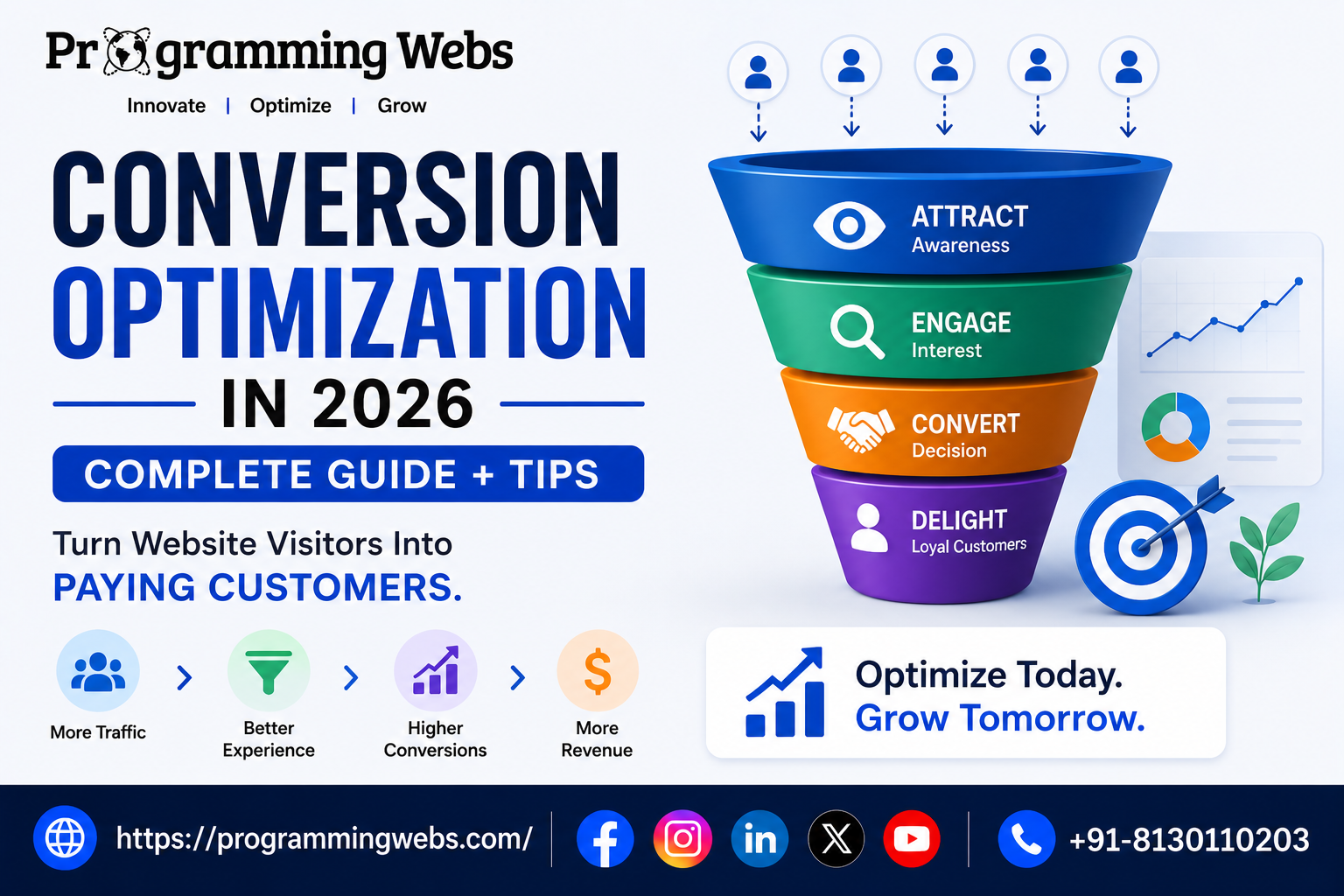
That’s exactly where conversion optimization comes in. In 2026, businesses that treat conversion optimization as a real strategy — not an afterthought — are the ones pulling ahead. This guide breaks down what conversion optimization actually means, why it matters more than ever this year, and exactly how to do it, step by step, whether you’re a startup founder, an SMB owner, or running a growing e-commerce store.
Let’s fix your leaky funnel.
What Is Conversion Optimization?
Conversion optimization (often shortened to CRO, or conversion rate optimization) is the process of improving your website so more visitors take a specific action — buying a product, filling out a form, booking a call, or signing up for a trial.
It’s not about getting more traffic. It’s about getting more value from the traffic you already have.
Think of your website like a shop. If 100 people walk in and only 2 buy something, you don’t fix that by putting more people on the sidewalk outside. You fix it by improving the shop — better layout, clearer pricing, friendlier staff, faster checkout. That’s conversion optimization in a nutshell.
Why Conversion Optimization Matters More Than Ever in 2026
The numbers tell the story clearly. Recent industry research shows average website conversion rates typically fall somewhere between 2.35% and 5.31%, while top-performing websites are pushing past 11% and beyond by using smarter, AI-assisted personalization and faster, friction-free experiences.
A few trends worth paying attention to this year:
- Mobile experience decides the outcome. Google’s own mobile speed research found that a majority of mobile visitors abandon a page if it takes longer than 3 seconds to load. If your site is slow on phones, you’re losing customers before they even see your offer.
- Simplicity beats complexity. Businesses that cut down form fields, simplify checkout steps, and offer guest checkout consistently see fewer drop-offs.
- Trust signals convert. Reviews, transparent pricing, and visible security badges are influencing buying decisions more than flashy design.
- Small, ongoing tests beat one-time redesigns. Brands running continuous, small experiments outperform businesses that redesign their site once a year and hope for the best.
- Even a 0.5% lift matters. A mid-sized online store that improves its conversion rate from 2.5% to just 3% can gain roughly 20% more sales — without spending an extra rupee or dollar on ads.
This is why every serious conversion optimization guide in 2026 starts with one idea: fix the funnel before you fund more traffic.
The Complete Conversion Optimization Framework (Step-by-Step)
Here’s the exact process our team at ProgrammingWebs follows when we take on a client’s website.
Step 1: Audit Your Website Like a Stranger Would See It
Before changing anything, you need to know what’s actually broken. Look at:
- Page load speed (especially on mobile)
- Where visitors are dropping off in your funnel
- Confusing navigation or unclear calls-to-action
- Broken forms, checkout errors, or outdated design
If this sounds overwhelming, our website maintenance and optimization team can run a full technical and conversion audit for you.
Step 2: Understand Your Visitors, Not Just Your Metrics
Numbers tell you what is happening. Heatmaps, session recordings, and user surveys tell you why. Watch how real visitors move through your site. Are they scrolling past your offer? Rage-clicking a broken button? Hesitating at checkout?
This is also where good SEO and CRO overlap — the visitors coming from search need to land on pages that actually match what they were searching for. If your SEO services are bringing the right people to the wrong page, no amount of design polish will save your conversion rate.
Step 3: Fix Your Landing Pages and CTAs
Your landing page is often the first — and only — impression you get. A strong landing page should:
- Have one clear headline that speaks to a specific problem
- Use a single, obvious call-to-action (not five competing buttons)
- Show proof — testimonials, case studies, numbers
- Load fast and look clean on mobile
This is a full specialty on its own, which is why many of our clients come to us specifically for landing page design before running any paid campaigns.
Step 4: Optimize for Speed and Mobile First
With most traffic now coming from phones, mobile-first design isn’t optional anymore. A slow, clunky mobile experience is one of the fastest ways to kill a conversion. If your website was built years ago on outdated code, it might be time for a rebuild through our website development or WordPress development team.
Step 5: Test, Measure, Repeat
Conversion optimization is never “done.” Run A/B tests on headlines, button colors, form length, and page layout. Keep what works, drop what doesn’t, and test again. This is the single biggest difference between businesses that grow steadily and ones that plateau.
Best Conversion Optimization Tips by Business Type
Different businesses need different approaches. Here’s a quick breakdown:
For SMBs and Local Businesses
- Add local trust signals — reviews, service area, local phone number
- Make your contact form short and mobile-friendly
- Pair CRO with strong local SEO services so nearby customers actually find you first
For Startups
- Focus on your signup or demo-booking flow — remove every unnecessary field
- Use social proof early, since new brands need trust fast
- Combine CRO with Google Ads management and Meta Ads management so paid traffic doesn’t go to waste
For E-commerce Brands
- Simplify checkout to as few steps as possible
- Show shipping costs early — hidden fees are a top reason for cart abandonment
- Optimize product pages with clear images, reviews, and urgency (limited stock, timers)
- If you’re on Shopify, our Shopify SEO services and Shopify development team can help align design with conversion goals
- Running on WordPress or WooCommerce instead? Check out our comparison guide: WooCommerce vs Shopify in 2026
For Enterprises
- Run structured, ongoing A/B testing across multiple landing pages and regions
- Personalize experiences based on visitor behavior and location
- Scale infrastructure with our full services suite covering both marketing and IT
Real-Life Example: How a Small Fix Made a Big Difference
Picture a small online store selling handmade skincare products. They were getting decent traffic from social media, but sales were low. After a quick audit, three problems stood out: shipping costs were hidden until the final checkout step, the mobile site took nearly 6 seconds to load, and there was no visible customer review on the product page.
Fixing just these three things — upfront pricing, faster mobile load time, and adding star ratings — is a textbook example of what a proper conversion rate optimization process looks like. Small, focused changes like these are usually what separate a website that “just exists” from one that actually generates revenue.
Common Conversion Optimization Mistakes to Avoid
- Chasing traffic instead of fixing the funnel. More visitors won’t help if your site doesn’t convert them.
- Redesigning everything at once. You won’t know which change actually worked.
- Ignoring mobile users. They’re often the majority of your traffic.
- Skipping data and going with “gut feeling.” Always test before rolling out a big change.
- Treating SEO and CRO as separate projects. They should work together — our ecommerce SEO services are built with conversion in mind from day one.
Why Choose ProgrammingWebs for Conversion Optimization
There’s no shortage of agencies promising results. What makes ProgrammingWebs different is simple: we don’t treat SEO, ads, design, and development as separate departments — we treat them as one connected system built around a single goal, turning your visitors into paying customers.
- We combine technical audits, UX research, and data-backed testing instead of guesswork
- Our team handles everything under one roof — from social media marketing to development to conversion strategy — so nothing gets lost between vendors
- We work with SMBs, startups, e-commerce brands, and enterprises across different markets, adapting our approach to your budget and goals
- Transparent process, honest reporting, and pricing you can actually plan around — see our pricing page
- You can see our work for yourself in our portfolio
We’re not here to sell you a one-time redesign. We’re here to build a website and marketing engine that keeps converting, month after month.
Frequently Asked Questions
1. What is conversion optimization in simple terms? Conversion optimization is the process of improving your website so a higher percentage of visitors take a desired action, like buying, signing up, or contacting you.
2. What is a good conversion rate in 2026? Most websites average around 2.35% to 5.31%, though it varies heavily by industry. E-commerce sites often see averages closer to 2–5%, while lead-generation and service-based sites can be higher.
3. How long does conversion optimization take to show results? Some fixes, like speeding up a slow page, can show results within days. Full CRO programs with ongoing testing usually show consistent improvement over 2–3 months.
4. Is conversion optimization only for e-commerce websites? No. Any website with a goal — bookings, form fills, demo requests, phone calls — can benefit from conversion optimization, including SaaS, local businesses, and B2B companies.
5. What’s the difference between SEO and conversion optimization? SEO focuses on getting visitors to your site through search. Conversion optimization focuses on what happens after they arrive — turning that traffic into leads or sales. Both work best together.
6. What tools are used for conversion optimization? Common tools include heatmaps, session recordings, A/B testing platforms, and analytics dashboards to track visitor behavior and test changes.
7. Can a small business afford conversion optimization? Yes. Many high-impact fixes, like clearer CTAs, faster load times, or shorter forms, cost very little but can significantly improve results, which is why it’s one of the highest-ROI investments for small businesses.
Final Thoughts: Stop Losing Customers You Already Paid to Attract
Every visitor who leaves without converting is money you already spent to bring in — wasted. The businesses winning in 2026 aren’t necessarily the ones with the biggest ad budgets. They’re the ones who’ve fixed their funnel so every visitor has the best possible chance of becoming a customer.
If your website is getting traffic but not turning it into leads or sales, it’s time for a proper conversion optimization guide applied to your actual business — not generic advice.
Ready to turn your website into a conversion machine? Contact ProgrammingWebs today for a free conversion audit, or explore our full range of services to see how we can help your business grow. You can also browse our blog for more practical, no-fluff marketing and IT guides.