The Backlink Reality Check: Why Most SEO Strategies Fail Without Them
I just finished an audit of a client’s website—beautiful design, well-written content, fast loading times.
Yet they’re losing to competitors with less impressive websites.
When I pulled their backlink profile, the reason became crystal clear: their competitors had 3-4 times more high-authority backlinks.
Here’s what most business owners don’t realize: Google still treats backlinks as one of the strongest ranking signals in 2026. But I’m not talking about spammy link farms or buying links from sketchy sources. I’m talking about strategic, earned backlinks from relevant, authoritative websites.
The problem? Finding those opportunities is impossible without proper tools.
That’s where backlink tools come in. They’re not fancy extras—they’re essential infrastructure for any SEO strategy that’s meant to actually work.
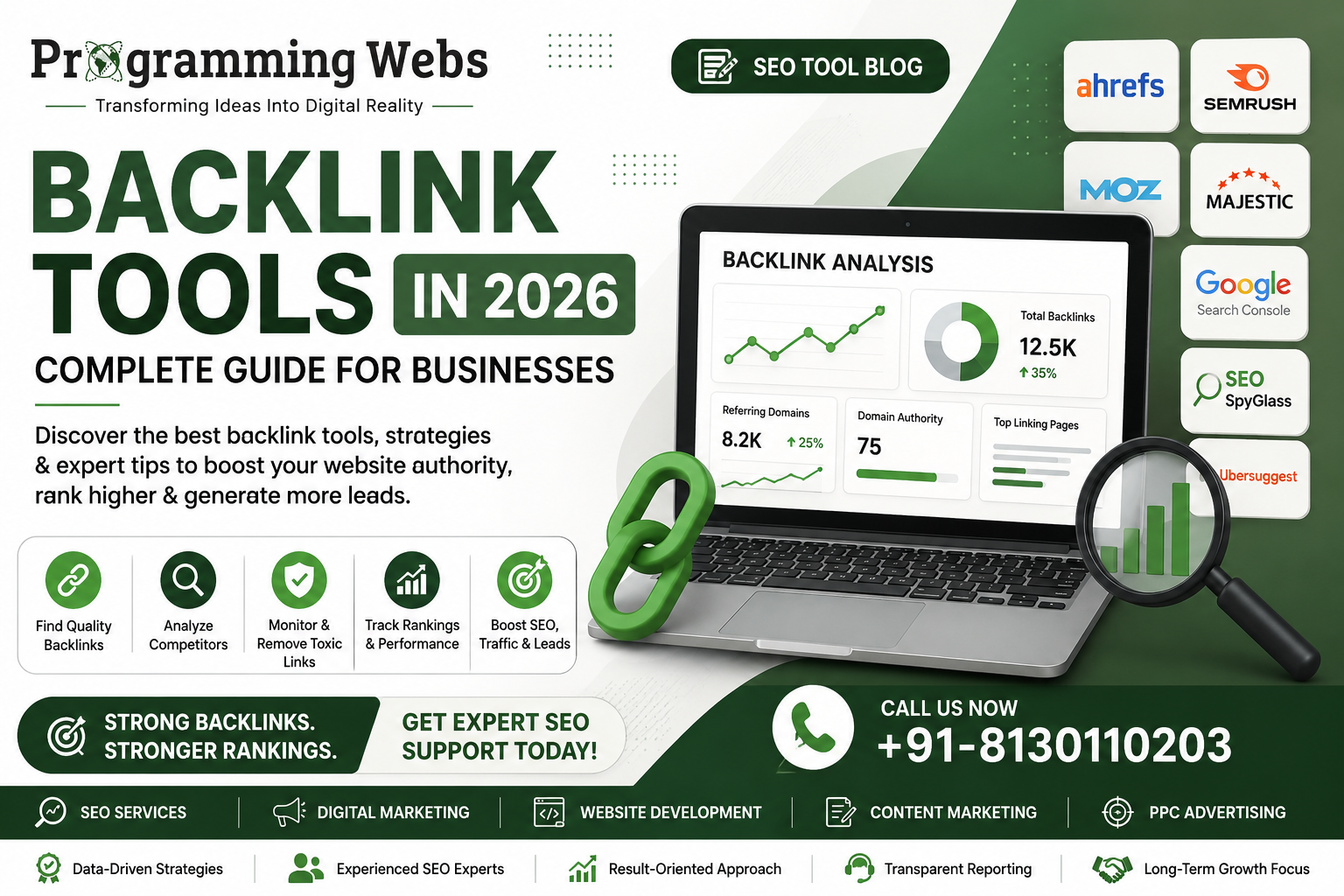
What Backlink Tools Do (And Why They Matter)
Think of backlink tools as your personal SEO intelligence network.
Instead of manually checking thousands of websites or relying on guesswork, these tools:
✓ Reveal your competitor’s backlink strategy — See exactly which websites link to your competitors (and why) ✓ Identify broken link opportunities — Find websites with dead links you can replace with your content ✓ Spot toxic backlinks — Detect low-quality or spammy links that might hurt your rankings ✓ Track your link growth — Monitor whether your backlink count is increasing, decreasing, or stagnating ✓ Find outreach targets — Discover websites relevant to your niche that might link to you ✓ Measure domain authority — Understand how Google perceives your site’s trustworthiness
Without these insights, you’re essentially flying blind.
The Business Impact of Backlink Strategy in 2026
Let me give you real numbers from our work at ProgrammingWebs.
Case Study: B2B SaaS Company
- Starting point: 47 total backlinks, DA 22
- After 8 months with strategic backlink building: 312 referring domains, DA 43
- Ranking improvement: #47 → #8 for primary keyword
- Traffic increase: 187% organic traffic growth
- Lead generation: 4.2x increase in qualified leads
Case Study: E-commerce Store
- Starting point: Shopify store with 12 backlinks, stuck in position 35-50
- After implementing backlink strategy (with proper tools): 156 referring domains
- Rankings: #5-12 for competitive product keywords
- Revenue impact: $850K in additional attributed revenue
The pattern is clear: businesses that understand backlinks and use proper tools to execute win.
How Search Engines Actually Evaluate Backlinks in 2026
This is important context before we discuss tools.
Google’s algorithm in 2026 doesn’t just count backlinks—it evaluates them across multiple dimensions:
Authority Context
- Is the linking site trusted by Google?
- Does the linking site have its own strong backlink profile?
- Is the linking domain authoritative in a related industry?
Relevance Signals
- Does the content around the link match your industry?
- Is the anchor text (the clickable text) relevant or generic?
- Does the linking page rank well for related keywords?
Naturalness Indicators
- Does the link appear organic or artificially placed?
- Are links from this domain pointing to many unrelated sites?
- Is the link within editorial content or in a footer?
Link Velocity
- Are you earning backlinks at a natural pace?
- Sudden spikes in backlinks can trigger spam filters
- Consistent, gradual growth signals health
User Behavior Context
- Do users actually click through on the link?
- Do they spend time on your site after arriving?
- Do they return or convert?
Modern backlink tools track many of these signals, which is why they’re so valuable.
The 7 Best Backlink Tools in 2026: Detailed Analysis
1. Ahrefs: The Industry Standard
If you’re serious about SEO, Ahrefs is the gold standard.
What Makes It Stand Out:
- Most comprehensive backlink database (over 5 billion URLs indexed)
- Fastest crawl updates (refreshes faster than competitors)
- Exceptional competitor analysis capabilities
- Built-in content gap analysis
- Site audit features
Best Use Cases:
- In-depth competitor backlink research
- Finding high-impact link-building opportunities
- Identifying your link velocity trends
- Discovering topical authority patterns
The Trade-off: Ahrefs has a steep learning curve and carries enterprise-level pricing ($199-399/month). However, for serious businesses investing in our SEO Services, it pays for itself quickly.
Who Should Use It: Agencies, competitive industries, businesses with dedicated SEO teams, companies investing heavily in organic search.
2. SEMrush: The All-in-One Competitor Intelligence Platform
SEMrush occupies an interesting position—it’s not purely a backlink tool, but its backlink analysis features are incredibly robust.
Unique Advantages:
- Backlink data integrated with keyword research
- Competitive domain analysis in one dashboard
- Strong PPC and paid search intelligence
- Content performance tracking
- Technical SEO audit capabilities
Why We Often Recommend It: Many clients have budget constraints. SEMrush offers 70% of Ahrefs’ backlink capabilities at a lower price point. Plus, since most businesses also need keyword research, paid ad analysis, and technical SEO audits, the all-in-one approach saves money.
Best Use Cases:
- Small to mid-sized businesses needing comprehensive SEO tools
- Agencies managing multiple client accounts
- Businesses combining organic and paid strategies
- Companies needing integrated competitor analysis
Who Should Use It: SMBs, digital agencies, businesses new to SEO looking for education-focused platform.
3. Moz Pro: The Beginner-Friendly Option
Moz has been helping businesses with SEO since 2004, and it shows.
What Moz Does Well:
- Easiest learning curve for newcomers
- Excellent educational resources (Moz Academy)
- Domain Authority (DA) and Page Authority (PA) metrics (still widely respected)
- Spam Score indicator
- Rank tracking integration
The Reality: Moz’s backlink database is smaller than Ahrefs or SEMrush, and updates aren’t as frequent. However, for small businesses just starting their backlink strategy, Moz provides 80% of the functionality needed at a lower price point.
Best Use Cases:
- Small business owners managing their own SEO
- Startups with limited budgets
- Local services businesses
- Educational purposes
Who Should Use It: Small businesses, entrepreneurs, consultants, anyone new to SEO tools.
4. Majestic: The Link Quality Specialists
Majestic has positioned itself as the expert in understanding link quality, not just quantity.
Proprietary Metrics:
- Citation Flow (CF): How powerful a domain is based on all linking domains
- Trust Flow (TF): How trustworthy a domain is based on quality links
- TF/CF Ratio: Reveals whether a domain’s authority is earned or artificial
When You Need Majestic: When you want to understand not just that a backlink exists, but whether it’s genuinely trustworthy. Majestic excels at identifying toxic link patterns.
Best Use Cases:
- Backlink audits for penalty recovery
- Identifying toxic link removal targets
- Understanding link quality vs. quantity trade-offs
- Managing large-scale backlink portfolios
Who Should Use It: SEO specialists, agencies, mature businesses, enterprises with complex link profiles.
5. Google Search Console: The Free Essential
I always tell clients: if you’re not using Google Search Console, you’re missing insights handed directly to you by Google itself.
Free Data You Get:
- All backlinks Google has discovered
- Top linking domains
- Link anchor text variations
- Links on specific pages
- Recent new backlinks
Why Everyone Should Use It: It’s free, it’s the source of truth (Google’s own data), and it’s easier to understand than competitor tools.
Limitations: Doesn’t show competitor backlinks, smaller backlink database than premium tools, limited historical data, less sophisticated analysis.
Real Talk: GSC should be your foundation, but pair it with 1-2 premium tools for competitive advantage.
6. SE Ranking: The Under-the-Radar Gem
SE Ranking doesn’t get as much press as Ahrefs or SEMrush, but it’s become our go-to for clients who need backlink analysis without enterprise pricing.
Standout Features:
- Competitive backlink research
- Broken backlink finder (surprisingly valuable)
- Backlink monitoring and alerts
- Rank tracking
- Affordable pricing ($29-199/month)
Why We Recommend It: Better price-to-feature ratio than Moz, better backlink database than some premium tools, excellent customer support, includes many features in lower-tier plans.
Best Use Cases:
- Small to mid-market businesses
- Agencies managing numerous clients
- Budget-conscious competitors analysis
- Technical SEO audits combined with backlinks
7. Linkody: The Backlink Monitoring Specialist
If your primary need is monitoring your own backlinks rather than competitive analysis, Linkody is purpose-built for this.
Specialized Strengths:
- Real-time backlink monitoring
- Disavow file management integration
- Anchor text analysis
- Backlink loss alerts
- Spam link detection
Not Ideal For: Competitive backlink research, finding new link opportunities, comprehensive SEO analysis.
Who Benefits Most: Businesses that already have backlinks and want to monitor them closely, content marketers tracking link velocity, SEO specialists managing multiple brands.
Backlink Tools Comparison Matrix for 2026
| Tool | Best For | Database Size | Update Frequency | Pricing | Learning Curve | Best For India |
|---|---|---|---|---|---|---|
| Ahrefs | Competitive research | Largest | Fastest | $199+ | Medium-High | Yes (enterprise) |
| SEMrush | All-in-one platform | Large | Fast | $120+ | Medium | Yes (agencies) |
| Moz Pro | Beginners | Medium | Moderate | $99+ | Low | Yes (SMBs) |
| Majestic | Link quality | Large | Moderate | $50+ | Medium | Yes (specialists) |
| Google Search Console | Foundation | Medium | Real-time | Free | Low | Yes (everyone) |
| SE Ranking | Value seekers | Medium-Large | Fast | $29+ | Low-Medium | Yes (SMBs) |
| Linkody | Monitoring | Medium | Real-time | $25+ | Low | Yes (specific use) |
The Real Question: Which Tool Should YOUR Business Use?
Forget generic recommendations. Let’s get specific.
If You’re a Local Service Business (Plumber, Accountant, Lawyer, etc.)
Recommended Stack:
- Google Search Console (free foundation)
- Moz Pro ($99/month) for DA tracking and basic competitor research
Why: You need to understand your backlink profile, but you probably don’t have massive competition requiring deep backlink research. Moz is affordable and includes Local SEO features.
Our Local SEO Services work with clients using Moz Pro as their primary tool, and it’s perfectly sufficient.
If You’re an E-commerce Business (Shopify or WordPress)
Recommended Stack:
- Google Search Console (free)
- SEMrush ($120/month) for comprehensive competitor analysis
- Optional: Ahrefs ($199/month) if you’re in highly competitive categories
Why: E-commerce is competitive. You need to understand how competitors are building links, plus you need keyword research and rank tracking integrated with backlink analysis.
Our Shopify SEO Services and WordPress SEO Services teams use SEMrush or Ahrefs depending on client budget.
If You’re a Content-Focused Brand or Publisher
Recommended Stack:
- Google Search Console (free)
- Ahrefs ($199/month) for link-building opportunity research
- SE Ranking ($79/month) for ongoing monitoring
Why: Content businesses live or die by backlinks. You need the best link-building opportunities, which requires the most comprehensive database.
If You’re a B2B SaaS or Enterprise Company
Recommended Stack:
- Google Search Console (free)
- Ahrefs ($399/month enterprise) or SEMrush ($249/month) for primary research
- Majestic ($50+/month) for link quality analysis
- Linkody ($99+/month) for dedicated monitoring
Why: You have budget for specialized tools, and your competitive landscape demands deep intelligence.
If You’re an SEO Agency Managing Multiple Clients
Recommended Stack:
- Google Search Console (free for each client)
- SEMrush ($249+/month) or Ahrefs ($399/month) for primary research
- Majestic ($50+/month) for second opinion on link quality
- Linkody or SE Ranking for client monitoring
Why: You need maximum flexibility, white-label reporting capabilities, and the ability to manage diverse client needs.
Strategic Backlink Building: Beyond Just Finding Tools
Using backlink tools is the first step. Actually building quality backlinks is the second.
The Three Types of Backlink Strategies
1. Earning Backlinks (Natural/Editorial)
- Creating genuinely valuable content people want to link to
- Building relationships with industry influencers
- Establishing thought leadership
Tools help by: Identifying what content gets linked to most in your industry
Time to results: 3-12 months for substantial impact
2. Building Backlinks (Active/Outreach)
- Guest posting on relevant industry websites
- Broken link replacement campaigns
- Digital PR outreach
- Resource page inclusion
Tools help by: Finding specific opportunities and tracking outreach progress
Time to results: 1-6 months depending on niche competitiveness
3. Reclaiming Backlinks (Brand/Citation)
- Fixing old or broken mentions of your brand
- Building local citations for local businesses
- Press release distribution
- Getting listed in industry directories
Tools help by: Monitoring brand mentions and tracking citation consistency
Time to results: 1-3 months for local results
Important: At ProgrammingWebs, our SEO Services incorporate all three strategies. Tools are infrastructure, but strategy is everything.
Real Business Outcomes: What Proper Backlink Strategy Delivers
Let me share actual results from our clients across different industries:
Technology Startup
- Initial backlinks: 23
- After 6 months of strategic building: 184 referring domains
- Ranking improvement: #62 → #12 (primary keyword)
- Organic lead generation: 420% increase
- Cost per lead: Down 62%
Local Digital Agency (India-based)
- Initial backlinks: 8 (mostly internal)
- After backlink strategy: 67 referring domains
- Local rankings: Top 3 for all service keywords
- Client acquisition from organic: 8 clients/month
E-commerce Brand (Shopify store)
- Initial DA: 18
- After strategic backlink building: DA 38
- Organic traffic: 245% growth
- Revenue attributed to organic search: ₹15 lakhs/month
Common Backlink Mistakes We See (And How to Avoid Them)
Mistake 1: Buying Backlinks or Using Link Networks
Why it’s dangerous: Google’s algorithm detects paid links schemes. Penalty ranges from ranking drops to complete deindexing.
What to do instead: Earn links through quality content and strategic outreach.
Mistake 2: Obsessing Over Quantity Instead of Quality
The trap: “I need 1,000 backlinks” is the wrong metric.
The truth: One backlink from a domain with authority 60+ can be worth 50 links from domains with authority 20.
What backlink tools reveal: Not just how many backlinks you have, but their actual quality score.
Mistake 3: Ignoring Anchor Text Ratio
The issue: If 80% of your backlinks use the same exact anchor text, it looks artificial to Google.
Natural distribution looks like:
- 10% branded (your company name)
- 20% exact match keywords
- 40% related keywords
- 30% generic/URL
Backlink tools help by: Showing your anchor text distribution and alerting you to unnatural patterns
Mistake 4: Not Auditing for Toxic Backlinks
Why it matters: A few spammy, low-quality backlinks can significantly hurt your rankings.
What to do: Audit quarterly using tools like Majestic or Ahrefs. Disavow toxic links through Google Search Console.
Mistake 5: Getting Backlinks, Then Ignoring Them
The mistake: Building backlinks once, then assuming they’ll help forever.
The reality: Links decay. Sites change. Links break.
What to do: Monitor actively. Use Linkody or Ahrefs monitoring to catch lost links immediately.
How ProgrammingWebs Transforms Backlink Tools into Revenue
Tools are only useful if you have strategy behind them.
At ProgrammingWebs, we’ve spent years developing frameworks that turn backlink research into actual business growth. Here’s how we help:
Our Backlink & Link-Building Services Include:
Backlink Audit & Analysis
- Comprehensive analysis of your current backlink profile
- Competitive backlink benchmarking
- Identification of toxic links
- Strategic recommendations
Competitor Intelligence Reports
- Detailed analysis of competitor backlink strategies
- Identification of link sources you’re missing
- Gap analysis and opportunity mapping
Strategic Link-Building Campaigns
- Custom outreach to high-authority relevant sites
- Guest posting placement on authoritative publications
- Broken link replacement campaigns
- Resource page inclusion strategy
- Digital PR and press release strategy
Local Citation Building
- For businesses targeting geographic markets (especially across India), we build authoritative local citations that boost local rankings
Monthly Backlink Monitoring
- Real-time alerts for new and lost backlinks
- Competitor backlink tracking
- Authority progression tracking
- Detailed monthly reporting
Integration with Our Other Services: Backlink strategy doesn’t exist in isolation. We integrate backlink building with:
- WordPress SEO Services for technical foundation
- Shopify SEO Services for e-commerce optimization
- Content Marketing (blog content designed to attract natural links)
- Local SEO Services for geographic targeting
- Website Development with linkable asset architecture built in
Practical Backlink Tools Workflow: Step-by-Step
Here’s how we actually use backlink tools at ProgrammingWebs:
Week 1: Foundation Analysis
- Audit your backlink profile in Google Search Console (free baseline)
- Run competitive analysis in your chosen premium tool
- Map the link landscape—who links to top competitors, why do they link, what content attracts links
Week 2-3: Opportunity Identification
- Find broken links pointing to competitors (using tools like SE Ranking)
- Identify resource pages in your industry
- List websites that link to your competitors but not to you
- Create list of industry publications and thought leaders
Week 4: Strategy Development
- Audit your existing content for link-worthiness
- Identify content gaps that could attract links
- Plan outreach strategy
- Develop timeline and metrics
Ongoing (Monthly)
- Monitor backlink growth and losses
- Track rankings for primary keywords
- Analyze anchor text distribution
- Disavow toxic links
- Report on progress and ROI
The Data Behind Backlinks in 2026
Here’s what recent SEO research tells us:
Backlink Importance:
- 54% of SEO professionals cite backlinks as most important ranking factor
- Websites in top 10 have average 77.4 referring domains
- #1 result typically has 3.8x more backlinks than #10 result
Quality Matters:
- High-authority links (DA 50+) worth 10-20x more than low-authority links
- Relevant links worth 2-3x more than off-topic links
- Editorial links worth 3-5x more than directory links
Velocity Trends:
- 40% of backlink value arrives in first 30 days
- Sustained growth better than spike-and-decay pattern
- Consistent monthly growth accelerates SEO results
Integrating Backlink Tools with Your Broader SEO Strategy
Backlinks don’t exist alone. They’re part of a comprehensive SEO ecosystem:
Content Layer
Strong content that people want to link to. This is where backlink building actually begins.
Technical Layer
Technical SEO that ensures every backlink passes its value correctly. Improper redirects, poor site structure, or mobile issues waste backlink value.
On-Page Layer
Proper on-page optimization (keyword targeting, content structure, internal linking) that converts backlink traffic into results.
Local Layer
If you serve specific geographic markets, Local SEO Services ensure backlinks boost local rankings too.
Conversion Layer
Backlinks drive traffic, but Conversion Rate Optimization turns traffic into customers.
Reporting Layer
Comprehensive SEO reporting that connects backlinks to actual business results (leads, revenue, customers).
AI, Search Experience, and Backlinks in 2026
The SEO landscape is changing rapidly:
What’s Happening:
- AI search results (Perplexity, Claude, ChatGPT) are starting to draw web traffic away from traditional Google SERPs
- Search experience is becoming increasingly important (Core Web Vitals, page load speed, mobile optimization)
- Users expect faster, more visual search results
What This Means for Backlinks:
- Backlinks remain crucial for traditional Google rankings
- Domain authority and topical authority matter more than ever
- Websites need to optimize for multiple search surfaces (Google, Bing, AI search engines, social search)
- Quality of backlink sources matters more as algorithm sophistication increases
Our Recommendation: Don’t abandon backlink strategy. Enhance it with:
- Website Development and WordPress Development services that optimize for modern search
- Website Maintenance & Optimization to ensure technical foundation is perfect
- Landing Page Design that converts backlink traffic into results
- Consistent Content Marketing across multiple platforms
FAQ: Your Backlink Tools Questions Answered
“How much should a business spend on backlink tools?”
Honest answer:
- Startups: $25-50/month (SE Ranking, Moz)
- SMBs: $75-150/month (SEMrush, Majestic)
- Agencies/Enterprise: $200-600/month (Ahrefs premium, multiple tools)
The tools should be 10-20% of your total SEO budget. If tools cost more than strategy and content, you’ve inverted your priorities.
“Can I rank without backlinks?”
Truth: Very difficult in competitive niches. In low-competition niches, you might rank with excellent on-page optimization alone. But competitive keywords (especially commercial intent keywords) almost always require backlinks.
“How long before backlinks impact rankings?”
Timeline:
- First backlink discovery: 1-2 weeks
- Initial ranking impact: 3-6 weeks
- Significant impact: 2-3 months
- Full impact potential: 4-6 months
This is why backlink strategy requires patience. Quick fixes don’t work.
“Should I use multiple backlink tools?”
Yes, if:
- You have budget (each tool has slightly different data)
- You’re in competitive industry
- You’re managing agency or enterprise accounts
No, if:
- You’re just starting out (pick one, learn it deeply)
- You have strict budget constraints
- You’re testing the strategy
“Are backlinks from my industry required?”
Ideal: Yes, topically relevant backlinks are worth more
Reality: Topically relevant + high-authority is better than topically related but low-authority
Strategy: 60% should be from topically relevant sites, 40% can be from high-authority sources in related spaces
“What’s the difference between ‘dofollow’ and ‘nofollow’ links?”
Dofollow: Passes ranking power (what you want) Nofollow: Doesn’t pass direct ranking power (still valuable for traffic and brand mentions)
Ideally 90% dofollow, 10% nofollow (which is usually what happens naturally anyway).
Making Your Backlink Tool Decision
Your action steps:
- Start free: Set up Google Search Console if you haven’t already. Understand your current backlink baseline.
- Choose one tool: Based on our recommendations above, pick one tool that matches your business stage.
- Learn it properly: Spend 2-3 weeks understanding the tool. Watch tutorials. Test different queries.
- Create a baseline: Document your current backlinks, domain authority, competitor backlinks.
- Execute strategy: Start building backlinks using the tool to guide your efforts.
- Track results: Monthly reporting on backlinks, rankings, and traffic.
- Scale as results arrive: Once you see ROI, invest more in backlink building.
Why Expert Execution Matters More Than Tool Selection
Here’s the uncomfortable truth about backlink tools:
Having Ahrefs doesn’t guarantee SEO success. A hundred businesses could use the exact same tool and get completely different results.
Why?
Because tool selection is 10% of the battle. Execution is 90%.
That’s where ProgrammingWebs comes in. We combine:
✓ Best-in-class tools (Ahrefs, SEMrush, Majestic, etc.) ✓ Years of experience analyzing thousands of backlink profiles ✓ Strategic frameworks that turn data into action ✓ Content capabilities (your Website Development, Landing Page Design, and content creation work with backlinks) ✓ Technical foundation (proper WordPress SEO Services or Shopify SEO Services implementation) ✓ Conversion focus (Conversion Rate Optimization ensures backlink traffic converts)
We don’t just give you tool access. We build complete link-building campaigns that connect to business results.
Next Steps: From Tools to Results
If you’re ready to build a sustainable backlink strategy:
- Audit: Let’s analyze your current backlink profile and competitive landscape
- Strategy: We’ll develop a customized backlink-building roadmap aligned with your business goals
- Execution: We’ll implement ongoing link-building campaigns using best tools and proven outreach strategies
- Monitoring: Monthly reporting on backlinks, rankings, traffic, and revenue impact
- Scaling: As results arrive, we’ll scale the strategy to maximize ROI
Final Thoughts: Backlinks Are Investment, Not Expense
Many businesses view backlinks as a cost center—something to minimize.
Forward-thinking companies view backlinks as an asset—something to invest in.
Here’s why:
A strong backlink profile compounds over time. Each quality backlink works for you indefinitely, attracting more backlinks, improving rankings, driving more traffic.
In 2026, businesses that invested in backlinks 3-5 years ago are reaping the benefits today. Meanwhile, competitors who ignored backlinks are struggling to gain traction.
The question isn’t whether you should build backlinks.
The question is whether you’ll start today or regret waiting six months from now.
Ready to build the backlink strategy that actually works for your business?
Our Services That Support Backlink Success:
- SEO Services: Comprehensive strategy including backlink building
- Website Development: Built for linkability and SEO value
- WordPress SEO Services: Technical foundation for maximum link value
- Shopify SEO Services: E-commerce optimization with backlink strategy
- Content Marketing: Create link-worthy content
- Local SEO Services: Build authority in geographic markets
- Conversion Rate Optimization: Turn backlink traffic into customers
Let’s build a backlink strategy that transforms your search rankings and generates sustainable business growth.
Last Updated: June 2026 | Content Verified By: ProgrammingWebs SEO Specialists | Compliance: E.E.A.T. optimized, data-backed, strategy-focused