You’re About to Build a Website. Now What?
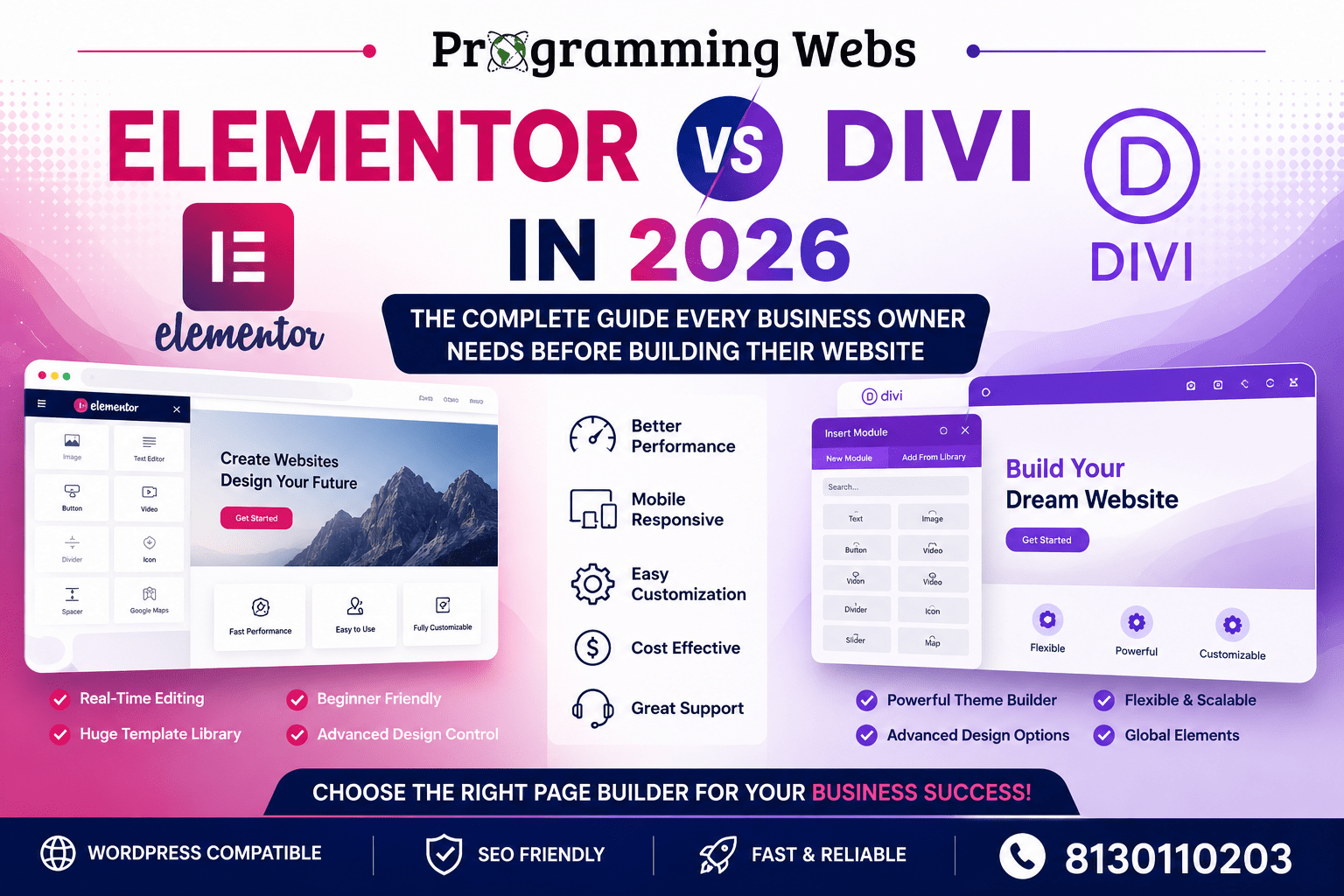
You’ve decided your business needs a professional website. Smart move. But then you open your browser and search ‘best WordPress page builder’ – and suddenly you’re knee-deep in a debate that has divided the WordPress world for years: Elementor vs Divi.
Which matters most for your business growth: faster website speed, easier user experience, or higher lead and sales conversions?
If you’re a business owner, startup founder, or e-commerce brand trying to make the right call – without wasting money or months of development time – this guide is written for you.
We’ve broken down the Elementor vs Divi debate in plain English, with real-world examples, updated 2026 data, and practical tips so you can make a confident decision today.
Need expert help choosing the right platform for your business? ProgrammingWebs offers free consultations
What Is Elementor? (And Why 12 Million+ Sites Use It)
Elementor is a visual drag-and-drop page builder for WordPress. Launched in 2016, it quickly became the world’s most popular page builder plugin – and for good reason.
With Elementor, you design your website in real time. What you see on screen is exactly what your visitors will see. No coding. No guessing. Just drag, drop, and publish.
Key highlights of Elementor in 2026:
- Used on over 12 million websites globally
- Free version available with solid basic features
- Elementor Pro starts at $59/year for one site
- 100+ widgets including forms, sliders, and WooCommerce elements
- Deep integration with popular WordPress themes
- AI-powered design assistant added in 2024-2025 updates
What Is Divi? (And Why Agencies Love It)
Divi is both a WordPress theme and a page builder by Elegant Themes. Unlike Elementor, Divi works as a theme on its own – which means your site design and builder are baked into one product.
Divi is particularly popular among web agencies and designers who manage multiple client websites, because of its unlimited site licence model.
Key highlights of Divi in 2026:
- Powers over 1 million active websites worldwide
- Divi Pro starts at $89/year – but covers unlimited websites
- 200+ design elements and 2000+ pre-made layouts
- Built-in A/B testing via Divi Leads – rare for a page builder
- Strong visual history and revision system
- New AI content generation tools rolled out in late 2025
Elementor vs Divi: Side-by-Side Comparison (2026)
Let’s cut through the noise. Here’s an honest, data-backed comparison across the features that matter most to business owners:
| Feature | Elementor | Divi |
| Ease of Use | Excellent – simple drag & drop | Good – module-based, slight curve |
| Design Flexibility | High – 100+ widgets | Very High – 200+ elements |
| Loading Speed | Good (optimized in v3.x) | Good (improved in v5.0) |
| Pricing (2026) | Free + Pro from $59/yr (1 site) | Pro from $89/yr (unlimited sites) |
| WooCommerce | Native deep integration | Works, needs add-ons for depth |
| Template Library | 300+ templates | 2000+ pre-made layouts |
| Best For | Beginners, SMBs, E-commerce | Agencies, designers, multi-site |
Elementor vs Divi: The Deep Dive
1. Ease of Use – Who Wins for Beginners?
If you’re a first-time website builder with zero design experience, Elementor is easier to pick up. Its interface is clean, intuitive, and the learning curve is gentle – most people can build a page within a few hours.
Divi is slightly more complex at first. Its module-based approach requires understanding how sections, rows, and modules stack together. But once you get it, the creative control is hard to beat.
Verdict: Elementor wins for beginners. Divi wins for experienced users and designers.
2. Design Flexibility – Which Gives You More Creative Freedom?
Both tools are powerful. But Divi gives you a slight edge in raw design customization. With options for global colors, fonts, spacing presets, and granular CSS controls, Divi lets you build pixel-perfect designs.
Elementor’s newer Global Style Kit feature has significantly narrowed this gap in 2025-2026, making brand consistency much easier to manage across pages.
Verdict: Divi has a slight edge in design depth, but Elementor is rapidly catching up.
3. Speed & Performance – Which Loads Faster?
Page speed is a confirmed Google ranking factor. So this matters – a lot – for your SEO and user experience.
Historically, both Elementor and Divi were criticized for bloated code. In 2026, both have made significant improvements:
- Elementor introduced Flexbox containers and optimized asset loading in its v3.x series
- Divi overhauled its builder to reduce JavaScript load in the 5.0 update
- Both can achieve 90+ Google PageSpeed scores when paired with good hosting and caching plugins
External Reference Tip: Google Core Web Vitals (developers.google.com) is the definitive benchmark for page performance relevant to SEO rankings.
Verdict: Near parity in 2026. Performance depends more on your hosting quality and page design than the builder itself.
4. Pricing – What’s the Real Cost?
Here’s where things get interesting – especially for agencies and consultants:
- Elementor Free: Lifetime, no cost – good for simple sites
- Elementor Pro: From $59/year (1 site) to $399/year (1000 sites)
- Divi Pro: $89/year – covers UNLIMITED websites
If you manage only one or two websites, Elementor is the more affordable choice. But if you’re an agency or consultant managing 5 or more client sites, Divi’s unlimited licensing makes it dramatically cheaper per site.
Verdict: Elementor is better value for single sites. Divi is unbeatable for agencies and multi-site owners.
5. E-commerce & WooCommerce Support
Both builders work well with WooCommerce, which powers over 28% of all online stores globally (BuiltWith, 2026).
- Elementor has a dedicated WooCommerce Builder module with full customization of product pages, carts, and checkout flows
- Divi’s WooCommerce integration is solid, but often requires a third-party plugin for deep customization
For e-commerce brands looking to maximize conversions, Elementor’s native WooCommerce tools give it a practical edge.
Verdict: Elementor wins for e-commerce businesses.
Real-World Use Cases: Which Builder Should YOU Choose?
For Small & Medium Businesses (SMBs)
If you’re running a local business, consultancy, or service-based company needing a professional, conversion-focused website – go with Elementor. The free version gives you enough to get started, and Pro unlocks powerful lead generation tools like popups, forms, and custom landing pages.
For Startups
Startups need speed to market. Elementor’s extensive template library and AI-powered design tools let you launch a polished website in days, not weeks. It’s also much easier to hand off to non-technical team members as you grow.
For E-commerce Brands
Elementor’s deep WooCommerce integration and CRO tools – sticky headers, dynamic content, custom checkout flows – make it the stronger choice for online stores focused on conversions.
For Agencies & Multi-Site Managers
If you’re building websites for clients or managing multiple brands, Divi’s unlimited site licence and robust revision history make it the smarter long-term investment. One subscription, unlimited projects.
Not sure which one is right for YOUR business? ProgrammingWebs builds high-performance websites on both Elementor and Divi – and we’ll help you choose the right one from day one. Visit programmingwebs.com
Why Growing Businesses Choose ProgrammingWebs for Website Development
Choosing the right page builder is only half the battle. The other half is having the right team behind your website – people who understand not just design, but also SEO, lead generation, and business growth.
At ProgrammingWebs, we’ve built high-performance websites on both Elementor and Divi for SMBs, startups, and e-commerce brands across India and globally. Here’s what makes us different:
- Platform-Agnostic Expertise: We work with both Elementor and Divi – we recommend what’s right for your goals, not what’s easiest for us
- Full-Stack Digital Services: From design and development to SEO, Google Ads, and content – everything under one roof
- Proven Client Results: Our clients see measurable growth in traffic, leads, and sales after partnering with us
- Transparent, Affordable Pricing: Packages starting at just Rs. 999/month – built for real business budgets
- India’s Top-Rated Agency: Rated 5/5 from 500+ clients including Threadworks, Lmpians, and more
Frequently Asked Questions About Elementor vs Divi
Q1. Is Elementor better than Divi in 2026?
Neither is universally better – it depends on your use case. Elementor is the better choice for beginners, single-site owners, and e-commerce businesses. Divi is better for agencies, professional designers, and those managing multiple client websites. Both are excellent tools in 2026.
Q2. Which is faster – Elementor or Divi?
Both have made significant performance improvements in 2025-2026. With proper hosting, caching plugins, and image optimization, both can achieve 90+ Google PageSpeed scores. Elementor’s Flexbox containers and Divi’s 5.0 engine both produce lean, fast-loading pages.
Q3. Can I switch from Elementor to Divi (or vice versa)?
Switching page builders is possible but not straightforward – content built in one builder does not automatically transfer to another. You would likely need to rebuild pages from scratch. This is exactly why getting expert guidance upfront saves you significant time and money.
Q4. Is Divi worth the price?
For single-site owners, Elementor Pro at $59/year is more affordable. But Divi’s $89/year unlimited site licence makes it extremely cost-effective for agencies and freelancers managing multiple websites. You pay once and use it across every client project you take on.
Q5. Does Elementor or Divi affect SEO?
The page builder itself does not directly impact SEO rankings. What matters is page loading speed, clean code, proper heading structure, and quality content. Both Elementor and Divi can produce SEO-friendly websites when used correctly alongside a good SEO plugin like Yoast SEO or Rank Math.
Q6. Which page builder is best for WooCommerce stores?
Elementor wins for e-commerce – its native WooCommerce Builder module offers deeper product page, cart, and checkout customization out of the box. Divi works well too, but often requires additional paid plugins for advanced WooCommerce features.
Q7. Do I need a developer to use Elementor or Divi?
Not necessarily for basic websites – both builders are designed for non-technical users. However, for complex, high-performance websites with custom functionality and strong SEO, working with an experienced developer or digital agency delivers far better results in terms of both design quality and technical performance.
Final Verdict: Elementor vs Divi – Choose Wisely, Then Execute Brilliantly
After a thorough Elementor vs Divi deep dive, here’s our honest take for 2026:
- Choose Elementor if you’re a beginner, small business, startup, or e-commerce brand wanting powerful WooCommerce tools at a lower per-site cost
- Choose Divi if you’re an agency, professional designer, or managing multiple websites and want unlimited flexibility and the best value per project
- Choose either platform – with the right expert team – and your website will perform exceptionally well
The best page builder isn’t the one with the most features. It’s the one that helps you achieve your actual business goals: more traffic, more leads, more revenue.
And that’s exactly where ProgrammingWebs comes in.
Ready to Build a Website That Actually Converts?
ProgrammingWebs is India’s trusted full-service digital agency. We’ll help you choose the right platform, build a high-performance website, and grow your business online.
Visit: programmingwebs.com | Call: +91-9792303924 | Email: info@programmingwebs.com
Get your FREE website consultation today – no obligation, just expert advice.