If you’ve ever poured money into Google Ads and watched your budget disappear without matching sales, you already know the frustration. You’re not alone — most ecommerce owners either overspend chasing clicks that never convert, or they avoid Google Ads altogether because it feels like a black box.
Here’s the truth: google ads for ecommerce isn’t complicated once you understand how the system actually thinks in 2026. Google has shifted heavily toward AI-driven campaigns, and the brands winning right now aren’t the ones with the biggest budgets — they’re the ones using the right structure, the right feed data, and the right bidding strategy.
This guide breaks it all down in plain language. No jargon, no fluff — just a practical google ads for ecommerce guide you can actually use, whether you run a Shopify store, a WooCommerce shop, or a growing D2C brand.
Why Google Ads Still Matters for Ecommerce in 2026
A lot of brands have shifted budget toward social media, and that’s fine — but it misses something important. Google Ads captures people who are already searching with intent to buy. Someone typing “buy running shoes size 10” is miles closer to checkout than someone scrolling a feed.
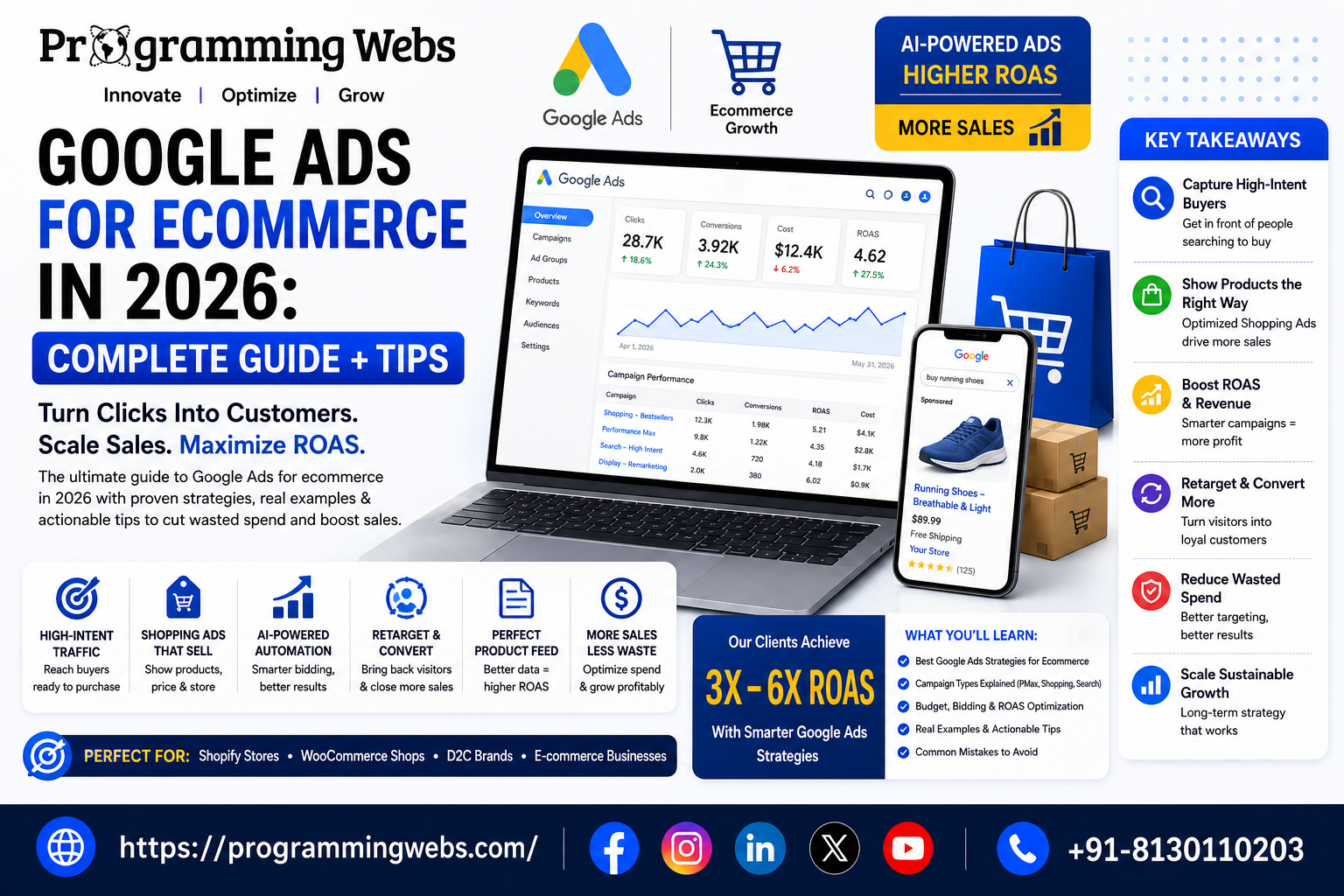
The numbers back this up. Well-optimized ecommerce Google Ads campaigns are typically landing between 3x and 6x ROAS in 2026, with Shopping and Search campaigns often outperforming other formats when the account is structured correctly. Some analysts even put average ecommerce ROAS from Google Ads as high as 3.68:1 across thousands of tracked brands, while top performers push well past 8x. The gap between average and top performers almost always comes down to strategy, not luck.
If you’re weighing Google Ads against organic growth, it helps to also look at our breakdown of SEO services — because the brands that win long-term almost always combine both paid and organic traffic instead of relying on one channel.
Google Ads for Ecommerce Guide: How the Ecosystem Actually Works
Before you touch a campaign, it helps to understand the moving parts. Google Ads for ecommerce isn’t one tool — it’s an ecosystem of campaign types working together.
1. Performance Max (PMax)
Performance Max is Google’s AI-powered campaign type that runs across Search, Shopping, Display, YouTube, Gmail, and Discover from a single campaign. It’s fast to launch — often under 15 minutes — but it trades transparency for convenience. You don’t get granular control over exactly where your budget goes.
2. Standard Shopping Campaigns
Shopping ads show your product image, price, and store name directly in search results. These campaigns rely entirely on your product feed quality, which is why Merchant Center optimization is often the single biggest lever for ecommerce advertisers.
3. Search Campaigns
Traditional text ads targeting specific keywords. These often deliver the highest-intent traffic because people are actively typing what they want to buy.
4. Display & Remarketing
These campaigns bring back visitors who browsed but didn’t purchase. Retargeting display campaigns typically convert two to four times better than cold traffic because you’re reminding warm leads instead of chasing strangers.
Real example: Imagine a mid-sized skincare brand running Standard Shopping for their five bestselling products, while using Performance Max for new product launches and seasonal collections. This kind of split — proven products in Shopping, experimental products in PMax — is exactly the kind of structure that separates profitable accounts from ones that bleed money.
Best Google Ads for Ecommerce Strategies That Actually Scale
If you’re searching for the best google ads for ecommerce approach, stop thinking in terms of “one perfect campaign.” Instead, think in layers:
- Foundation layer: Your proven bestsellers, running in tightly controlled Shopping or Search campaigns with strict ROAS targets.
- Acceleration layer: Mid-performing products that need more data before you can trust automated bidding.
- Amplification layer: New launches and seasonal products, where Performance Max’s broader reach helps generate the data you need.
This tiered structure matters because dumping every product into one campaign gives Google’s algorithm almost nothing useful to learn from. Product-level segmentation is consistently one of the biggest differences between accounts that scale profitably and ones that plateau.
If your store runs on Shopify, this is also where feed hygiene ties directly into your Shopify SEO services and Shopify development setup — messy product titles and missing metadata hurt both your organic rankings and your paid feed performance at the same time.
Google Ads for Ecommerce Tips That Move the Needle
Here are practical, no-nonsense google ads for ecommerce tips you can apply this week:
- Fix your product feed first. Titles, images, GTINs, and categories directly affect Shopping ad performance. A messy feed quietly kills ROAS before the campaign even starts.
- Set a realistic starting budget. Brands launching with less than $1,000/month often struggle because the algorithm’s learning phase drags on too long. A range of $1,500–$3,000/month tends to generate meaningful data within 60 days.
- Use ad extensions. Advertisers using three or more extensions (sitelinks, callouts, promotions) commonly see a noticeable lift in click-through rate compared to bare-bones ads.
- Don’t trust default attribution blindly. Default 7-day click / 1-day view windows can inflate Google’s perceived contribution, which skews how you allocate budget across channels.
- Pair ads with a strong landing page. Even a perfect campaign fails if the landing page is slow or confusing. This is where landing page design and conversion rate optimization make a measurable difference.
- Layer retargeting on top of prospecting. New-visitor campaigns build awareness; retargeting closes the sale. You need both working together.
- Review search terms weekly. Wasted spend often hides in irrelevant search queries that slip past broad match keywords.
Common Mistakes Ecommerce Brands Make With Google Ads
Even smart founders fall into these traps:
- Treating Google Ads as “set and forget.” Rising CPCs (up roughly 8% year-over-year in many verticals) mean lazy accounts lose profitability quietly over time.
- Ignoring Performance Max’s blended ROAS trap. A campaign showing 4.8x blended ROAS can hide a Display placement dragging performance down while Shopping alone could be pulling 6x or more.
- Skipping negative keywords. Without them, you pay for clicks that were never going to convert.
- No conversion tracking hygiene. If your tracking is broken, every optimization decision you make afterward is built on bad data.
- Running ads without SEO support. Paid traffic gets expensive fast if your organic foundation is weak. Many brands pair Google Ads with Ecommerce SEO services to reduce long-term dependency on paid spend.
Google Ads vs. SEO for Ecommerce: Do You Need Both?
Short answer: yes. Google Ads captures intent right now. SEO builds a compounding asset that keeps bringing traffic long after you stop paying per click. If you’re comparing platforms for your online store, our guide on Shopify vs WordPress is a useful next read, since your platform choice affects both your SEO and ad performance.
For businesses managing multiple locations or serving specific regions, it’s also worth understanding Local SEO vs National SEO before you decide how to split your marketing budget.
Why Choose ProgrammingWebs for Google Ads Management
Running Google Ads well takes more than turning on a campaign — it takes constant testing, feed management, and honest reporting. At ProgrammingWebs, our Google Ads Management team focuses on real ROAS, not vanity metrics.
Here’s what sets our approach apart:
- We build campaigns around your actual profit margins, not generic industry averages.
- We combine paid ads with organic growth through our SEO Services so you’re not permanently dependent on ad spend.
- We handle feed optimization for Shopify and WooCommerce stores through our Website Development and WordPress SEO Services teams.
- We pair every campaign with Conversion Rate Optimization and Meta Ads Management for full-funnel coverage across platforms.
- We report transparently — no confusing dashboards, just clear numbers tied to revenue.
Whether you’re a startup launching your first campaign or an established ecommerce brand looking to scale past a plateau, our team builds strategies suited to your budget and goals. Take a look at our Portfolio and Pricing pages to see how we work, or learn more About Us.
FAQs: Google Ads for Ecommerce
1. What is a good ROAS for ecommerce Google Ads in 2026? Most brands should aim for 2.5x to 4x as a baseline, though this depends heavily on your profit margin. A high-margin brand can profitably run at a lower ROAS than a thin-margin dropshipping store.
2. Should I use Performance Max or Standard Shopping for my store? Both, ideally. Use Standard Shopping for proven bestsellers where you want tight control, and Performance Max for new products or seasonal launches where broader reach helps generate data faster.
3. How much budget do I need to start Google Ads for ecommerce? A starting range of $1,500–$3,000 per month is generally enough to exit the algorithm’s learning phase within about 60 days. Anything under $1,000/month often struggles to gather enough data.
4. Do I need SEO if I’m already running Google Ads? Yes. Google Ads brings immediate traffic, but SEO reduces your long-term cost per acquisition and builds an asset that keeps working even when you pause your ad spend.
5. Why is my Google Ads Shopping campaign underperforming? The most common cause is a weak or incomplete product feed — missing GTINs, poor titles, or bad categorization. Feed quality usually matters more than bid strategy.
6. Is Google Ads better than Meta Ads for ecommerce? They serve different purposes. Google Ads captures people already searching with intent, while Meta Ads is stronger at creating demand among people who weren’t actively looking. Most scaling brands use both together.
7. How long does it take to see results from Google Ads for ecommerce? Expect a learning phase of 4–8 weeks before performance stabilizes, especially for new accounts or newly launched Performance Max campaigns.
Final Thoughts: Turn Clicks Into Customers
Google Ads for ecommerce isn’t about spending more — it’s about spending smarter. The brands winning in 2026 are pairing clean product feeds, tiered campaign structures, and strong landing pages with consistent optimization. Skip any one of those pieces, and you’re leaving money on the table.
If you’re ready to stop guessing and start scaling with a strategy built around your actual numbers, our team at ProgrammingWebs is here to help. Contact us today for a free consultation, explore our full range of Services, or head back to our Blog for more guides like this one. Your next customer is already searching — let’s make sure they find you.