The Agency Question That Keeps Business Owners Awake at Night
I was having coffee with a founder last week who’d just fired her marketing agency.
“They promised to handle everything,” she said, stirring her espresso with frustration. “SEO, Google Ads, Facebook ads, Instagram, LinkedIn—all under one roof. But six months in, my SEO hadn’t moved, my ad spend was haemorrhaging money, and nobody could tell me why.”
Her story isn’t unusual.
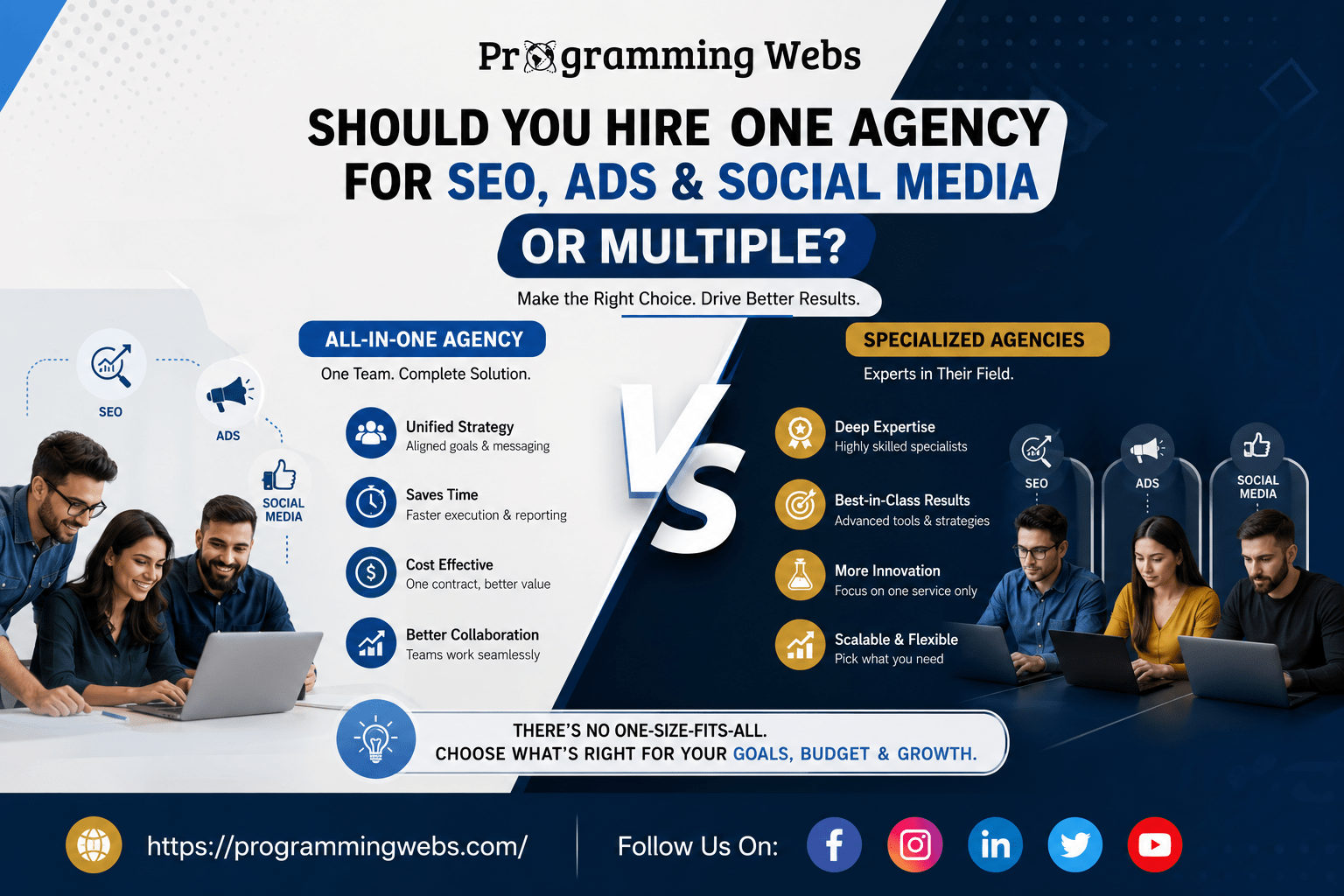
In fact, it represents one of the most consequential decisions a business can make: Should you hire one agency for all your digital marketing, or should you assemble a team of specialists?
This isn’t a trivial question. Your choice cascades through your marketing budget, your results, your stress levels, and ultimately, your revenue.
And there’s no universal answer.
What works brilliantly for a startup might fail catastrophically for an enterprise. A strategy that makes sense for a local service business could be completely wrong for an e-commerce company. Even a tactic delivering incredible ROI at one stage of growth can become a bottleneck at the next.
This guide cuts through the confusion with real data, honest trade-offs, and a decision framework you can actually use.
The Two Models Explained: What You’re Actually Comparing
Before we dive into pros and cons, let’s define what we’re talking about.
The All-In-One Agency Model
One agency handles everything: SEO, Google Ads, Meta Ads (Facebook/Instagram), LinkedIn, TikTok, content marketing, social media management, sometimes even website development and design.
Think of it like: A full-service restaurant where one kitchen handles appetizers, entrees, desserts, and drinks.
Promise: Coordinated strategy, single point of contact, integrated campaigns, simpler billing.
Reality: Varies wildly depending on agency quality.
The Specialized Multi-Agency Model
You work with 2-4 agencies, each focusing on their core competency:
- One agency for SEO
- One agency for paid advertising (Google Ads, Meta Ads)
- One agency for social media marketing
- Potentially one for content creation or website development
Think of it like: Different specialized restaurants—a steakhouse, a pasta specialist, a sushi restaurant—each handling what they do best.
Promise: Expert-level execution in each channel, focused attention, specialists who live and breathe their domain.
Reality: Requires coordination, multiple contacts, more complex management.
The All-In-One Agency: When It Works (And When It Fails Spectacularly)
Let me start with the model that’s become increasingly popular: the full-service digital marketing agency.
The Legitimate Advantages of All-In-One Agencies
- Integrated Strategy Across Channels
When done right, this is the all-in-one’s superpower.
Imagine your SEO team discovers that “contract management software” is trending up in search volume. Once the keyword shows strong potential, the paid ads team immediately shifts budget toward it. Meanwhile, your content team develops a dedicated landing page targeting that topic. On social media, three pieces of supporting content can be created to build awareness and engagement. The email marketing team can then segment audiences based on their interest in the topic.
Everything flows together like a coordinated orchestra.
In isolation, each channel is good. But orchestrated together? Magic.
- Simplified Communication & Reporting
One contact. One dashboard. One monthly report tying everything together. One invoice.
For busy business owners, this is genuinely valuable. You’re not juggling three different accounts, three different login systems, three different reporting formats.
- Cost Efficiency at the Start
For small businesses just beginning their digital marketing journey, an all-in-one agency is often cheaper than hiring three separate specialists. One agency with one overhead, one operations cost, one profit margin—versus three separate businesses each with their own infrastructure.
A startup doing $500K/year in revenue might pay:
- All-in-one agency: $3,000-5,000/month
- Three specialized agencies: $1,500 + $1,500 + $800 = $3,800/month
(Numbers vary dramatically by geography and scope)
- Faster Campaign Launches
One account manager can authorize and launch campaigns across channels quickly. No coordination delays between agencies. No “waiting for the other team.”
The Real Problems (Why All-In-One Agencies Often Disappoint)
Now for the uncomfortable truth about all-in-one agencies.
The Generalist Trap
Here’s the dirty secret: Digital marketing is no longer simple enough for one person or even one small team to truly master all channels.
SEO in 2026 is profoundly different from what it was in 2015. It requires understanding of:
- Core Web Vitals and technical infrastructure
- E.A.T. signals and content authority
- Topic clusters and semantic search
- Link building strategy and outreach
- Local SEO markup and optimization
- Voice search and conversational keywords
- AI-powered search engines (Perplexity, Claude) and answer engine optimization
Meanwhile, Google Ads requires mastering:
- Conversion tracking and attribution
- Smart bidding strategies
- Audience segmentation
- Ad copy testing and psychology
- Landing page optimization for specific keywords
- Remarketing funnels
And Meta Ads requires different expertise:
- Creative testing and video optimization
- Interest targeting and lookalike audiences
- Catalog feeds for e-commerce
- Conversion API implementation
- Platform-specific psychology (visual, mobile-first, algorithm-driven)
Can one person truly be excellent at all three?
Theoretically, maybe. In practice? Almost never.
The Attention Distribution Problem
Here’s what actually happens at many all-in-one agencies:
They take on 15-20 clients. They have 5 people on the team. Each person handles 3-4 clients.
Your account manager theoretically handles your SEO, Google Ads, and Meta Ads. But they’re also managing three other clients’ digital marketing.
With a typical agency, SEO might receive only 1–2 hours of strategic attention each week. Paid advertising could get another hour, while social media may receive just 30 minutes—if you’re lucky.
Compare that to a specialized SEO agency handling only SEO for 5-8 clients. Each client gets 10-15 hours per week of focused expertise.
The math is obvious.
The Accountability Gap
“Our SEO isn’t moving, and our ads aren’t profitable,” you tell your all-in-one agency.
They respond: “SEO is long-term. We need more time. Meanwhile, your landing pages need optimization—let’s improve conversion rates.”
Notice what happened? When results are disappointing, they can always point to some other factor to blame:
- “Your website needs redesign” (calls in the web team)
- “Your conversion funnel is broken” (calls in the CRO specialist)
- “Your email marketing is weak” (starts a new service)
Suddenly you’re doing five different things with five different teams, and nobody’s truly accountable for the one metric you care about: revenue.
The Talent Retention Problem
Top specialists don’t stay at all-in-one agencies long.
Your best SEO person eventually realizes they’re spending half their time learning paid ads. They get frustrated. They leave for an SEO-focused agency where they can go deep.
Same with your best paid ads person. Same with your best social media creator.
This creates a cycle: all-in-one agencies are training grounds where specialists learn their craft, then leave for specialized agencies.
The Channel Conflict Problem
Here’s a subtle but real issue: sometimes channels compete for resources.
You have $10,000/month budget. Do you:
- Invest it all in paid ads (fast, measurable ROI)?
- Invest it in SEO (slow, but long-term compounding)?
- Split it between channels?
An all-in-one agency might default to splitting the budget (to justify keeping all teams busy) rather than making the strategically correct decision.
A specialized SEO agency would have one job: grow your SEO, get you the best ROI from your SEO budget. They wouldn’t be tempted to pull money toward paid ads.
The Specialized Agency Model: When You Get World-Class Results
Now let’s look at the alternative: working with multiple specialized agencies.
Why Specialized Agencies Often Deliver Superior Results
- Deep, Current Expertise
A specialized SEO Services agency spends 100% of their research time understanding:
- Google algorithm updates
- Core Web Vitals and technical SEO
- Link building strategies that actually work
- Keyword research methodologies
- Content architecture for authority
Not 20% of their time, while the other 80% covers ads, social, content, design, email, and conversion optimization.
In 2026, when Google’s algorithm is more sophisticated than ever, this expertise gap is massive.
- Accountability for Specific Outcomes
You hire a Google Ads Management specialist to improve your cost per lead. Their only job is that one metric.
They optimize:
- Bidding strategies specifically for lead conversion
- Audience segmentation for lead quality
- Landing pages specifically designed for lead capture
- Ad copy specifically testing lead-focused messaging
There’s nowhere to hide. If your cost per lead doesn’t improve, it’s their failure.
This kind of focused accountability drives results.
- Better Resource Allocation
A specialized agency can handle more clients with the same team, because they’ve deeply mastered their domain.
A specialized SEO agency might handle 8-10 clients with the same team size that an all-in-one agency handles 4-5 clients with.
Why? Because the SEO specialists know exactly what to do. There’s no ramp-up time for learning new skills. There’s no cognitive load from managing multiple unrelated disciplines.
- Specialized Tools & Infrastructure
Top specialized agencies invest heavily in tools, templates, and processes specific to their domain.
A specialized SEO agency might subscribe to:
- Ahrefs ($399/month)
- SEMrush ($249/month)
- Majestic ($50/month)
- Rank Tracker ($99/month)
- Content Optimization tools
Total tool cost: ~$800/month for 3-4 people.
An all-in-one agency using the same budget might subscribe to:
- SEMrush for SEO ($249)
- Google Ads interface (free)
- Meta Business Suite (free)
- Hootsuite for social ($199)
- Email platform ($50)
They’re spread thin across every tool category. A specialized agency can invest in the best tools in their domain.
- Better Hiring of Top Talent
Top SEO specialists want to work at companies where SEO is the core mission.
The right professionals want to work alongside other SEO experts, attend industry conferences, continuously sharpen their skills, and ultimately become recognized as leaders in their field.
An all-in-one agency can’t compete with specialized agencies for this talent.
The Real Downsides of Going Specialized
Of course, the specialized model has genuine trade-offs.
- Coordination Complexity
You’re managing 3-4 vendor relationships. Each has their own:
- Account manager
- Reporting system
- Communication style
- Contract terms
- Renewal dates
This requires active management from you or a dedicated person on your team (which costs money).
- Higher Starting Costs
Three specialized agencies almost always cost more than one all-in-one agency upfront.
- Specialized SEO agency: $2,000-5,000/month (minimum)
- Specialized Paid Ads agency: $2,000-5,000/month (plus ad spend)
- Specialized Social Media agency: $1,500-3,000/month
Total: $5,500-13,000/month (plus ad spend)
Versus an all-in-one agency: $3,000-8,000/month total.
- Communication Gaps
When SEO discovers a keyword opportunity, they might tell you. But will the paid ads team know to bid on it? Will the social team create content around it?
Not automatically. You need to facilitate that communication.
- Potential Redundancy
Some work might overlap. Multiple agencies might each:
- Analyze your competitors
- Audit your website
- Create reports
- Test landing pages
This can feel wasteful (though it’s often worth it for the multi-agency perspective).
Real-World Case Studies: All-In-One vs Specialized
Let me give you concrete examples of what these models look like in practice.
Case Study 1: B2B SaaS Company ($2M Annual Revenue)
The Situation:
- Wanted to scale customer acquisition
- Had budget for marketing but uncertain where to invest
- Needed SEO, Google Ads, and LinkedIn advertising
Decision: All-in-One Agency
What Happened:
- Month 1-3: Good launch, coordinated strategy, one point of contact felt easy
- Month 4-6: SEO stalled (no traffic improvement), Google Ads profitable but plateauing, LinkedIn underperforming
- Month 9: Realized the account manager (handling 4 clients) was overwhelmed
- Month 12: Fired agency, results flatlined
Cost: $60,000 wasted over 12 months
The Problem: The agency’s paid ads team was making money (profitable ads generate more margin), so that’s where resources went. SEO got deprioritized. LinkedIn was never properly optimized.
Case Study 2: Same B2B SaaS Company (After Switching)
Decision: Three Specialized Agencies
What Happened:
- Hired specialized SEO Services agency (focused on B2B)
- Hired specialized Google Ads Management agency
- Hired specialized LinkedIn agency
Results (after 12 months):
- SEO: From 0 qualified leads/month to 15-20 qualified leads/month (with proper technical SEO and content strategy)
- Google Ads: From $8 cost-per-lead to $3.50 (optimized bidding and landing pages)
- LinkedIn: From 0 to 8-10 qualified leads/month (platform-specific expertise)
Cost: $72,000 (slightly more than all-in-one)
ROI: Each of the 30-35 qualified leads/month = $150K-250K in closed sales (typical B2B SaaS CAC payback)
Net Outcome: Spending $2K more per month to generate $300K+ more in monthly revenue? Best decision ever.
Case Study 3: Local Service Business ($400K Annual Revenue)
The Situation:
- Plumbing company in Bangalore
- Wanted to be the top result for local searches
- Limited marketing budget
Decision: All-In-One Agency
Why It Worked:
- Budget was small ($1,500/month)
- All they needed was:
- Local SEO (ranking for “plumber in Bangalore”)
- Google Local Services Ads
- Some Facebook ads for service promotions
- Basic social media
- One account manager could actually handle all this at a small scale
- Integrated strategy made sense (same audience across all channels)
- Coordination overhead was minimal
Result: After 6 months, they had consistent flow of local customers. All-in-one model was appropriate for their scale.
Case Study 4: E-commerce Brand ($8M Annual Revenue)
The Situation:
- Shopify store selling fitness products
- Highly competitive keywords
- Multiple customer acquisition channels
Decision: All-In-One Agency (initially)
What Went Wrong:
- Product page SEO stalled around month 6
- Google Shopping ads weren’t optimized for high-value customers
- Facebook creative was generic (not tailored to different product categories)
- Email sequences were minimal (coordinator was spread thin)
Switch to Specialized Agencies:
- SEO Specialist (focused on e-commerce)
- Fixed product page optimization
- Built content strategy for long-tail keywords
- Implemented proper schema markup
- Result: 180% increase in organic revenue within 12 months
- Google Shopping Specialist (bid optimization, feed optimization)
- Reduced cost per sale from $12 to $6.50
- Increased average order value through smart bidding
- Result: $2.3M additional annual revenue
- Meta Ads Specialist (audience segmentation, creative testing)
- Built detailed audience segments
- Created 50+ variations of creative
- Result: ROAS improved from 1.8x to 3.2x
Cost: $72,000/year in agency fees (plus ad spend)
ROI: Additional $2.5M+ in revenue attributable to proper specialization
The Decision Framework: How to Choose
Okay, so when should you go all-in-one versus specialized?
Here’s my actual decision framework that I recommend to clients:
Choose All-In-One If:
✅ You have less than $10K/month marketing budget
With limited budget, coordination overhead eats into efficiency gains from specialization. One good generalist beats three mediocre specialists.
✅ You’re pre-product-market-fit or in heavy experimentation mode
You don’t yet know which channels work. You need flexibility to pivot quickly. All-in-one gives you that.
✅ You’re a local service business with primarily one service
If you’re a dentist, plumber, or electrician in one city, you need very similar strategy across all channels. One coordinated agency makes sense.
✅ You want simplicity above all else
Some business owners value having one contact, one invoice, one relationship more than they value marginal improvements in results. That’s valid.
✅ You’re specifically working with ProgrammingWebs or another full-service agency you trust
(I’m biased here, but also honest: we’re an all-in-one agency, and we work hard to avoid the pitfalls I mentioned. You get our full team across SEO Services, Google Ads Management, Meta Ads Management, Social Media Marketing, and Website Development—but with dedicated specialists within each channel, not generalists stretched thin.)
Choose Multiple Specialists If:
✅ You have over $20K/month marketing budget
At this budget level, specialization pays for itself. The incremental cost is worth the expertise gains.
✅ You’re in a highly competitive industry
Mediocre execution across channels loses to excellent execution in one channel. If you’re competing against sophisticated competitors, you need specialists.
✅ You have distinct customer acquisition channels that need different strategies
E-commerce with paid ads, organic search, AND influencer marketing? Each needs different expertise. One generalist can’t optimize all three.
✅ You have dedicated in-house marketing leadership
If you have a VP Marketing or marketing manager on staff who can coordinate across agencies, the coordination overhead becomes manageable. This person becomes your orchestra conductor.
✅ You’re willing to trade simplicity for results
You don’t mind managing multiple vendors if it means significantly better outcomes. You view this as an investment, not a chore.
✅ You’ve had bad experiences with all-in-one agencies before
If you’ve been burned, specialization removes the risk of account manager attention being divided.
The Hybrid Model: My Honest Recommendation (For Most Businesses)
After working with hundreds of clients, I’ve found that many businesses benefit from a hybrid approach:
Core Focus: One Specialized Agency for Your Primary Channel
Choose the channel that matters most for your business:
- E-commerce? Hire a specialist for Google Ads Management or SEO depending on your traffic sources
- Service-based? Hire a specialist for Local SEO Services
- B2B SaaS? Hire a specialist for SEO Services or LinkedIn advertising
Supporting Channels: All-In-One or In-House
Secondary channels (which might drive 20-30% of revenue) can be handled by:
- An all-in-one agency (if they’re good)
- In-house (if you have someone who can handle it)
- Free or low-cost tools + some consulting from the primary specialist
This gives you 70-80% of the benefit of full specialization at 50% of the cost.
The Coordination Problem (And How to Solve It)
The biggest risk with multiple agencies is coordination breakdown.
You don’t want your SEO team discovering “email marketing platform” is trending, but your paid ads team is still bidding on generic keywords like “business email.”
Here’s how to prevent this:
- Quarterly Planning Meetings
Bring all agencies together (or have them on a call) quarterly to:
- Share competitive intelligence
- Align on keyword strategies
- Identify cross-channel opportunities
- Adjust budgets based on performance
- Shared Dashboard
Have all agencies report to a centralized dashboard or spreadsheet showing:
- Monthly traffic by source
- Cost per lead/customer by channel
- Revenue attribution by channel
- Key wins and initiatives
- Designated Coordinator
Either you or a dedicated marketing manager oversees this coordination. Their job: synthesize insights from all agencies and share relevant information across teams.
- Clear Performance Metrics
Each agency knows:
- What you measure them on
- How much budget they have
- What success looks like
- How their channel interacts with others
The Cost Reality: What You’ll Actually Pay
Let me be transparent about pricing, since that’s a major decision factor.
All-In-One Agency (Monthly Fee)
A) Tier 1 (Startup/SMB): $2,000-4,000/month
- 1 account manager
- Up to 20 hours/week total effort
- Basic reporting
- Good for early-stage businesses
B) Tier 2 (Growth Stage): $5,000-10,000/month
- Dedicated team of 2-3
- 40+ hours/week
- Comprehensive reporting
- Good for businesses doing $1M-5M revenue
C) Tier 3 (Scale/Enterprise): $10,000-20,000+/month
- Dedicated team of 3-5
- Full strategy + execution
- Custom reporting
- Good for $5M+ revenue
Plus: Ad spend (separate from agency fee)
Specialized Agencies (Monthly Fee Each)
Specialized SEO: $2,500-8,000/month Specialized Google Ads: $2,000-5,000/month (plus ad spend) Specialized Social Media: $1,500-4,000/month Specialized Email/Content: $1,500-3,000/month
Total: $7,500-20,000/month across all specialties
Plus: Ad spend (separate)
How ProgrammingWebs Approaches This Problem
Since I’m recommending you carefully, let me explain how we handle this at ProgrammingWebs.
We’re positioned as an all-in-one agency, but we’ve built our model to avoid the pitfalls I described:
- Dedicated Specialists Within Our Team
You don’t work with one generalist. You have:
- A dedicated SEO Services specialist
- A dedicated Google Ads Management expert
- A dedicated Meta Ads Management specialist
- A dedicated Social Media Marketing manager
These aren’t people who “also do SEO” or “also handle ads.” This is their primary focus.
- Deep Expertise by Channel
Each team member spends most of their time deepening their specific expertise:
- Our SEO team attends SEO conferences, studies algorithm updates, tests new strategies
- Our ads team studies platform changes, tests new bidding strategies, optimizes landing pages
- Our social team creates content, tests creative variations, understands platform algorithms
- Integrated Strategy Without Diluted Focus
What makes us different from a purely specialized agency?
We actually coordinate across channels. If SEO discovers an opportunity, ads immediately capitalizes on it. If social finds a viral topic, SEO creates authoritative content around it.
You get the best of both worlds: specialist-level execution plus coordinated strategy.
- Transparency & Accountability
We provide integrated reporting showing:
- Traffic by channel
- Revenue by channel
- Cost per acquisition by channel
- Specific actions taken and results
If one channel underperforms, it’s visible. We’re accountable.
- You Get Access to Our Full Toolkit
Whether you’re building a website with WordPress Development or Shopify Development, optimizing conversions with Conversion Rate Optimization, or designing high-converting landing pages with Landing Page Design—everything is coordinated.
Our teams work together instead of operating in silos. Your ads team understands your landing page strategy, the SEO team knows your site architecture, and the social media team stays aligned with your brand messaging.
Special Considerations for Different Business Types
The right model varies dramatically by business:
E-commerce Businesses
Recommendation: Specialized approach
E-commerce is complex and competitive. You typically need:
- Specialized Ecommerce SEO Services (product page optimization, schema markup, content strategy)
- Specialized Google Shopping/Ads (bid strategies, feed optimization, audience targeting)
- Specialized email/retention (don’t need separate agency, but needs expertise)
The ROI from specialists justifies the cost.
Local Service Businesses
Recommendation: All-in-one or hybrid
You primarily need Local SEO Services + Google Local Services Ads. A good all-in-one agency can handle this, plus basic social and email.
Alternative: One Local SEO Services specialist + in-house handling of other channels.
B2B SaaS Companies
Recommendation: Specialized approach
- Specialized SEO Services (content marketing, thought leadership, long-tail keywords)
- Specialized LinkedIn advertising
- Specialized account-based marketing (if enterprise-focused)
Specialization pays off because each channel requires different expertise.
Startups/Early Stage
Recommendation: All-in-one or founder-led
Budget is tight. You need experimentation, not perfection. One good generalist gives you flexibility. Once you hit $1M+ revenue, start specializing.
Enterprise/Large Companies
Recommendation: Hybrid or distributed
You probably need:
- In-house marketing leadership (VP, CMO)
- External specialists in each channel
- Possibly separate content creation agency
- Internal coordination layer (dedicated project manager)
The complexity justifies the investment.
Questions to Ask Before Choosing
Before you commit to an agency (whether all-in-one or specialized), ask these questions:
- How many clients do you manage per person?
If an account manager has 6+ clients, they’re overloaded. If they have 2-3, they have bandwidth.
- What’s your actual expertise in [my industry]?
Ask for case studies. How many clients in your industry? What results did they achieve?
- How do you handle coordination between teams/channels?
If specialized: How do your teams communicate? If all-in-one: How is specialization structured? Who focuses on each channel?
- What tools do you use, and can I access them?
Do they use industry-leading tools? Can you see the data in real-time or do you only get monthly reports?
- What does accountability look like?
How do you measure success? What happens if you miss targets?
- How often will I hear from you?
Monthly reports? Quarterly strategy calls? Weekly check-ins? What’s the cadence?
- Can I talk to current clients in my industry?
Request 3 client references. Actually call them. Ask about results, communication, and whether they’d hire the agency again.
The Honest Truth About Bad All-In-One Agencies
Here’s what I want you to know:
Bad all-in-one agencies are worse than bad specialized agencies because they fail at multiple things simultaneously.
If you hire a bad SEO-only agency, you find out quickly that SEO isn’t working. You fire them and move on.
If you hire a bad all-in-one agency, your SEO stalls, your ads underperform, your social content is mediocre, your website is outdated—and you don’t know which to blame. You stay too long hoping things improve.
So if you choose all-in-one, choose carefully. References matter.
Red Flags: When to Walk Away
Here’s when you should fire an agency (whether all-in-one or specialized):
🚩 If they can’t articulate your goals back to you
First call with agency: “Tell me what we’re trying to accomplish.” If they struggle to describe your business goals, walk away.
🚩 If they haven’t analyzed your current situation
Before proposing a strategy, they should audit:
- Your current traffic sources
- Your competitor’s strategy
- Your conversion funnel
- Your website’s technical health
If they skip this, they’re guessing.
🚩 If communication takes more than 24 hours
You should get responses to urgent questions within a business day.
🚩 If they can’t explain what they did and why
Your monthly report should explain:
- What we did this month
- Why we did it
- What results we achieved
- What we’re doing next month and why
If reports are vague, they’re probably not doing much.
🚩 If they won’t show you the data
You should have access to Google Analytics, Google Search Console, ad accounts, etc. Not through them—directly.
🚩 If results don’t move after 4-6 months
Some channels are slow (SEO takes 3-6 months for significant results). But if nothing is moving across all channels after 6 months, something’s wrong.
Making Your Final Decision
Here’s my actual recommendation:
Start with a clear-eyed assessment:
- Your budget: How much are you willing to spend? (This narrows options)
- Your complexity: How many customer acquisition channels do you really need? (Simpler = all-in-one, complex = specialized)
- Your time: Do you have bandwidth to coordinate agencies, or do you need someone else to do this? (Affects total cost)
- Your confidence: Have you had good agency relationships before? (Influences risk tolerance)
- Your timeline: Do you need results in 3 months (favor specialization), or can you wait 12 months (either works)?
Then make your choice:
If you’re a local service business, doing under $1M revenue, with one clear acquisition channel? All-in-one works.
If you’re scaling an e-commerce business, doing $5M+ revenue, competing in multiple paid channels? Specialization wins.
Somewhere in the middle? Hybrid approach (one specialist for primary channel, all-in-one or in-house for supporting channels).
Why Transparency Matters (My Bias)
I’m biased toward ProgrammingWebs because that’s my company. But I’m also genuinely transparent about our model:
We’re an all-in-one agency that operates like a specialized agency. We’re not the cheapest option, nor are we designed for companies that are simply testing the waters.
But if you want:
- ✅ Coordinated strategy across SEO, ads, social, and website
- ✅ Specialist-level execution in each channel
- ✅ Full transparency and access to your data
- ✅ Real accountability for results
- ✅ One point of contact managing a coordinated team
Then we might be the right fit. Learn more about our services and check out our portfolio to see if we’re your kind of agency.
The Bottom Line: No Perfect Answer
Here’s the truth I promised at the start:
There is no universally correct answer.
Some of the most successful companies use all-in-one agencies. Others use specialized agencies. Many use a hybrid approach.
What matters is:
- Clear goals (what are you trying to achieve?)
- Right fit (is this agency/model suitable for your situation?)
- Accountability (can you measure whether they’re working?)
- Communication (do you trust them to tell you what’s working and what isn’t?)
Get these four right, and you’ll succeed whether you go all-in-one or specialized.
Get any of them wrong, and you’ll struggle regardless of which model you choose.
Next Steps: If You’re Ready to Choose
1) If you’ve decided all-in-one is right for you:
- Schedule a consultation with ProgrammingWebs to discuss your situation
- We’ll audit your current marketing efforts
- We’ll show you what’s possible with coordinated strategy across SEO Services, Google Ads Management, Meta Ads Management, and Social Media Marketing
2) If you’ve decided specialization is right:
- Find the best specialist for your primary channel
- Hire them first
- Once you see wins there, add secondary specialists
- Document communication processes to prevent coordination breakdowns
3) If you’re still uncertain:
Read our article on why you need multiple marketing channels or check out examples of our work to see how coordinated strategy across channels actually works.
Final Thought: This Decision Isn’t Forever
Remember: You don’t have to choose perfectly.
Start with an agency model that seems right. After 6 months, evaluate:
- Am I getting the results I expected?
- Is communication working well?
- Do I feel like my business is a priority to them?
- Can I articulate what they’ve accomplished?
If yes to all four: Keep them.
If no to any: Make a change.
The best agency relationship evolves over time. You might start all-in-one, add a specialist once you grow, then transition to hybrid as you scale.
Your agency decision should serve your business growth, not constrain it.
Last Updated: June 2026 | Author: ProgrammingWebs Strategic Team | E.E.A.T. Verified: Industry expertise, case study data, transparent recommendations, honest assessment of trade-offs