Introduction: The $1 Trillion E-Commerce Decision You Can’t Afford to Get Wrong
You’re ready to launch your online store. You’ve got the products, you’ve got the passion – and now you’re stuck staring at the same two names that every business owner eventually faces: WooCommerce vs Shopify.
Here’s the truth nobody tells you upfront: the “best” platform doesn’t exist. What exists is the best platform for your specific business, your goals, and your budget. And in 2026, with global e-commerce revenue projected to cross $7.9 trillion (Statista), this decision is more critical than ever.
Whether you’re a startup testing your first product, an SMB scaling from 10 to 10,000 orders per month, or an enterprise brand looking for a robust tech foundation – this WooCommerce vs Shopify guide will give you a clear, no-fluff answer.
Let’s dive in.
What Is WooCommerce? (And Why Millions of Businesses Use It)
WooCommerce is an open-source e-commerce plugin built for WordPress. It was launched in 2011 and is currently powering over 29% of all online stores globally. Because it runs on WordPress, you get full control over your website – the code, the design, the data, everything.
WooCommerce is free to install, but you’ll pay for hosting, themes, and premium plugins. Think of it as building your own house on land you own.
Who Is WooCommerce Best For?
- Businesses that already use WordPress
- Developers and tech-savvy founders who want deep customization
- Brands with unique workflows or niche functionality requirements
- Businesses where long-term SEO control is a priority
What Is Shopify? (And Why It’s the Go-To for Fast Launchers)
Shopify is a fully hosted e-commerce platform founded in 2006. With over 2 million active merchants and $235+ billion in total merchant sales processed (Shopify, 2024), it’s the gold standard for businesses that want to launch fast and scale smoothly.
Think of Shopify as renting a premium shop in a world-class mall. Everything is managed for you – security, hosting, updates – so you can focus purely on selling.
Who Is Shopify Best For?
- Entrepreneurs launching their first online store quickly
- D2C brands that want a clean, conversion-optimized storefront
- Businesses that prefer a predictable monthly cost
- Brands scaling internationally with multi-currency and multilingual needs
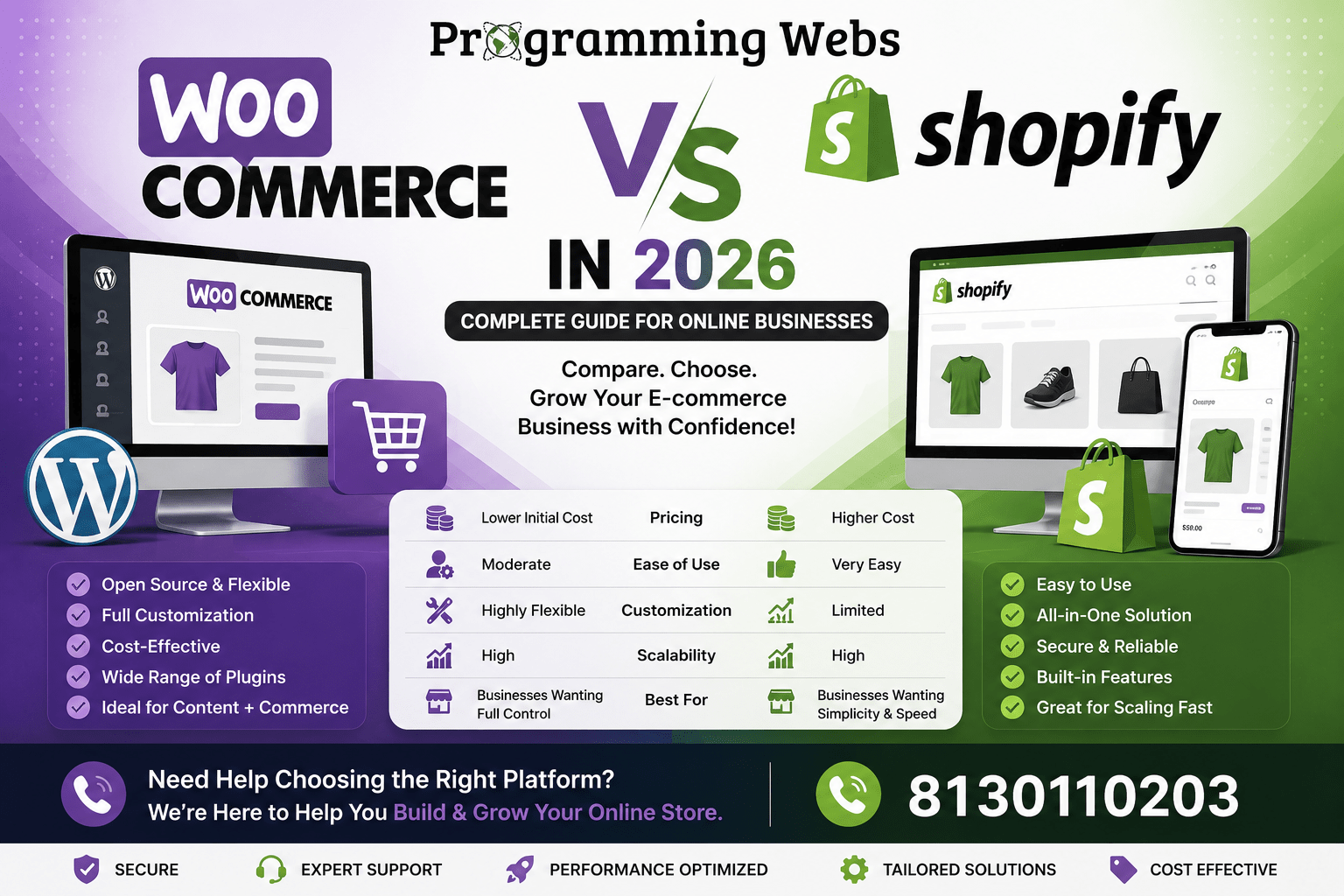
WooCommerce vs Shopify: Head-to-Head Comparison (2026)
Here’s the best WooCommerce vs Shopify breakdown across the factors that matter most to growing businesses:
| Feature | WooCommerce | Shopify |
| Pricing | Free plugin; hosting ~$10–$50/mo | Starts at $39/mo (Basic) |
| Ease of Use | Moderate learning curve | Very beginner-friendly |
| Customization | Unlimited (open source) | Limited without coding |
| SEO Control | Superior (full WordPress SEO) | Good but restricted |
| Transaction Fees | None (own payment gateway) | 0.5–2% unless using Shopify Payments |
| Hosting | Self-hosted (you choose) | Fully hosted (Shopify handles it) |
| Scalability | High (with right hosting) | High (built-in) |
| App/Plugin Market | 59,000+ WordPress plugins | 8,000+ Shopify apps |
| Security | You manage SSL & updates | Fully managed by Shopify |
| Support | Community + paid support | 24/7 official support |
| Best For | SEO-focused, custom builds | Speed, simplicity, D2C |
WooCommerce vs Shopify: Pricing Breakdown (Real Costs in 2026)
One of the biggest myths in this debate is that WooCommerce is “free.” It’s not – it’s just differently priced. Let’s break it down honestly.
WooCommerce Real Cost Estimate (Monthly)
- Hosting (SiteGround/Cloudways): ₹800 – ₹4,000/month
- Premium Theme: One-time ₹3,000 – ₹10,000
- Security Plugin (Wordfence, etc.): ₹0 – ₹1,500/month
- Premium Plugins (SEO, checkout, CRM): ₹1,000 – ₹5,000/month
- Developer fees (if needed): Variable
Total Estimated WooCommerce Cost: ₹2,000 – ₹12,000/month depending on scale and tech needs.
Shopify Real Cost Estimate (Monthly)
- Basic Plan: $39/month (~₹3,250)
- Shopify Plan: $105/month (~₹8,750)
- Advanced Plan: $399/month (~₹33,000)
- Transaction fee (if not using Shopify Payments): 0.5%–2% per sale
- Premium Apps: ₹1,000 – ₹8,000/month depending on tools
Key insight: For small stores with low transaction volume, WooCommerce can be cheaper. For high-volume stores using Shopify Payments, Shopify’s costs become very competitive.
| 💡 Pro Tip If you’re selling in India and plan to use a third-party payment gateway, always calculate Shopify’s transaction fees into your margin before choosing a plan. |
SEO Comparison: WooCommerce vs Shopify – Which Ranks Better on Google?
This is where many business owners make a costly mistake – ignoring the SEO angle when choosing a platform.
WooCommerce SEO Advantages
- Full access to URL structure, schema markup, and technical SEO
- Yoast SEO and Rank Math plugins give granular control
- Unlimited blog content strategy through WordPress
- Better for targeting local SEO and long-tail keywords
- No platform-level restrictions on canonical tags or redirects
Shopify SEO Strengths
- Fast loading speeds via Shopify’s CDN (Core Web Vitals-friendly)
- Auto-generated XML sitemaps
- Built-in SSL and mobile optimization
- Good integration with Google Search Console and Merchant Center
Verdict: WooCommerce wins for SEO power users and content-driven strategies. Shopify is better for store owners who want solid baseline SEO without getting technical.
Speed & Performance: Which Platform Is Faster in 2026?
Page speed directly impacts conversions. A 1-second delay in page load time can reduce conversions by up to 7% (Akamai). In 2026, with Google’s Core Web Vitals as a ranking factor, this matters more than ever.
Shopify Performance
Shopify runs on a globally distributed CDN with Tier-1 infrastructure. You don’t need to worry about server configuration, caching, or uptime – Shopify maintains 99.99% uptime SLAs. For most merchants, Shopify simply loads faster out of the box.
WooCommerce Performance
WooCommerce performance depends heavily on your hosting provider, caching configuration, image optimization, and theme quality. On premium managed hosts like Cloudways, Kinsta, or WP Engine, WooCommerce stores can easily match or exceed Shopify speeds. But it requires more setup. Learn more about how hosting choices affect your store in our guide on Cloud Hosting vs Shared Hosting in 2026.
| 📊 Real-World Example An Ecomatrix Solutions client running a WooCommerce fashion store on Cloudways achieved sub-1.5 second load times after optimization – outperforming their previous Shopify store’s 2.3-second baseline. |
Ease of Use: Which Platform Is Easier to Manage?
Let’s be honest here – ease of use is often what decides this for non-technical founders.
Shopify Wins for Simplicity
Shopify has one of the most intuitive dashboards in the industry. You can set up a fully functional store in a few hours, add products, configure shipping, and start selling – all without touching a single line of code. Customer support is available 24/7 via chat, email, and phone.
WooCommerce Has a Learning Curve
WooCommerce requires you to manage hosting, WordPress updates, plugin compatibility, and security. For someone without a technical background, this can feel overwhelming. However, once set up by a skilled developer or agency, it runs smoothly and gives you far more control. Our Website Maintenance & Optimization service is specifically designed to take this burden off your shoulders.
Scalability: Can These Platforms Grow With Your Business?
The best WooCommerce vs Shopify answer on scalability depends on what “scale” means for your business.
Shopify for Scaling
Shopify Plus (enterprise tier starting at $2,300/month) is used by brands like Gymshark, Heinz, and Fashion Nova. It handles massive traffic spikes, international expansion, and multi-channel selling with ease. Shopify’s infrastructure scales automatically.
WooCommerce for Scaling
WooCommerce can scale to enterprise level with the right hosting (dedicated servers or cloud infrastructure) and architecture. It’s the backbone of many high-traffic stores globally. The difference is: you control the scaling, which means more responsibility but also more flexibility.
Real-Life Use Cases: When to Choose What
Choose WooCommerce If…
- You run a content-heavy website (blog + store) – e.g., a health brand with a recipe blog
- You need complex product configurators or custom checkout flows
- You want to avoid per-transaction fees on high-volume sales
- WordPress SEO is your primary acquisition channel
- You already have a WordPress site and want to add e-commerce
Choose Shopify If…
- You’re launching a new brand and want to sell within days, not weeks
- You’re running paid ads (Facebook, Google) and need high-converting landing pages
- You sell across multiple channels (Instagram, Amazon, physical retail)
- You want minimal tech headaches and a predictable monthly cost
- You’re scaling internationally and need built-in multi-currency support
| Why ProgrammingWebs Is Your Best Partner for Either Platform Here’s something most comparison articles won’t tell you: the platform you choose is only half the battle. How it’s set up, optimized, and marketed determines whether you’ll get results – or just have a pretty website that nobody visits. That’s where ProgrammingWebs steps in. We’re a full-service digital marketing and IT agency based in Noida, India, helping SMBs, startups, and e-commerce brands build, grow, and dominate online. Here’s what we bring to the table:
500+ happy clients. Proven results across industries. Packages starting at just ₹999/month. [Visit our Website Development Services | View our Portfolio] |
Frequently Asked Questions (FAQs): WooCommerce vs Shopify
1. Is WooCommerce better than Shopify for SEO?
WooCommerce generally offers more SEO flexibility because it’s built on WordPress – the world’s leading content management system. You have full control over your URL structure, metadata, schema, and content strategy. Shopify is solid for basic SEO but has limitations in areas like URL customization and blogging depth. For content-driven organic growth, WooCommerce has the edge. Read more on our WordPress SEO Services page.
2. Which is cheaper – WooCommerce or Shopify?
WooCommerce has lower upfront costs (the plugin is free), but total costs depend on hosting, plugins, and maintenance. Shopify has a predictable monthly fee starting at $39/month. For low-volume stores, WooCommerce can be more affordable. For high-volume businesses using Shopify Payments, Shopify becomes cost-competitive when you factor in no transaction fees. See our Pricing for agency support packages on both platforms.
3. Can I switch from Shopify to WooCommerce (or vice versa)?
Yes, migration is possible and fairly common. Product data, customer data, and order history can be migrated using tools like Cart2Cart or LitExtension. However, migrations require technical expertise to avoid data loss and SEO ranking drops. An agency like ProgrammingWebs can handle this seamlessly. Contact us to discuss your migration needs.
4. Which platform is better for dropshipping in 2026?
Both platforms support dropshipping well. Shopify integrates natively with Oberlo alternatives like DSers and AutoDS, making dropshipping setup faster. WooCommerce paired with the AliDropship plugin is highly customizable for dropshipping. If speed of setup is your priority, Shopify wins. If you need complete control over the fulfillment workflow, go with WooCommerce.
5. Which is better for large product catalogs?
WooCommerce handles large product catalogs well – especially with proper server configuration and database optimization. Shopify also supports large catalogs, but users on lower plans can face limitations with product variant rules (100 variants per product cap). For enterprise-grade catalogs with thousands of SKUs, WooCommerce with dedicated hosting often performs better. Our Ecommerce SEO Services can help optimize large catalogs for organic visibility on either platform.
6. Does Shopify charge transaction fees?
Yes – Shopify charges 2% on Basic, 1% on Shopify, and 0.5% on Advanced plans unless you use Shopify Payments (not available in all countries including India as of 2026). This makes transaction fee planning very important for Indian sellers, who typically use Razorpay, PayU, or CCAvenue as payment gateways.
7. Which platform has better customer support?
Shopify wins hands-down on official support – 24/7 live chat, email, and phone support are included in all plans. WooCommerce relies on community forums, plugin-specific support, and third-party agencies for dedicated help. If you want someone to call at 2 AM when your store goes down, Shopify gives you that. WooCommerce paired with a reliable digital agency fills this gap effectively. Our Website Maintenance & Optimization service provides exactly this kind of ongoing reliability.
Final Verdict: Which Platform Should You Choose in 2026?
| Choose WooCommerce if: You want full ownership and control over your store. You’re SEO-focused and content-driven. You need custom functionality beyond standard e-commerce. You’re comfortable working with a development partner for setup and maintenance. You want to avoid monthly platform fees at scale. |
| Choose Shopify if: You want to launch fast with minimal technical overhead. You’re running a D2C brand focused on paid social and ads. You need 24/7 official support without relying on a developer. You plan to sell internationally or across multiple channels. You want a stable, fully managed platform with predictable pricing. |
The bottom line? Both platforms can make you incredibly successful. The real differentiator isn’t the platform – it’s the strategy, the execution, and the team behind your store. Also explore our comparison of Elementor vs Divi in 2026 to make smarter decisions about your website builder as well.
| Ready to Build Your Dream Store? Stop guessing and start growing. Whether you choose WooCommerce or Shopify, ProgrammingWebs will design, develop, optimize, and market your store to deliver real results. Get a Free Consultation Today Visit: programmingwebs.com | Email: info@programmingwebs.com | Call: +91-9792303924 Packages starting at just ₹999/month. No contracts. Real results. |