WooCommerce vs Shopify in 2026: The Complete Guide Every Business Owner Needs Before Choosing
You’re ready to launch your online store. You’ve got the product, the vision, and the drive. But then comes the question that stops almost every founder in their tracks:
“Should I use WooCommerce or Shopify?”
It sounds simple. But pick the wrong platform, and you could spend months rebuilding your store from scratch – losing time, money, and customers along the way.
Here’s the truth: there’s no universal winner in the WooCommerce vs Shopify debate. The best platform depends entirely on your business model, budget, technical comfort, and growth goals.
In this complete WooCommerce vs Shopify guide for 2026, we break down everything – costs, features, SEO, scalability, and real-life use cases – so you can make a confident, informed decision. Whether you’re an SMB owner, a startup founder, or running a fast-growing e-commerce brand, this guide is built for you.
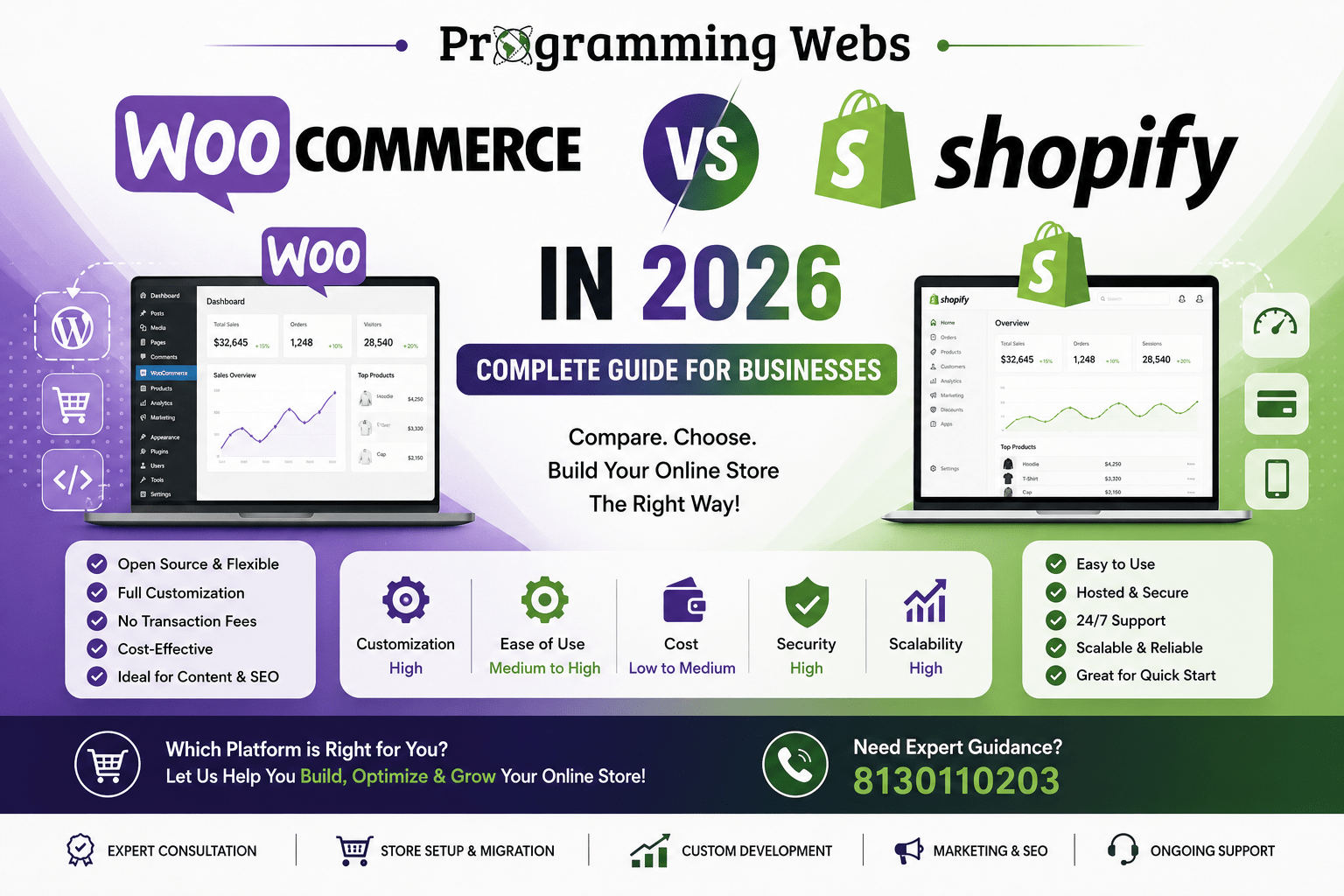
WooCommerce vs Shopify: Quick Snapshot (2026)
| Feature | WooCommerce | Shopify |
| Platform Type | Self-hosted (WordPress) | Fully hosted SaaS |
| Starting Cost | Free + hosting (~$10–30/mo) | From $39/month |
| Ease of Use | Moderate (needs setup) | Very easy (plug & play) |
| Customization | Highly flexible | Limited without apps |
| SEO Control | Excellent | Good |
| Transaction Fees | None (payment gateway fees only) | 0.5–2% (unless Shopify Payments) |
| Best For | Developers, content-heavy stores | Beginners, fast launchers |
| Scalability | High (with right hosting) | High (managed) |
What Is WooCommerce? (And Who Is It Really For?)
WooCommerce is a free, open-source e-commerce plugin built on top of WordPress. It powers over 28% of all online stores globally – making it one of the most widely used e-commerce solutions in the world.
Because it runs on WordPress, you get complete control over your store’s design, functionality, and data. Want to add a custom checkout flow? Done. Need a blog-integrated product page? Easy. WooCommerce gives you the keys to the entire kingdom.
WooCommerce Works Best For:
- Businesses that already have a WordPress website
- Content-heavy brands that rely on blogging and SEO for traffic
- Developers and agencies who want full customization freedom
- Stores with complex product structures (subscriptions, bundles, custom pricing)
- Budget-conscious businesses who prefer to control hosting costs
Real-life example: A handmade jewellery brand in Jaipur with an active blog and SEO strategy chose WooCommerce because it gave them full control over their product pages, meta tags, and content marketing – all in one place.
What Is Shopify? (And When Does It Shine?)
Shopify is a fully hosted, all-in-one e-commerce platform. You don’t need to worry about servers, updates, or technical maintenance. Everything – from your storefront to payments to shipping – is managed within Shopify’s ecosystem.
As of 2026, Shopify powers over 4.5 million online stores across 175 countries. Their platform is known for speed, reliability, and a polished out-of-the-box experience that lets you go live in hours, not days.
Shopify Works Best For:
- First-time store owners who want a simple, guided setup
- DTC (direct-to-consumer) product brands focused on fast launches
- Businesses that want built-in payment processing (Shopify Payments)
- Stores planning heavy use of social commerce (Instagram, TikTok, Facebook)
- Entrepreneurs who prefer minimal technical management
Real-life example: A beauty startup in Mumbai used Shopify to launch their D2C brand in under a week, connected it to Instagram Shopping, and started getting orders before even running paid ads.
WooCommerce vs Shopify: In-Depth Comparison
1. Pricing & Total Cost of Ownership
This is where WooCommerce and Shopify differ the most – and where many business owners get surprised.
WooCommerce: The plugin itself is free, but you’ll pay for hosting ($10–$50/month), a domain ($12–$15/year), a premium theme ($50–$200 one-time), and any paid plugins you need. Total monthly cost can range from $30 to $150+, but you have full control. Understanding hosting is key – read our guide on Cloud Hosting vs Shared Hosting in 2026 to make the right choice.
Shopify: Plans start at $39/month (Basic), go up to $105/month (Shopify), and $399/month (Advanced). Add app subscriptions, and costs can grow quickly. Shopify also charges transaction fees (0.5%–2%) unless you use Shopify Payments.
Verdict: WooCommerce wins on starting cost. Shopify wins on predictability.
2. SEO Capabilities
SEO is one area where WooCommerce has a clear structural advantage. Built on WordPress, it gives you:
- Full control over URL structure, breadcrumbs, and sitemaps
- Deep integration with Yoast SEO, Rank Math, and other powerful plugins
- Better blogging capabilities – essential for content marketing strategies
- Schema markup, canonical tags, and robots.txt customization
Shopify’s SEO has improved significantly in 2025–2026, but it still has limitations – like forced URL structures (/collections/, /products/) that can’t be changed.
Our WordPress SEO Services and Shopify SEO Services are specifically designed to maximise organic visibility on whichever platform you choose.
Verdict: WooCommerce wins for SEO – especially for content-driven businesses.
3. Ease of Use
Let’s be honest – WooCommerce has a steeper learning curve. Setting up WordPress, installing WooCommerce, configuring payment gateways, and managing hosting requires time and some technical knowledge (or a good agency partner).
Shopify, on the other hand, is designed for non-technical users. Its drag-and-drop store builder, guided setup wizard, and 24/7 support make it one of the easiest platforms to launch on.
Verdict: Shopify wins on ease of use. WooCommerce rewards those who invest time to learn it.
4. Customization & Flexibility
WooCommerce is open-source – which means you can build literally anything. Custom checkout flows, loyalty programs, multi-vendor marketplaces, subscription boxes – the only limit is your developer’s imagination. Explore our Website Development services to see what’s possible.
Shopify offers over 8,000 apps in its marketplace and supports Liquid templating for theme customization. However, deep customizations often require hiring a Shopify developer or paying for expensive apps.
Verdict: WooCommerce wins on raw flexibility. Shopify wins on out-of-the-box usability.
5. Security & Maintenance
This is one area where Shopify genuinely shines. Since it’s fully hosted, Shopify handles all security patches, SSL certificates, PCI compliance, and server uptime. You don’t have to think about it.
With WooCommerce, security is your responsibility. You’ll need to keep WordPress, plugins, and themes updated, set up regular backups, and implement a solid security protocol – especially critical for stores handling payment data. Our Website Maintenance & Optimization service takes this entire burden off your plate.
Verdict: Shopify wins on security and zero-maintenance experience.
Best WooCommerce vs Shopify Choice by Business Type
| Business Type | Recommended Platform | Key Reason |
| Startup / First Store | Shopify | Fast setup, low learning curve |
| SMB with WordPress Site | WooCommerce | Seamless integration |
| SEO-Driven Brand | WooCommerce | Superior SEO control |
| High-Volume D2C Brand | Shopify | Reliability & built-in tools |
| Developer / Agency | WooCommerce | Full customization power |
| Social Commerce Brand | Shopify | Native social integrations |
| Budget-Constrained Business | WooCommerce | Lower ongoing costs |
Why Businesses Trust ProgrammingWebs to Set Up Their Online Store
Here’s something many platforms won’t tell you: choosing the right platform is only half the battle. How you build, configure, and grow it makes all the difference.
That’s exactly what ProgrammingWebs does. We’ve helped SMBs, startups, and e-commerce brands across India and beyond build high-performing online stores on both WooCommerce and Shopify – and we know exactly which one fits your business needs.
What You Get With ProgrammingWebs:
|
From a ₹999/month starter plan to fully custom enterprise builds, ProgrammingWebs scales with your ambition. We’ve helped brands like Threadworks, The Wedding Basket, and Triazinesoft grow their digital footprint – and we’re ready to do the same for you. View our Portfolio to see our work.
5 WooCommerce vs Shopify Tips Before You Decide
- Don’t just pick what’s popular – pick what fits
Both platforms have millions of users. What matters is which one aligns with YOUR technical skills, budget, and business model.
- Think long-term, not just launch day
Shopify is great to launch fast, but WooCommerce may save you thousands in the long run if you scale heavily.
- SEO is a long game
If organic traffic is part of your growth plan (it should be), WooCommerce gives you significantly more SEO control. Our SEO Services can help you build a strategy that works on either platform.
- Budget for more than just the platform
Add up hosting, themes, plugins/apps, payment fees, and ongoing development before making a cost comparison.
- Get expert help for setup
A poorly configured WooCommerce or Shopify store can hurt your speed, SEO, and sales. Work with an experienced agency to get it right the first time. Also, if you’re deciding between page builders, check out our Elementor vs Divi in 2026 guide for more clarity.
Frequently Asked Questions
Is WooCommerce better than Shopify for SEO?
Yes, in most cases. WooCommerce (built on WordPress) gives you more granular control over SEO elements like URL slugs, meta tags, breadcrumbs, and schema markup. If organic search traffic is central to your strategy, WooCommerce is the stronger choice.
Which is cheaper – WooCommerce or Shopify?
WooCommerce has a lower entry cost since the plugin is free. You pay for hosting and plugins, which can total ₹800–₹3,500/month. Shopify starts at $39/month (~₹3,200) with no hosting needed. WooCommerce is typically more cost-effective for budget-conscious businesses at scale.
Can I migrate from Shopify to WooCommerce (or vice versa)?
Yes, migration is possible but complex. It involves transferring products, orders, customer data, and SEO settings. It’s highly recommended to work with a professional agency like ProgrammingWebs to ensure zero data loss and minimal downtime. Contact us to discuss your migration requirements.
Which platform is better for beginners in 2026?
Shopify is significantly easier for beginners. Its setup wizard, hosted infrastructure, and 24/7 support reduce the technical burden. WooCommerce is better suited for users with some WordPress familiarity or access to a web development partner.
Does WooCommerce or Shopify handle payments better?
Shopify has Shopify Payments built in, which simplifies checkout and avoids third-party transaction fees. WooCommerce supports over 100 payment gateways (including Razorpay, Stripe, PayPal, and more) but requires manual configuration. Both handle payments well – Shopify wins on simplicity, WooCommerce wins on flexibility.
Which is better for large-scale e-commerce stores?
Both can scale, but in different ways. Shopify Plus handles enterprise-level traffic with ease. WooCommerce can scale equally well with the right managed hosting (like WP Engine or Kinsta). The deciding factor is usually customization needs and budget.
Is WooCommerce free to use?
The WooCommerce plugin is free and open-source. However, you’ll pay for web hosting, a domain name, an SSL certificate, premium themes, and any paid extensions you need. Real-world monthly costs typically range from ₹1,000 to ₹5,000+ depending on your store’s requirements.
Conclusion: Which Platform Should You Choose in 2026?
The WooCommerce vs Shopify debate doesn’t have a one-size-fits-all answer – and anyone who tells you otherwise isn’t giving you the full picture.
Choose WooCommerce if you want maximum flexibility, stronger SEO control, lower long-term costs, and have access to a reliable development partner.
Choose Shopify if you want to launch fast, prefer a hands-off technical experience, and plan to leverage social commerce heavily.
Either way, the platform is just the beginning. Your store’s real growth comes from how well it’s built, optimized, and marketed – and that’s exactly where we come in. Also check out our About Us page to learn more about the team behind your store’s success.
| Ready to Build Your Dream Online Store? Stop second-guessing – let our experts at ProgrammingWebs analyse your business and recommend the perfect platform, then build it for you. 📞 Call Us: +91-9792303924 | +91-8130110203 ✉ Email: info@programmingwebs.com 🌐 Visit: www.programmingwebs.com Request a Free Consultation Today → https://programmingwebs.com/contact/ |
— Published by ProgrammingWebs | programmingwebs.com —