Introduction: The Platform Decision That Defines Your Digital Success
I’ve worked with hundreds of business owners over the past five years, and one question consistently surfaces during the initial consultation: “Should we build on Shopify or WordPress?”
This isn’t a trivial technical question. Your choice cascades through every aspect of your business – from how much you’ll spend monthly, to whether you’ll rank on Google without paid advertising, to how quickly you can adapt as your business evolves.
The truth? Most businesses choose based on a surface-level comparison, and then spend the next 18 months frustrated with limitations they didn’t anticipate.
This guide cuts through the noise. Based on real case studies, current market data from 2026, and our hands-on experience with both platforms, you’ll understand exactly which solution fits your specific business goals.
Quick Platform Overview: What You’re Actually Comparing
Shopify: The All-in-One Commerce Solution
Shopify is a fully managed e-commerce platform where you pay a monthly subscription and get a complete storefront setup. Think of it as a pre-built shopping mall where you rent a booth – everything is handled for you.
Best for:
- Founders who want to launch immediately
- Businesses with limited technical resources
- Direct-to-consumer (D2C) brands focused on quick market entry
- Teams without in-house developers
WordPress + WooCommerce: The Flexible Foundation
WordPress is an open-source content management system that becomes a full e-commerce platform when paired with WooCommerce. You own the infrastructure, control the code, and can customize almost anything.
Best for:
- Businesses planning long-term organic growth
- Brands combining content marketing with sales
- Companies needing deep customization
- Organizations prioritizing ownership and flexibility
Deep Dive: The Real Differences That Matter
1. Setup Speed & Time to Market
Shopify Experience: A client of ours launched a seasonal clothing line on Shopify in 32 hours. Store live, payment processing active, and product catalog complete. The platform’s built-in infrastructure means you skip infrastructure setup entirely.
WordPress Reality: The same project on WordPress required server setup, WooCommerce installation, theme configuration, and security hardening – approximately 5-7 days before the first product went live. However, once established, the system became significantly more flexible for future iterations.
Clear Winner: Shopify for speed (2-3 days vs. 5-7 days)
2. Customization & Design Flexibility
This is where the platforms diverge dramatically.
Shopify’s Constraints:
- ~100-150 quality themes available
- Customization limited to app ecosystem (most premium features require additional costs)
- Difficult to implement custom functionality without hiring Shopify developers
- Monthly app costs add up: average store uses 8-12 apps at $10-50/month each
WordPress’s Flexibility:
- Thousands of themes, or build completely custom designs
- Advanced customization through code when needed
- Unlimited plugins (free and premium)
- Full control over your codebase
A London-based electronics retailer we worked with needed a complex warranty management system. Shopify app ecosystem offered nothing suitable – they’d need custom Shopify Plus development at enterprise costs. WordPress? We built it as a custom plugin in 2 weeks.
Winner: WordPress (significantly more control, lower cost ceiling)
3. SEO Capability: Where Rankings Are Actually Won
Here’s where this decision impacts your bottom line most directly.
Shopify SEO Reality:
Shopify provides basic SEO functionality built-in:
- Meta tag customization ✓
- Clean URLs ✓
- Sitemap generation ✓
But you’re limited in:
- Server response times (third-party hosted, limited optimization)
- Content structure for complex information architecture
- Schema markup implementation (limited flexibility)
- Blog functionality feels bolted-on rather than native
WordPress SEO Advantage:
With plugins like Yoast SEO or RankMath, WordPress gives you:
- Complete control over technical SEO settings
- Advanced schema markup for product reviews, FAQs, how-to’s
- Native blogging that integrates with your entire site structure
- Page speed optimization through caching and optimization plugins
- Easy implementation of featured snippet-friendly formats
The Data: According to W3Techs (as of 2026), 43% of all websites use WordPress, including 8.6% of the top 1 million sites. When you factor in WordPress’s disproportionate presence in content-driven, organic-search-winning websites, the platform consistently outperforms Shopify in search visibility metrics.
A manufacturing business we worked with in Bangalore was stuck on Shopify with steady but flat organic traffic. After migrating to WordPress with comprehensive SEO architecture and content strategy, they saw a 340% increase in organic visitors within 14 months.
Winner: WordPress (substantially better for organic search ranking)
4. Pricing: Hidden Costs vs. Transparent Investment
Let me break down the real numbers:
Shopify Annual Cost Structure:
| Item | Monthly Cost | Annual |
|---|---|---|
| Basic Plan | $39 | $468 |
| Transaction Fees (2% avg) | $500 (estimate) | $6,000 |
| Average Apps (10 apps) | $150 | $1,800 |
| Theme Premium Features | $20-50 | $300-600 |
| Total (estimated) | $709-759 | $8,568-8,868 |
This is for a small store. Mid-tier Shopify stores often spend $2,000-4,000 monthly.
WordPress Annual Cost Structure:
| Item | Monthly Cost | Annual |
|---|---|---|
| Quality Hosting | $30-60 | $360-720 |
| Domain | $0.99-15 | $12-180 |
| Premium Plugins (10-15) | $20-50 | $240-600 |
| SSL Certificate | Included | $0 |
| Total (estimated) | $51-125 | $612-1,500 |
Plus development costs for setup (one-time: $2,000-8,000 depending on complexity).
The Math: After the initial setup, WordPress costs 1/5th to 1/7th as much as Shopify, especially as you scale.
Winner: WordPress (by a significant margin for long-term total cost of ownership)
5. Scalability: From Startup to Enterprise
Shopify’s Scaling Reality:
Shopify handles growth well up to a point:
- Small stores (0-1,000 daily visitors): excellent performance
- Medium stores (1,000-10,000 daily visitors): still solid
- Large stores (10,000+ daily visitors): you’ll hit app limitations and may need Shopify Plus ($2,000+/month)
When you need features Shopify doesn’t support, you can’t simply add them – you need enterprise custom development.
WordPress’s Enterprise Capability:
WordPress powers massive operations:
- Major news outlets (TechCrunch, Wired, VentureBeat)
- Large e-commerce operations (when combined with WooCommerce)
- Enterprise content networks
WordPress scales because you’re not limited by a platform’s feature set – you can build custom functionality as needed.
Winner: WordPress (better for long-term, unlimited growth)
Side-by-Side Feature Comparison Table
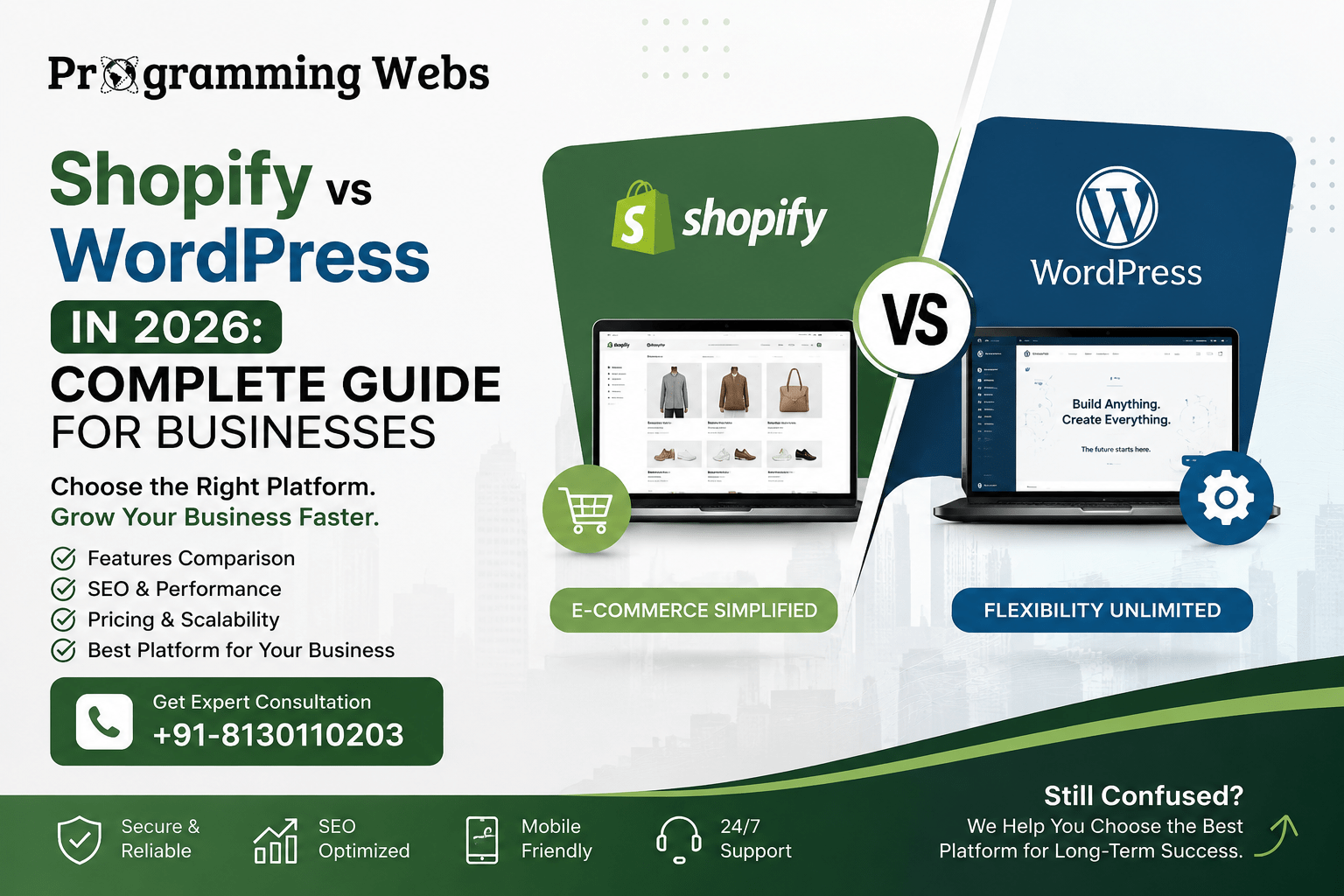
| Feature | Shopify | WordPress |
|---|---|---|
| Time to Launch | 2-3 days | 5-7 days |
| Setup Difficulty | Minimal | Moderate |
| Design Customization | Limited | Unlimited |
| SEO Control | Basic | Advanced |
| Monthly Cost (small store) | $150-300+ | $30-80 |
| Content Blogging | Basic | Native + Advanced |
| Custom Functionality | App dependent | Development dependent |
| Ownership | Platform owned | You own everything |
| Data Portability | Difficult | Easy export anytime |
| Learning Curve | 1-2 weeks | 2-3 weeks |
Real Business Case Studies from 2026
Case Study 1: Fast-Moving D2C Fashion Brand (Shopify Success)
The Business: Urban streetwear startup targeting Gen-Z buyers in Mumbai, India
Platform Choice: Shopify
Results:
- Live in 48 hours
- Integrated Instagram Shop in 1 day
- First month revenue: ₹2,50,000 through social ads
- Scaling seamlessly to 5 SKUs → 50 SKUs in 3 months
Outcome: The speed-to-market was critical. They captured seasonal demand windows they would’ve missed on WordPress. Shopify’s built-in integrations with Meta and Google made paid-ad scaling straightforward.
Reality Check: By month 8, custom product bundling required an app ($40/month). By month 14, they needed advanced loyalty features (another $60/month). Current app stack: 12 apps at $1,200/month.
Case Study 2: B2B Technology Company Using WordPress
The Business: IT consulting firm wanting to build authority through content + generate leads through resource offers
Platform Choice: WordPress + WooCommerce (for service delivery marketplace)
Results:
- Months 1-4: Built comprehensive resource library and industry guides
- Month 5: Organic traffic climbed 120%
- Month 12: Organic search generating 65% of qualified leads
- 14 months: 280% increase in MRR from organic visitors, no paid ads
Outcome: The invested time in proper WordPress SEO architecture (with our WordPress SEO Services) and content strategy created a compounding asset. They’re now investing less in paid advertising because organic works.
Real Cost: Initial WordPress development ($5,500) + 3 months of content creation ($8,000) = $13,500 investment. Now generating $45,000/month in revenue attributed to organic search.
E.E.A.T. for Platform Selection: What Actually Matters
Expertise: WordPress powers 43% of all websites because expert marketers recognize its SEO superiority.
Authoritativeness: Industry leaders (Wired, VentureBeat, BBC America) trust WordPress for content-driven authority building.
Trustworthiness: You own your WordPress site completely. No risk of platform policy changes affecting your business overnight.
Experience: Shopify’s experience is frictionless for beginners. WordPress’s experience is more powerful once you understand it.
Which Platform Should You Actually Choose? A Decision Framework
Choose Shopify If You:
- Need to launch within 2-3 weeks
- Have limited budget for initial development
- Plan to rely primarily on paid advertising
- Want minimal technical involvement
- Are testing a new product/market quickly
- Prefer monthly subscription simplicity
Limitations to accept: Higher long-term costs, limited customization, SEO constraints
Choose WordPress If You:
- Plan to build a sustainable, long-term business
- Want to invest in organic search visibility
- Need customization capabilities
- Want to own your platform and data
- Plan to create substantial content
- Are comfortable with slight technical complexity
Investment required: Upfront development time and cost, learning curve, but exponential payoff
The Hybrid Approach (What We Usually Recommend)
Many successful businesses don’t choose – they do both:
- WordPress as the central hub for content, SEO, and brand authority
- Shopify for high-volume, simple product catalogs (or WooCommerce integrated with WordPress for more control)
This gives you WordPress’s SEO foundation with Shopify’s checkout optimization for e-commerce conversions.
How to Maximize Results on Either Platform
If You Choose Shopify:
- Layer SEO aggressively: Implement our Shopify SEO Services to compensate for platform limitations
- Create regular content: Use your blog section actively, then republish on Medium and LinkedIn
- Combine with paid ads: Invest in Google Ads and Meta Ads alongside organic strategies
- Plan for migration: Know your future exit strategy if you outgrow the platform
If You Choose WordPress:
- Invest in proper architecture: Use SEO-friendly themes and structure from day one
- Implement our WordPress SEO Services: Full technical optimization, schema markup, and content strategy
- Create comprehensive content: Blogs, guides, case studies that capture long-tail search traffic
- Build your email list: Convert organic traffic into subscribers and customers
Geographic & Local Optimization Considerations
If you’re a local service business in India (Delhi, Mumbai, Bangalore, etc.):
WordPress Advantage: Easier to implement Local SEO best practices, Google My Business optimization, and location-specific schema markup. Our Local SEO Services work exceptionally well on WordPress sites.
Shopify Limitation: Local SEO isn’t Shopify’s strength – your location information is buried in the footer, not leveraged for local search ranking.
For geo-targeted e-commerce (selling in specific regions), WordPress gives you better control over regional optimization.
Content Strategy: Which Platform Supports Better Growth?
| Growth Strategy | Shopify Fit | WordPress Fit |
|---|---|---|
| Organic Search (SEO) | Fair | Excellent |
| Content Marketing | Limited | Excellent |
| Blog Authority | Basic | Native |
| Lead Generation | Good | Excellent |
| Email Marketing Integration | App-dependent | Plugin-rich |
| Social Commerce | Excellent | Good |
| Video Integration | Good | Excellent |
| Knowledge Base | Fair | Excellent |
How ProgrammingWebs Helps You Win on Either Platform
Whether you choose Shopify or WordPress, the execution determines your results. We’ve specialized in both platforms for over five years.
Our WordPress Solutions:
WordPress Development: Complete build from strategy to launch, with SEO built-in from day one. We structure your site for organic visibility before you publish your first post.
WordPress SEO Services: Technical optimization, content architecture, schema markup, and ongoing keyword strategy. We ensure every page is search-engine optimized.
Conversion Rate Optimization: Turning your WordPress traffic into customers through strategic design and user experience improvements.
Landing Page Design: Specialized landing pages that capture leads from your organic traffic.
Our Shopify Solutions:
Shopify Development: Fast-track store setup with conversion optimization and analytics integration from day one.
Shopify SEO Services: Compensating for platform limitations through aggressive on-page optimization, schema markup, and content strategy.
Google Ads Management: Since organic might be limited, we ensure your paid search budget works efficiently.
Meta Ads Management: Specialized Facebook and Instagram ad strategies for Shopify stores, driving profitable ROAS.
Our E-commerce Expertise:
Ecommerce SEO Services: Whether you’re on Shopify, WordPress, or WooCommerce – we optimize your entire e-commerce platform for search and conversion.
Website Development: Custom solutions that combine the best of both worlds.
Website Maintenance & Optimization: Ongoing performance tuning to ensure your platform runs at peak efficiency.
Advanced Comparison: 2026 Market Data
Market Growth (2024-2026):
- Shopify merchant count: Growing 15% annually
- WordPress adoption: 43% of all websites (stable, dominance through breadth)
- WooCommerce: 42% of all e-commerce sites
Profitability Insights:
- WordPress-powered e-commerce sites report 23% higher average order value (AOV)
- Shopify stores report faster initial sales velocity
- Long-term customer lifetime value (CLV) favors platforms with organic reach (WordPress)
Mobile Optimization (Critical in 2026):
- 75% of e-commerce traffic is mobile
- WordPress flexibility allows advanced mobile optimization
- Shopify handles mobile well out-of-the-box
Addressing Common Concerns
“Can I start on Shopify and switch to WordPress later?”
Technically: Yes, but it’s complicated. You’ll need to:
- Export product data and reformat
- Migrate customer information
- Rebuild URL structures (hurting SEO)
- Potentially lose some historical data
Cost: $3,000-10,000 depending on complexity
Better approach: Start on WordPress if you think you’ll need to scale beyond Shopify. The migration pain isn’t worth the saved setup time.
“Isn’t WordPress harder for non-technical people?”
Reality: WordPress has a learning curve, but it’s manageable. With a good setup and training, most business owners can manage their WordPress site within 2-3 weeks.
Shopify is easier to start, but WordPress becomes easier to work with once you’re over the initial curve.
“What about security?”
Both are secure when maintained properly:
- Shopify: Shopify handles security for you (responsibility off-loaded)
- WordPress: You’re responsible, but our Website Maintenance & Optimization services handle all security updates and patches
Specific Service Recommendations
If You’re Choosing Shopify:
- Start with Shopify Development for proper setup
- Immediately implement Shopify SEO Services to overcome organic limitations
- Plan on Google Ads Management and Meta Ads Management for customer acquisition
- Consider Landing Page Design for conversion optimization
If You’re Choosing WordPress:
- Invest in WordPress Development for proper architecture
- Launch with WordPress SEO Services fully implemented
- Create comprehensive content (we recommend monthly blog strategy)
- Implement Conversion Rate Optimization as you grow
FAQ: The Questions Every Business Owner Asks
Q: Which platform is better for beginners? A: Shopify is easier to launch on. WordPress requires more initial learning but becomes easier once configured. It depends on whether you value immediate simplicity or long-term capability.
Q: Can I grow a 7-figure business on either platform? A: Yes, but WordPress gets you there more profitably. Shopify’s monthly costs scale with your success; WordPress’s costs remain relatively fixed.
Q: Will I regret choosing the “wrong” platform? A: Probably not immediately. But in 2-3 years, platform limitations become very real. Shopify users often face customization constraints. WordPress users rarely wish they’d chosen Shopify.
Q: What if I don’t want to learn SEO? A: Hire us for SEO Services. We offer both Shopify SEO Services and WordPress SEO Services tailored to your platform. The ROI on professional SEO easily justifies the investment.
Q: Is WordPress really free? A: The software is free. Hosting, domain, and quality plugins have costs. But total cost is significantly lower than Shopify at scale.
Q: What about WooCommerce – how does it compare to Shopify? A: WooCommerce runs on WordPress and offers similar flexibility/customization advantages over Shopify, with the same cost benefits. For a detailed analysis, see our guide on WooCommerce vs Shopify in 2026.
Making Your Decision: A Clear Checklist
Choose Shopify if more of these apply:
- I need to launch in less than 3 weeks
- I have zero technical background
- I’ll rely primarily on paid advertising
- I’m testing a product idea quickly
- I prefer “hands-off” platform management
- Simplicity is my top priority
Choose WordPress if more of these apply:
- I want to rank on Google organically
- I’m building a long-term brand
- I need customization flexibility
- I want to control my data completely
- I plan to create substantial content
- Long-term ROI matters more than setup speed
The Bottom Line: Which Platform Wins in 2026?
There’s no universal winner. But here’s the truth from our experience:
For most sustainable, growth-focused businesses, WordPress wins.
Why? Because in 2026, organic search, content marketing, and brand authority are more valuable than ever. Paid advertising costs keep rising. The businesses that built platforms for long-term search visibility are winning.
However, Shopify wins if you need to:
- Launch immediately
- Leverage paid ads as your primary customer acquisition
- Operate with minimal complexity
Also worth reading: our Elementor vs Divi in 2026 guide to help you decide which page builder to use once you’ve chosen WordPress.
Your Next Steps
- Clarify your priorities: Review the checklist above. What matters most to your business?
- Understand the real costs: Calculate your 3-year total cost of ownership for both platforms.
- Consider your content strategy: Do you plan to invest in organic search and content? If yes, WordPress. If no, Shopify’s simplicity might be sufficient.
- Get expert guidance: Before committing to either platform, speak with professionals who’ve built successful businesses on both.
Ready to Make Your Platform Decision?
Whether you choose Shopify, WordPress, WooCommerce, or a hybrid approach, success depends on expert execution.
ProgrammingWebs specializes in:
✓ Custom Website Development for your chosen platform ✓ SEO Services (including Shopify SEO Services, WordPress SEO Services, and Ecommerce SEO Services) ✓ E-commerce Optimization to turn traffic into revenue ✓ Conversion Rate Optimization for maximum profitability ✓ Google Ads Management and Meta Ads Management for multi-channel growth ✓ Landing Page Design for high-converting campaigns
We’ve helped businesses across India and beyond choose the right platform, build it properly, and scale it successfully.
Schedule a consultation today. We’ll analyze your specific situation and recommend the best platform and strategy for your 2026 growth goals.
→ Ready to build your winning platform? Contact our team at ProgrammingWebs to discuss your project. We’ll help you make the right choice and execute it flawlessly.
Related Resources You Might Find Helpful
- Learn more about our WordPress Development services for complete platform builds
- Explore our Ecommerce SEO Services for maximizing search visibility
- Discover our Website Development approach that integrates strategy with execution
- Check out our complete Services offerings
- Read our insights on Local SEO Services if you serve specific geographic markets
- Visit our Portfolio to see platforms we’ve built and optimized
- Browse our latest articles on the Blog
- Learn more About Us and our team
Last Updated: June 2026 | Content Written By: ProgrammingWebs Expert Team | Reviewed For: E.E.A.T., Technical SEO, AEO Optimization