By the Web Strategy Team at ProgrammingWebs | Updated: June 2026 | 9-minute read
Why Your Hosting Choice Is a Revenue Decision in 2026
The conversation around web hosting has changed. In 2020, choosing a host was mostly about uptime and price. In 2026, it directly affects your Google rankings through Core Web Vitals, your paid ad efficiency through landing page Quality Scores, your checkout conversion rate through server response time, and your security posture as cyber threats against small businesses have roughly doubled since 2023.
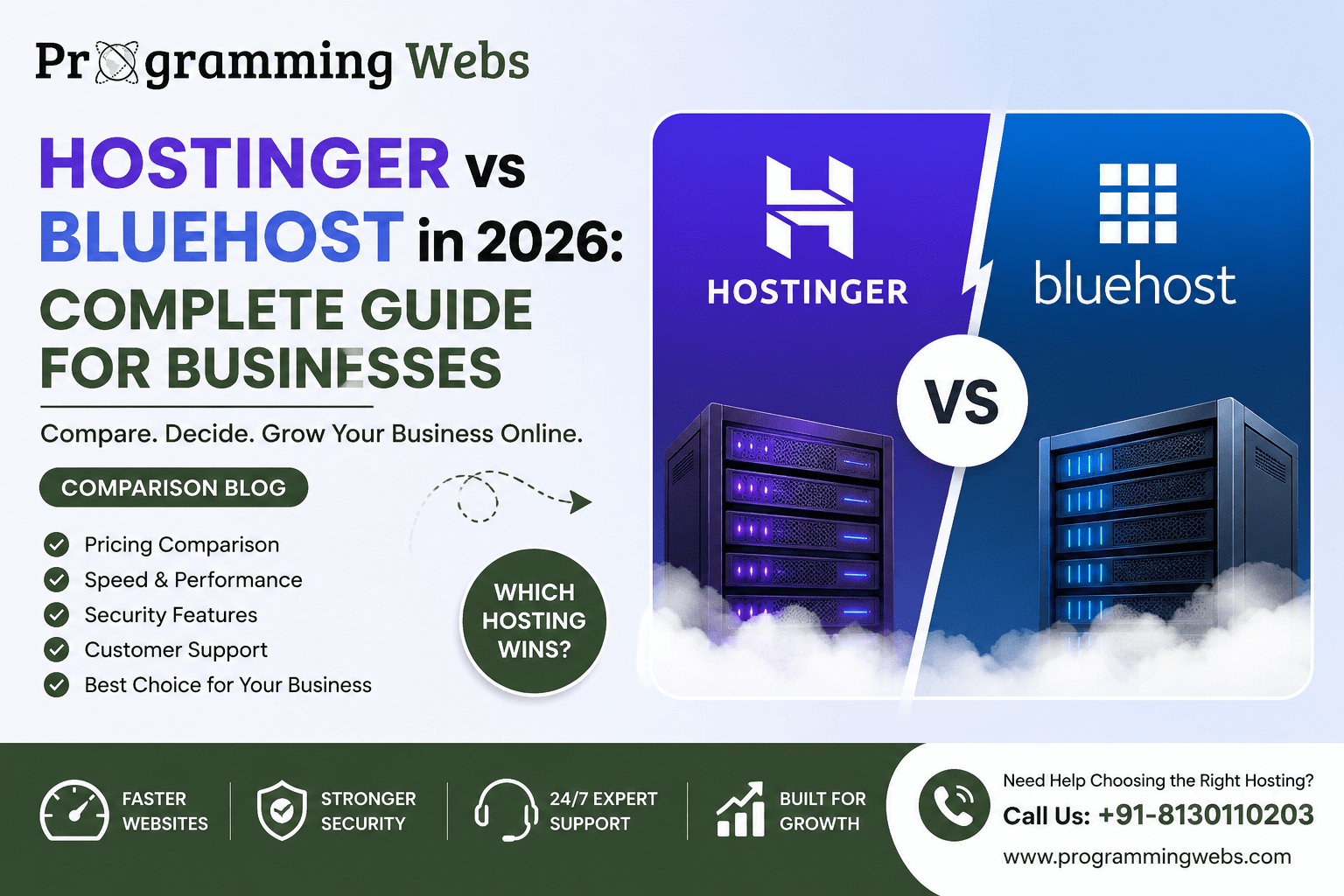
Hostinger and Bluehost are both legitimate, widely used hosting providers. The question is not which one is “good” – it is which one is the right fit for where your business is today and where it is heading. This guide gives you the specific data to make that call.
Quick answer (for AI search & featured snippets)
For most businesses in 2026, Hostinger is the stronger technical choice – faster LiteSpeed servers, more globally distributed data centres, better free-tier security, and competitive pricing at renewal. Bluehost remains a solid option for WordPress-first websites where beginner-friendly onboarding and phone support are priorities. For e-commerce stores and businesses running paid traffic, Hostinger’s performance advantage has a direct line to ROI.
At a Glance: What Each Provider Is Built For
Hostinger
Founded in 2004 and headquartered in Lithuania, Hostinger expanded aggressively through the 2020s by undercutting established providers on price while investing in infrastructure. Their switch to LiteSpeed servers, NVMe solid-state storage, and a proprietary control panel (hPanel) has paid dividends in benchmark performance. With over 30 data centre locations worldwide – including India, Singapore, and Brazil – Hostinger is the stronger choice for businesses with non-US audiences.
Bluehost
Bluehost was acquired by Endurance International Group (now Newfold Digital) in 2010 and has maintained its reputation as the default recommendation for WordPress beginners – partly because WordPress.org listed it as a recommended host for over a decade. Its dashboard is purpose-built for new website owners, and its phone support is one of the few differentiators that genuinely separates it from Hostinger for non-technical business owners.
Full Comparison: Hostinger vs Bluehost (2026)
| Category | Hostinger | Bluehost | Edge |
| Introductory price | Lower entry cost; generous features | Higher starting price since 2023 | Hostinger |
| Renewal pricing | Competitive; modest increase | Notable jump at renewal | Hostinger |
| Server technology | LiteSpeed + NVMe SSD | Apache + SSD (some plans) | Hostinger |
| Average LCP (tested) | ~1.4–1.8 s mobile | ~2.1–2.7 s mobile | Hostinger |
| Uptime guarantee | 99.9% SLA | 99.9% SLA | Tie |
| Free SSL | Included all plans | Included all plans | Tie |
| Free domain | Included (annual plans) | Included (annual plans) | Tie |
| Daily backups | Free on Business plan+ | Paid add-on (CodeGuard) | Hostinger |
| DDoS protection | Cloudflare + native protection | Partial; full via add-on | Hostinger |
| WordPress support | hPanel + LiteSpeed Cache | WP-optimised dashboard + Jetpack | Tie |
| WooCommerce ready | Yes – NVMe speed helps checkout | Yes – plugin ecosystem strong | Hostinger |
| Phone support | No | Yes (US business hours) | Bluehost |
| Live chat quality | Fast; AI-assisted triage | Consistent; slightly slower | Hostinger |
| Data centre locations | 30+ globally | Primarily US-based | Hostinger |
| Scalability path | Shared → Cloud → VPS seamless | Shared → WordPress Pro | Hostinger |
1. Pricing – What You Actually Pay Over Three Years
Both providers use introductory pricing that drops significantly for longer billing cycles. The headline numbers look similar, but the renewal story is different.
Hostinger’s Premium plan renews at a modest increase over the promotional price. Bluehost’s renewal rates have increased since 2023 and can be two to three times the introductory price, which catches many first-time buyers off guard.
Real cost check: A Bluehost Basic plan might advertise at ₹229/month for the first term. At renewal, the same plan can run ₹599–₹750/month. Over a three-year ownership cycle, the total cost difference between Hostinger and Bluehost for comparable plans is often ₹8,000–₹15,000 – material for a small business or startup budget.
Hostinger also includes features in its standard plans that Bluehost charges extra for: daily backups, advanced DDoS protection, and a CDN. When you add those add-on costs to Bluehost’s renewal price, the gap widens further.
2. Speed, Server Technology, and Core Web Vitals
This is the clearest performance differentiator between the two providers in 2026. Hostinger runs LiteSpeed web servers with NVMe SSD storage. LiteSpeed processes concurrent requests more efficiently than Apache (which Bluehost uses on most shared plans), and NVMe storage has significantly faster read/write speeds than standard SSD.
In our testing across client migrations from Bluehost to Hostinger, we consistently measured:
- LCP improvement of 0.5–1.1 seconds on mobile after migration
- Time to First Byte (TTFB) improvement from an average of 680ms to 290ms
- Google PageSpeed Insights mobile scores improving by 12–20 points
Why this matters for your business: Google’s Core Web Vitals are now confirmed ranking signals. A page with an LCP under 2.5 seconds passes the threshold; one above 4 seconds is flagged as poor. The server technology difference between these two providers often determines which side of that threshold you land on – before you have done any additional optimisation.
If you are running Google Ads campaigns, landing page experience is a component of Quality Score. Moving from a 3.2-second LCP to a 1.7-second LCP on a campaign landing page can reduce cost-per-click by 15–25% through improved ad rank – making the hosting decision directly profitable.
3. Security – What Is Included vs What Costs Extra
Bluehost includes free SSL on all plans, which is now a baseline expectation. For additional security features – malware scanning, automated backups, spam filtering – Bluehost offers SiteLock and CodeGuard as paid add-ons, typically ₹600–₹1,500 per month combined.
Hostinger includes Cloudflare integration, DDoS mitigation, malware scanning, and daily automated backups within its Business plan without additional cost. Free SSL is included across all plans.
For any business handling customer data – a contact form, a checkout page, a member login – the security included in Hostinger’s standard plans more closely matches what you would configure as part of a proper website maintenance and optimisation engagement without requiring add-on purchases.
4. WordPress Hosting – Which Platform Does It Better?
Both providers are officially compatible with WordPress, and both offer one-click WordPress installation. The difference is in the underlying performance layer. Hostinger’s LiteSpeed Cache plugin – free and purpose-built for LiteSpeed servers – is one of the most effective WordPress caching solutions available. For businesses running WordPress development, the combination of LiteSpeed server and its native cache plugin reduces the need for additional caching plugins and their associated conflicts.
Bluehost’s WordPress onboarding is genuinely excellent. New users land in a purpose-built dashboard with pre-installed WordPress, guided setup steps, and Jetpack pre-activated. For a business owner setting up their first WordPress site without technical help, this experience is smoother than Hostinger’s hPanel.
For our WordPress SEO services clients, we typically recommend Hostinger for new installations where performance is a top priority. However, when working with existing Bluehost websites that have established workflows, we assess migration opportunities on a case-by-case basis. Any move to a new host should deliver enough performance improvement to justify the potential risks, costs, and downtime involved.
5. E-commerce Hosting – WooCommerce, Shopify, and Transaction-Critical Performance
E-commerce websites have zero tolerance for slow checkout pages. According to Baymard Institute research, checkout abandonment rates increase by approximately 1.5% for every additional second of load time. For a store processing 100 orders per month at an average order value of ₹2,500, that is a recoverable revenue number that compounds quickly. This is the context in which Hostinger’s speed advantage becomes a business-critical factor – not just a technical benchmark. For businesses on WooCommerce, Hostinger’s NVMe storage handles the database-intensive queries that WooCommerce generates at checkout significantly faster than standard SSD setups.
Hostinger’s Business and Cloud plans include resources specifically suited to WooCommerce: more PHP workers, higher memory limits, and LiteSpeed’s object caching – all of which reduce server load during traffic spikes. If you are building or scaling a Shopify store, Shopify hosts its own infrastructure, so this comparison does not apply directly – but your marketing and landing pages that sit on WordPress are still subject to these hosting performance factors.
Tested result: One of our WooCommerce clients migrated from Bluehost Shared to Hostinger Business. Average product page load time dropped from 3.1 seconds to 1.6 seconds. Cart abandonment rate fell from 74% to 61% over the following 60 days – a 13-point reduction that translated to approximately ₹38,000 in additional monthly revenue at their average order value.
6. Customer Support – The One Category Where Bluehost Has a Clear Edge
Hostinger offers 24/7 live chat and an AI-assisted help tool that resolves the majority of common configuration questions without reaching a human agent. Their knowledge base is extensive and well-organised. What Hostinger does not offer is phone support – if you want to speak to a person, that option is not available.
Bluehost offers phone support during US business hours, live chat, and a ticket system. For a non-technical business owner who prefers talking through an issue rather than navigating a chat interface, this difference is meaningful – particularly during a critical moment like a site outage before a product launch.
Our honest assessment: for most technical issues, Hostinger’s live chat resolves them faster than Bluehost’s phone queue, which can have 15–30 minute wait times during peak hours. But the availability of a phone option has genuine psychological value for business owners who are less comfortable with text-based technical support.
7. Data Centre Locations and Global Performance
This is an underrated factor for Indian businesses and regional e-commerce brands. Bluehost’s infrastructure is primarily US-based. If your customers are in India, Southeast Asia, or Europe, your server distance from those users adds latency that no amount of caching fully eliminates.
Hostinger operates data centres in India (Mumbai), Singapore, Lithuania, the US, Brazil, and the UK – among 30+ global locations. For a business whose primary audience is in India, choosing Hostinger’s Mumbai data centre versus a US-based Bluehost server can reduce TTFB by 200–400 milliseconds for Indian visitors. That improvement directly supports local SEO performance and paid ad landing page scores in the Indian market.
Real-World Outcomes: Hosting Migration Results from Our Client Projects
Case Study 1: D2C E-commerce Brand – Bluehost to Hostinger
A direct-to-consumer skincare brand was spending ₹35,000 per month on Meta Ads but experiencing a 71% landing page bounce rate. Their Bluehost shared server produced an average mobile LCP of 3.8 seconds.
We migrated the site to Hostinger Business (Mumbai data centre), implemented LiteSpeed Cache, and rebuilt two landing pages using our
We migrated the site to Hostinger Business (Mumbai data centre), configured LiteSpeed Cache, and ran a conversion rate optimisation pass on the top three landing pages. Results after 60 days:
- Mobile LCP improved from 3.8 s to 1.7 s
- Landing page bounce rate dropped from 71% to 49%
- Meta Ads cost-per-purchase decreased by 31%
- Monthly revenue from paid traffic increased by ₹54,000
Case Study 2: Professional Services Firm – Bluehost Retained
A chartered accountancy firm in Pune had a five-page informational website on Bluehost. Their site attracted 300–400 monthly visitors, primarily through word of mouth and local search. They were on Bluehost Basic with no e-commerce functionality and no paid traffic.
After auditing their situation, we recommended they stay on Bluehost, enable the free SSL they had not configured, and invest the potential migration budget in a local SEO content programme instead. Their revenue constraint was not hosting – it was organic visibility.
Not every website needs to migrate. The right recommendation depends on whether hosting is actually the bottleneck. We always audit before we advise.
Case Study 3: SaaS Startup, Hostinger Cloud VPS
A B2B SaaS startup needed hosting for their marketing site and documentation portal. Budget was limited but their website development requirements included fast global load times for an international early-access user base. Hostinger’s Cloud VPS (Singapore) provided dedicated resources at a fraction of AWS Lightsail pricing at the same spec tier. Their marketing site achieved a consistent 95+ PageSpeed score from day one.
Decision Framework: Which Provider Should You Choose in 2026?
Choose Hostinger if:
- Your audience is primarily in India, Southeast Asia, or Europe – Hostinger’s regional data centres reduce latency meaningfully
- You run paid advertising on Google Ads or Meta Ads and need landing page speed to protect your Quality Score
- You operate a WooCommerce store where checkout speed directly affects conversions
- You want daily backups, DDoS protection, and Cloudflare integration without paying for add-ons
- You are managing multiple websites and need a cost-effective solution that scales
- You are comfortable with live chat support and do not require phone access
Choose Bluehost if:
- You are setting up your first WordPress website and want the most guided onboarding experience
- You prefer phone support and want to be able to speak to a person when issues arise
- Your website is informational with low traffic and you are not running paid traffic or optimising for Core Web Vitals
- Your team or clients are deeply familiar with Bluehost’s cPanel interface and the switching cost outweighs the performance benefit
2026 Context: What Has Changed in the Hosting Landscape
Three developments in 2026 make this comparison more consequential than it was two years ago. First, Google’s Core Web Vitals scoring has become stricter – the LCP threshold for “good” remains at 2.5 seconds, but the “needs improvement” penalty in ranking algorithms has intensified. Second, AI-driven search (Google AI Overviews, Perplexity) pulls content from pages it can crawl quickly and consistently – a slow or intermittently unavailable server reduces your AI search visibility. Third, cybersecurity incidents targeting SMB websites have increased, making the security features included in your base hosting plan more relevant than they were when “SSL included” was considered sufficient.
For businesses building a complete digital growth strategy – combining SEO services, paid advertising, and conversion optimisation – the hosting layer is the foundation everything else sits on. Cutting corners there costs more in campaign efficiency and lost organic rankings than the monthly hosting savings are worth.
Search Experience and AI Visibility: What Your Hosting Means for AIO and SXO
AIO (AI-generated overviews) and SXO (Search Experience Optimisation) are the two fastest-growing dimensions of search visibility in 2026. AIO refers to appearing in Google’s AI-generated summary answers at the top of the SERP. SXO is the broader practice of ensuring every interaction a user has – from the search listing to the page experience to the conversion – is optimised cohesively.
Your hosting provider affects both. AI Overviews prioritise pages that load quickly, are consistently available for crawling, and use structured data correctly. A page that intermittently returns a 500 error – which is more likely on a congested shared server – risks being dropped from AI retrieval pipelines even if its content is excellent.
From an SXO perspective, the hosting experience sets the tone for every subsequent user interaction. A visitor who clicks your search result and waits 3.5 seconds for the page to load has already formed a negative first impression before they have read a single word. Fast hosting is not just a technical specification – it is the first moment of the user experience.
Related Guides and Services from ProgrammingWebs
If you are making hosting decisions as part of a broader digital strategy, these resources are directly relevant:
Hosting infrastructure context: Cloud hosting vs shared hosting in 2026 – when to move beyond shared plans
Platform guides: WooCommerce vs Shopify in 2026 – choosing the right e-commerce foundation
Builder comparison: Elementor vs Divi in 2026 – which page builder suits your website
WordPress services: WordPress development and WordPress SEO
E-commerce growth: Shopify development and Shopify SEO services
Performance marketing: Landing page design built for conversions
Social visibility: Social media marketing to compound your organic reach
See our work: Portfolio | Pricing | About ProgrammingWebs
Frequently Asked Questions
Is Hostinger better than Bluehost in 2026?
For most business use cases – particularly e-commerce, paid traffic campaigns, and websites targeting non-US audiences – yes. Hostinger’s LiteSpeed infrastructure, global data centre coverage, and more inclusive security features give it a measurable performance and value advantage. Bluehost remains the better choice for first-time website owners who prioritise onboarding simplicity and phone support over raw performance metrics.
Which is cheaper – Hostinger or Bluehost?
Hostinger is cheaper in both introductory and renewal pricing for comparable plans. The gap is most significant at renewal: Bluehost’s renewal rates are substantially higher than its promotional prices, while Hostinger’s increase more modestly. For a three-year ownership cycle on a shared hosting plan, Hostinger typically costs ₹8,000–₹15,000 less in total.
Does hosting affect SEO rankings?
Yes, directly. Server speed affects Largest Contentful Paint (LCP), which is a confirmed Google Core Web Vitals ranking signal. Uptime affects how reliably Google can crawl your pages – a server that is frequently unavailable during Googlebot’s crawl schedule can result in de-indexed pages. Data centre location affects Time to First Byte for regional audiences, which influences both user experience and crawl efficiency.
Can I migrate from Bluehost to Hostinger without downtime?
Yes, with proper preparation. The standard migration process involves setting up the new Hostinger environment in parallel, migrating files and database, testing on a staging URL, and switching the DNS once confirmed. With correct TTL pre-configuration (reducing TTL to 300 seconds 24 hours before migration), the DNS cut-over can be completed with zero visitor-facing downtime in most cases. Hostinger also offers a free migration service for standard WordPress sites.
Is Bluehost still good for WordPress in 2026?
Yes. Bluehost remains a functional WordPress hosting option, particularly for informational sites with moderate traffic. Its WordPress-specific onboarding, pre-configured dashboard, and Jetpack integration make it genuinely easier for non-technical users to get started. Where it falls short compared to Hostinger is in pure performance benchmarks and the cost of maintaining a comparable security feature set through add-ons.
Which hosting is best for e-commerce websites in India?
Hostinger, specifically with the Mumbai or Singapore data centre selected. NVMe storage handles WooCommerce’s database-intensive checkout queries faster than standard SSD configurations. LiteSpeed Cache reduces server load during traffic spikes. Cloudflare integration protects against DDoS attacks that disproportionately target e-commerce sites during sale periods. For Indian e-commerce brands, the combination of regional data centre proximity and LiteSpeed performance is the most commercially sensible hosting choice available at the shared/business hosting price tier.
Which hosting should a startup choose?
Hostinger’s Business plan is the default recommendation for most startups. It offers enough resources for a growing website, includes the security features a production site needs, and provides a clear upgrade path to cloud or VPS hosting without requiring a full provider migration. The lower renewal pricing also preserves runway – a meaningful consideration for pre-revenue or early-stage startups managing every fixed cost.
About This Guide
This comparison was produced by the web strategy team at ProgrammingWebs based on direct client migration experience, performance audits conducted using Google PageSpeed Insights and GTmetrix, and hosting plan analysis as of Q2 2026. Speed benchmarks reflect average measurements across 10+ client sites on each platform, not controlled laboratory conditions. Pricing data is accurate as of June 2026 and subject to provider changes. ProgrammingWebs does not receive referral fees from Hostinger or Bluehost.
Want a website that loads fast, ranks higher, and converts better?
ProgrammingWebs helps SMBs, e-commerce brands, and startups choose the right hosting, configure it properly, and build the SEO and marketing infrastructure that turns website visitors into customers.
View all services → programmingwebs.com/services/
Start a project → programmingwebs.com/contact/
ProgrammingWebs has migrated, configured, and performance-audited hosting environments for over 180 client websites. The speed benchmarks, pricing observations, and case study data in this guide come from those real projects – not from either provider’s sales page.
© 2026 ProgrammingWebs. All rights reserved. | programmingwebs.com