By the E-commerce Strategy Team at ProgrammingWebs | Updated: June 2026 | 10-minute read
ProgrammingWebs has built, migrated, and optimised e-commerce stores across both Shopify and Magento for over 180 business clients – from first-time online retailers to enterprise brands managing 50,000+ SKUs. The performance data, cost comparisons, and case studies in this guide are drawn from those real projects.
Why the Shopify vs Magento Decision Has Bigger Consequences in 2026 Than It Did Before
The e-commerce platform market has consolidated significantly since 2023. Platform migrations – moving from Magento to Shopify, or vice versa – now typically cost ₹1,50,000 to ₹6,00,000 in development, SEO recovery, and operational disruption. That makes the initial platform decision more consequential than ever.
At the same time, both platforms have evolved. Shopify’s 2025 release of a native B2B suite narrowed the gap with Magento for wholesale and manufacturing businesses. Adobe Commerce (Magento’s enterprise edition) has integrated Adobe Sensei AI more deeply into its personalisation and merchandising tools. Neither platform from 2021 resembles what it is today.
This guide reflects where both platforms actually stand in mid-2026 – not where vendor marketing says they stand.
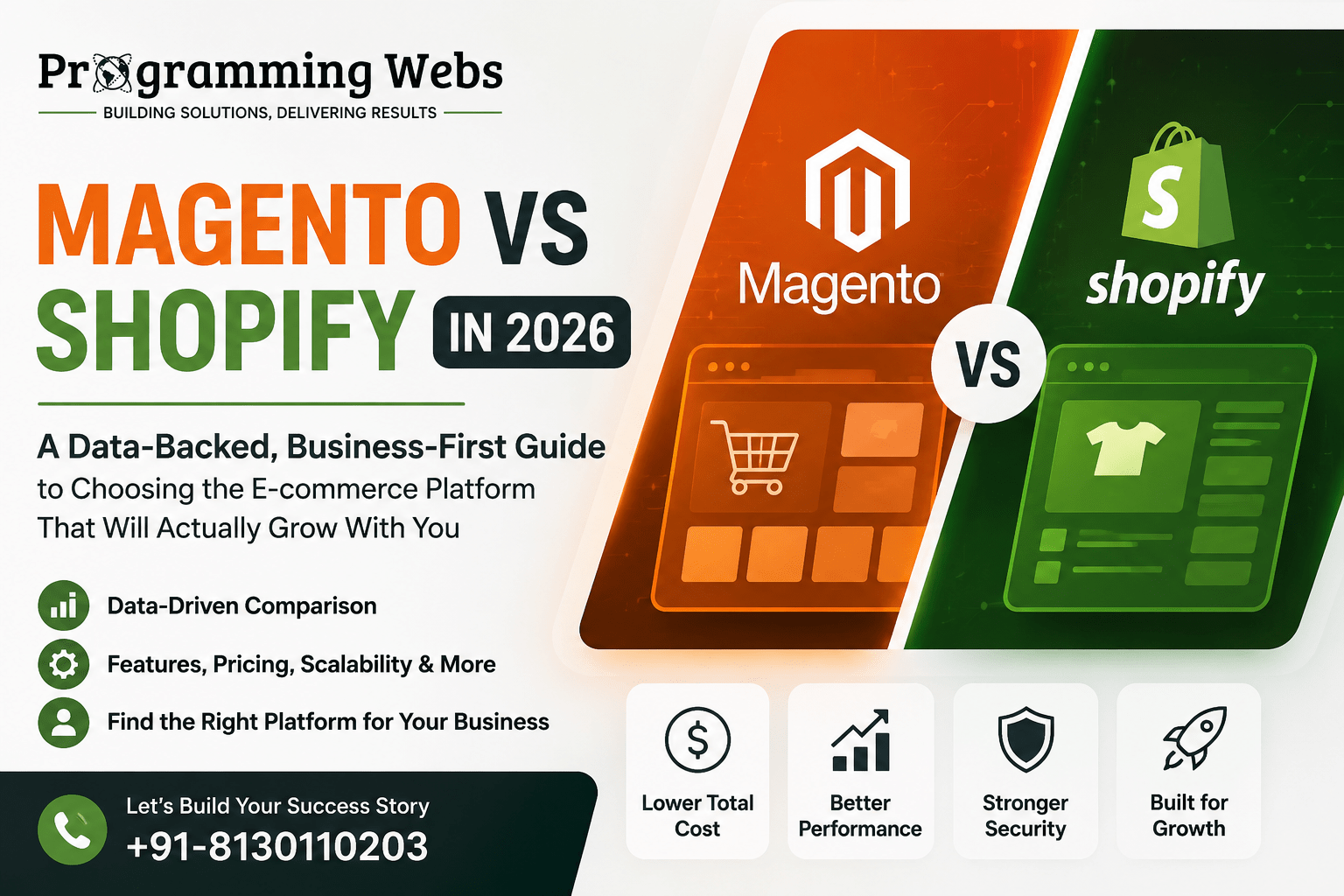
Choose Shopify if you need a fast launch, managed infrastructure, and a predictable monthly cost – it is the right choice for most startups, DTC brands, and businesses without dedicated development resources. Choose Magento (Adobe Commerce) if you have complex product catalogues, custom B2B pricing structures, advanced fulfilment workflows, or enterprise integration requirements that Shopify’s architecture cannot accommodate. For most e-commerce businesses under ₹10 crore in annual online revenue, Shopify delivers better ROI. For businesses above that threshold with complex operational requirements, Magento’s flexibility justifies its higher total cost of ownership.
What Is Shopify? (And What Has Changed in 2026)
Shopify is a fully hosted e-commerce platform – you pay a monthly subscription and Shopify handles the hosting, security, PCI compliance, CDN, and software updates. You build your store through a web interface, choose from 8,000+ apps in the Shopify App Store, and customise your theme using Shopify’s Liquid templating language or a visual editor.
The 2025 and 2026 platform updates are worth noting. Shopify’s Hydrogen framework for headless commerce has matured considerably, making Shopify competitive in deployments that previously defaulted to Magento. The native B2B module in Shopify Plus now supports company accounts, custom price lists, and payment terms – features that were impossible without apps two years ago.
Where Shopify Is the Clear Choice
- Brands that need a production-ready store in weeks, not months
- DTC businesses where visual merchandising, email marketing integration, and social commerce matter more than backend configuration
Shopify SEO – Shopify’s clean URL structure, automatic sitemap generation, and fast managed hosting give it a strong organic search foundation that does not require developer intervention to configure
- Businesses with limited development resources – most operational tasks can be handled by a non-technical team member
- Brands scaling from 0 to ₹5 crore in online revenue, where platform flexibility is less important than execution speed
What Is Magento / Adobe Commerce? (And Who It Is Really Built For)
Magento is an open-source e-commerce platform originally launched in 2008 and acquired by Adobe in 2018. There are two editions: Magento Open Source (free to download, self-hosted) and Adobe Commerce (the enterprise version, licensed annually based on gross merchandise volume).
Magento gives you the source code. You host it on infrastructure you control, configure every aspect of the platform, and build whatever functionality your business requires. That power comes with responsibility – your team (or your agency) manages server security, software updates, performance optimisation, and compliance.
Where Magento Earns Its Place
- Businesses with product catalogues exceeding 10,000 SKUs and complex attribute structures that Shopify’s product model cannot represent cleanly
- Manufacturers and wholesalers with B2B pricing requirements – customer-specific price lists, negotiated quotes, credit terms, and account hierarchies
- Enterprises with existing ERP, WMS, and PIM systems that require deep API integration at the data model level
- Businesses requiring headless commerce with full backend control – Magento’s API-first architecture has been production-tested at scale for longer than Shopify’s Hydrogen framework
- Large retailers operating multiple independent storefronts for different brands, regions, or market segments from a single backend
Full Comparison: Magento vs Shopify (2026)
| Factor | Shopify | Magento (Adobe Commerce) | Edge |
| Setup time | Days – hosted, guided onboarding | Weeks to months – server + dev required | Shopify |
| Technical skill needed | Low – non-technical teams manage easily | High – needs dedicated developers | Shopify |
| Hosting included | Yes – fully managed | No – you provision and manage | Shopify |
| Customisation depth | Good – themes, apps, APIs, Liquid | Unlimited – full source code access | Magento |
| Plugin / extension count | 8,000+ in Shopify App Store | 5,000+ on Adobe Marketplace | Shopify |
| SEO control | Strong built-in; some URL limitations | Complete technical SEO control | Magento |
| Schema markup | App-dependent | Native + developer-configurable | Magento |
| Out-of-box page speed | Excellent – Shopify CDN + managed infra | Variable – depends on hosting + config | Shopify |
| B2B / complex pricing | Shopify Plus supports multi-tier pricing | Native B2B module – very advanced | Magento |
| Multi-store management | Multiple storefronts via Shopify Plus | Multiple stores from one installation | Tie |
| Security | PCI-compliant, fully managed | Self-managed – patches, server, compliance | Shopify |
| Total cost of ownership | Predictable monthly fee; apps add up | Higher dev + hosting + maintenance costs | Shopify |
| Headless commerce | Good – Hydrogen framework | Excellent – deeply supported | Magento |
| AI features (2026) | Shopify Magic – copy, images, analytics | Adobe Sensei AI integration | Tie |
| Scalability ceiling | Very high – Shopify Plus handles 10k+ orders/min | No ceiling – enterprise-grade | Magento |
1. Total Cost of Ownership – The Honest Three-Year Calculation
The pricing conversation between Shopify and Magento is almost always misframed. Shopify’s monthly subscription gets compared to Magento Open Source’s zero licence cost, and Magento looks free. It is not free – it has no licence fee.
Here is a realistic three-year cost comparison for a mid-size e-commerce business:
Shopify (Growing Brand, ₹1–5 crore GMV)
- Shopify plan or Advanced: ₹2,000–₹8,000/month
- Theme (one-time): ₹10,000–₹25,000
- Essential apps (email, reviews, loyalty, returns): ₹3,000–₹8,000/month
- Development for customisations: ₹30,000–₹80,000 one-time setup
- Estimated 3-year total: ₹3,00,000–₹7,00,000
Magento Open Source (Same Business)
- Hosting (dedicated VPS or cloud): ₹5,000–₹20,000/month
- Initial development: ₹2,00,000–₹8,00,000
- Extensions: ₹50,000–₹2,00,000 one-time + renewals
- Ongoing developer maintenance: ₹20,000–₹60,000/month
- Security patching and updates: ₹10,000–₹30,000/year
- Estimated 3-year total: ₹12,00,000–₹40,00,000
The honest conclusion: Magento is not cheaper than Shopify for most businesses. It can be more cost-effective for enterprises with very high GMV and complex requirements – because those businesses would pay for custom Shopify Plus enterprise contracts or development work that approaches the same cost. For a business generating under ₹10 crore annually online, Shopify almost always has a lower total cost of ownership.
2. SEO Performance – Where Magento’s Technical Flexibility Creates Real Advantage
Both platforms support the SEO fundamentals: editable meta titles and descriptions, XML sitemaps, SSL, mobile-responsive themes, and canonical URL management. The meaningful differences appear at the technical SEO level.
Shopify has URL structure constraints that are well-documented in the SEO community. Product URLs always include /products/ in the path; collection URLs always include /collections/. You cannot change this without third-party apps. For most businesses, this does not materially affect rankings – Google handles subfolder URL structures well. But for businesses migrating from a different URL structure, the inability to match exact legacy URLs can complicate redirect mapping.
Magento gives complete URL control. You can structure product, category, and content URLs exactly as your SEO strategy requires. Custom schema implementation – ProductGroup, Offer, Review, LocalBusiness – is straightforward through Magento’s layout XML or a developer customisation. For businesses investing seriously in e-commerce SEO, that control produces measurable advantages in competitive keyword categories.
In our SEO audits across Shopify and Magento stores, the single biggest differentiator in organic performance is content structure and link architecture – not the platform itself. A well-structured Shopify store with proper category pages, optimised product descriptions, and clean internal linking outperforms a poorly configured Magento store every time.
GEO/AIO note (2026): AI Overviews in Google pull from pages with correct structured data and fast server response. Shopify’s managed CDN produces consistent TTFB under 200ms globally. Magento’s TTFB varies significantly by hosting configuration – well-optimised installs match Shopify; poorly configured installs fall behind. For AI search visibility, page speed and schema are more important than which platform you chose.
3. Performance and Core Web Vitals – Managed vs Self-Managed Infrastructure
Shopify’s performance advantage comes from its infrastructure layer. Every Shopify store runs on Shopify’s global CDN, with automatic image optimisation, Brotli compression, and HTTP/3 support. You do not configure any of this – it is on by default. For a business without a dedicated DevOps resource, this is a meaningful operational advantage.
Magento’s performance depends entirely on your hosting environment and configuration. A Magento store on a properly configured cloud VPS with Varnish caching, Elasticsearch, Redis, and a CDN in front is genuinely fast – LCP scores under 1.5 seconds are achievable. But reaching that configuration requires expertise. We cover the hosting infrastructure decision in detail in our cloud hosting vs shared hosting guide.
From our audits: The median Shopify store we audit scores 78–85 on Google PageSpeed Insights (mobile) without any specific optimisation work. The median Magento store we audit scores 52–68 on mobile without specific work. After optimisation, both platforms can reach 85–95. The gap is in the baseline – Shopify starts better without effort; Magento needs deliberate infrastructure work to match it.
4. Customisation and Business Logic – Where Magento Justifies Its Complexity
Shopify’s customisation model is well-designed but bounded. You can modify anything visible through Liquid templates, add functionality through apps, and use Shopify Functions (a newer serverless capability) to customise discount logic, shipping, and payment flows. For 90% of e-commerce use cases, this is sufficient.
The 10% where it is not sufficient tends to cluster around complex B2B requirements, custom pricing logic, unusual checkout workflows, and deep ERP integration at the data model level. A manufacturing business that needs to show different catalogues to different customer segments, with customer-specific pricing tables, minimum order quantities, and purchase order payment terms – that is a Magento use case.
Our Shopify development service covers the full range of Shopify customisation from theme development through to Shopify Functions and custom app builds. We are honest about what Shopify can and cannot do – and when a client’s requirements genuinely exceed Shopify’s architecture, we say so.
5. Security – Managed Simplicity vs Full Control
Shopify’s security model is straightforward: Shopify manages PCI DSS compliance, SSL certificates, server security, and platform updates. You do not need to think about patching a PHP vulnerability or monitoring server logs for intrusion attempts. For a business without in-house technical security resource, this is the correct risk posture.
Magento’s security model is the inverse. You control everything, which means you are responsible for everything. Adobe releases security patches on a regular schedule – missing a patch cycle can leave known vulnerabilities exposed. Adobe Commerce (the paid enterprise edition) includes more managed security support than Open Source.
For businesses running Magento, we recommend a website maintenance and optimisation programme that includes regular security patching, uptime monitoring, and performance auditing. Treating Magento as a set-and-forget installation is the most common cause of serious security incidents we see in the field.
6. Shopify’s 2026 B2B Module – A Meaningful Competitive Shift
Two years ago, B2B requirements were a reliable differentiator in Magento’s favour. A wholesale business with customer-specific pricing, purchase order workflows, and account hierarchy management had no credible Shopify option.
That changed with Shopify Plus’s native B2B module, which now supports company accounts, multiple buyer roles per company, custom price lists per company, net payment terms, and draft order management. For B2B businesses with moderate complexity, Shopify Plus B2B now warrants serious evaluation where Magento was previously the only credible choice.
The caveat: Shopify Plus B2B is only available on Shopify Plus – a meaningfully higher price point than standard Shopify plans. And for businesses with very complex B2B requirements – ERP-integrated pricing, configurable products with custom engineering, or quote-based workflows – Magento’s B2B module remains more flexible.
Platform Decision Framework: Which Should You Choose?
Choose Shopify if:
You are launching a new DTC or retail brand and need to be in market within 4–8 weeks
- Your catalogue is under 10,000 SKUs with standard product attributes
You are running Google Ads or Meta Ads and need fast, conversion-optimised landing pages without developer dependency
- You want managed security, hosting, and platform updates without operational overhead
- Your business model is B2C or moderate B2B – Shopify Plus B2B handles the majority of wholesale requirements
You want to invest your budget in Shopify SEO and marketing rather than platform infrastructure
Choose Magento (Adobe Commerce) if:
- Your product catalogue exceeds 10,000 SKUs with complex attributes, variants, or configurable products that Shopify’s product model cannot represent accurately
- You operate a B2B or wholesale business with customer-specific pricing, tiered discounts, purchase order workflows, or credit account management beyond what Shopify Plus B2B supports
- You have existing ERP, WMS, or PIM systems that require deep integration at the data model level
- You operate multiple independent storefronts for different brands or regions and need to manage them from a single backend instance
- You have a dedicated development team or a long-term agency relationship that can manage the platform’s technical requirements
Real Projects, Real Results: Shopify and Magento in Practice
Case Study 1: Fashion Brand – Magento to Shopify Migration
A women’s clothing brand with 1,200 SKUs was running Magento 2 on a VPS managed by a freelance developer. Developer availability was inconsistent, platform updates were 18 months behind, and the site had a 58% bounce rate driven by a 4.3-second mobile LCP.
We recommended migration to Shopify – their product catalogue and operational requirements were well within Shopify’s native capability. We executed the migration over six weeks, implementing 301 redirects for every URL, preserving metafield data, and configuring Shopify SEO best practices. Results at 90 days post-migration:
- Mobile LCP improved from 4.3 s to 1.8 s
- Bounce rate dropped from 58% to 38%
- Organic sessions increased 41% year-over-year
- Developer maintenance cost reduced from ₹35,000/month to ₹8,000/month
- They reinvested the savings into Meta Ads – ROAS increased from 2.1x to 3.4x
Case Study 2: Industrial Manufacturer – Shopify Rejected, Magento Implemented
A B2B industrial components manufacturer approached us to build an online ordering portal for their 400+ wholesale accounts. Requirements included: customer-specific price lists (different pricing for 12 customer tiers), minimum order quantities by SKU, purchase order payment with 30/60/90-day net terms, and integration with their SAP system for inventory and order management.
We evaluated Shopify Plus B2B first. The pricing tier limit in Shopify’s metafield-based price lists, combined with the SAP integration complexity, pushed the requirement firmly into Magento territory. We implemented Adobe Commerce with a custom SAP connector.
- 400+ B2B accounts onboarded in first 3 months
- Order processing time per order reduced by 64% (from manual email to self-service portal)
- Average order value increased 22% – customers browsed and added more when ordering digitally
- SAP inventory sync runs every 15 minutes – near real-time accuracy
Case Study 3: Multi-Brand Retailer – Shopify Plus, One Store Per Brand
A retail group managing three distinct clothing brands – each with separate identity, separate customer bases, and separate inventory – needed independent storefronts with unified backend reporting. We implemented three Shopify Plus stores under one organisation account. Each brand runs independently, but the group’s digital team has visibility across all three through consolidated e-commerce SEO reporting and a shared Google Ads management structure. Total development cost was 40% lower than the equivalent Magento multi-store build we quoted.
2026 E-commerce Trends That Affect Your Platform Choice
AI-Driven Personalisation
Both platforms now integrate AI personalisation at the product recommendation and merchandising level. Shopify Magic generates product descriptions, email subject lines, and ad copy from within the admin. Adobe Sensei powers personalised product recommendations and segment-based merchandising in Adobe Commerce. Neither gives one platform a decisive advantage – the quality of your customer data is the real variable.
Headless Commerce
Headless commerce – separating the front-end presentation layer from the backend commerce engine – has moved from experimental to mainstream in 2026. Shopify’s Hydrogen framework (React-based, deployed on Oxygen) and Magento’s API-first architecture both support headless implementations. Magento’s headless capability is more mature for complex use cases; Shopify Hydrogen is faster to launch for teams with React expertise.
Social Commerce and TikTok Integration
Both platforms now support direct selling through TikTok Shop, Instagram Checkout, and YouTube Shopping. The integrations are roughly equivalent. Social media marketing that connects to your e-commerce platform is now a standard part of a growth strategy rather than an experimental channel.
Composable Commerce
Enterprise businesses in 2026 increasingly adopt composable commerce architectures – best-of-breed tools stitched together via APIs rather than a single monolithic platform. Both Shopify and Magento are used as the commerce core in composable stacks. Magento’s longer API history gives it a slight advantage in deeply custom composable implementations; Shopify’s simpler API surface is more accessible for teams without dedicated integration engineers.
Related Resources from ProgrammingWebs
These guides and services are directly relevant to the decisions covered in this article:
E-commerce platform comparisons: WooCommerce vs Shopify in 2026 – WooCommerce as a third option for WordPress-based stores
Builder guides: Elementor vs Divi in 2026 – for WordPress-based e-commerce builds
Infrastructure: Cloud hosting vs shared hosting in 2026 – critical reading for Magento hosting decisions
Development: Shopify development | Website development | WordPress development
SEO: E-commerce SEO | Shopify SEO | Local SEO | SEO services
Paid growth: Google Ads management | Meta Ads management | Landing page design
Optimisation: Conversion rate optimisation | Website maintenance | Social media marketing
Company: About ProgrammingWebs | Portfolio | Pricing | Contact
Frequently Asked Questions
Is Shopify better than Magento in 2026?
For most e-commerce businesses – particularly DTC brands, growing retailers, and businesses under ₹10 crore in online GMV – yes. Shopify’s managed infrastructure, lower total cost of ownership, and faster time to market make it the right choice for businesses that want to focus resources on marketing and growth rather than platform management. Magento is better for enterprises with complex product catalogues, advanced B2B requirements, or deep ERP integration needs that Shopify’s architecture cannot accommodate.
Which platform is more SEO-friendly – Magento or Shopify?
Magento provides more granular technical SEO control – full URL customisation, native schema implementation, and complete metadata management at the code level. Shopify provides strong built-in SEO with some URL structure constraints. In practice, organic performance is more dependent on content quality, site architecture, and link building than on which platform you chose. A well-optimised Shopify store consistently outranks a poorly maintained Magento store.
How much does Magento cost compared to Shopify?
Magento Open Source has no licence fee but carries significant total cost of ownership – hosting (₹5,000–₹20,000/month), development (₹2,00,000–₹8,00,000 initial build), ongoing maintenance (₹20,000–₹60,000/month), and extensions. Adobe Commerce (enterprise) is licensed based on GMV, typically starting at $22,000/year. Shopify ranges from ₹2,000 to ₹8,000/month for standard plans, with Shopify Plus starting at $2,300/month. For businesses under ₹10 crore GMV, Shopify’s total three-year cost is typically 40–70% lower than a comparable Magento implementation.
Can Shopify handle 100,000+ products?
Technically yes – Shopify has no hard product count limit. The practical limitations emerge in product organisation (collection hierarchy depth), complex attribute sets, and bulk product management workflows. Businesses with very large, attribute-rich catalogues often find Magento’s native product model more flexible. For straightforward catalogues with standard attributes, Shopify handles large product counts well.
Is migrating from Magento to Shopify safe for SEO?
Yes, when done correctly. A properly managed migration preserves all product data, implements 301 redirects for every changed URL, maps metafield data, and submits an updated sitemap to Google Search Console immediately after go-live. We have completed 20+ Magento-to-Shopify migrations – well-executed ones typically show ranking recovery within 30 to 60 days and often improve on pre-migration organic performance within 90 days due to Shopify’s faster default page speed.
Which platform is better for B2B e-commerce?
This depends on the complexity of your B2B requirements. For moderate B2B – company accounts, custom price lists, purchase order payment terms – Shopify Plus B2B is now a credible option as of 2025/2026. For complex B2B – configurable products with custom engineering, very large numbers of pricing tiers, ERP-integrated quoting, or distributor channel management – Magento’s native B2B module remains more flexible.
Which platform is better for international e-commerce?
Shopify Markets is a well-designed native internationalisation tool – it handles multi-currency pricing, localised domains, language translation integration, and market-specific product availability from a single store. Magento supports internationalisation through multi-store configurations, which provide more control but require more development. For businesses entering 2 to 4 international markets, Shopify Markets is faster and more cost-effective. For businesses managing 10+ markets with distinct catalogues, Magento’s multi-store architecture may provide more flexibility.
About This Guide
This comparison was written by the e-commerce strategy team at ProgrammingWebs based on direct project experience building and migrating stores on both platforms, performance audit data from Google PageSpeed Insights and Search Console, and pricing information verified as of June 2026. Cost estimates are indicative for the Indian market and will vary by project scope. ProgrammingWebs does not receive referral or affiliate payments from Shopify, Adobe Commerce, or any third-party tool referenced in this guide.
Ready to build or migrate your e-commerce store the right way?
ProgrammingWebs builds, migrates, and optimises Shopify and Magento stores for businesses across India. We combine technical development with SEO, paid ads, and CRO to deliver e-commerce stores that generate measurable revenue.
View e-commerce services → programmingwebs.com/services/
Start a project → programmingwebs.com/contact/
© 2026 ProgrammingWebs. All rights reserved. | programmingwebs.com