By the Web Strategy Team at ProgrammingWebs | Updated: June 2026 | 10-minute read
ProgrammingWebs has built and migrated websites for over 180 businesses – from bootstrapped startups to seven-figure e-commerce brands. This guide draws on that project history, not on vendor marketing. Where we have tested specific tools, we say so. Where the answer depends on your situation, we say that too.
Why the Platform Question Is More Consequential in 2026 Than It Was Three Years Ago
The stakes of this decision have increased. In 2023, picking an AI website builder over WordPress meant a simpler launch with some SEO limitations. In 2026, it can mean the difference between appearing in Google’s AI Overviews and being invisible in them, between owning your content and being locked into a platform whose pricing model changed without warning, and between a website that grows with your business and one that forces an expensive migration once you outgrow it.
AI builders have genuinely improved – the best of them now produce decent SEO metadata, reasonable page speed scores, and designs that do not look off-the-shelf. But WordPress has not stood still either. The addition of AI-assisted content tools, the maturation of Full Site Editing, and a plugin ecosystem that now touches nearly every marketing and sales workflow means the gap between the two has not narrowed as much as AI builder marketing suggests.
This guide gives you a straight comparison so you can make the right call for your business – not the easiest one.
Quick answer
Use an AI website builder if you need a live, presentable website in under 48 hours, your primary goal is lead capture or brand presence, and you have no dedicated web development resource. Choose WordPress if you are investing in long-term SEO, running an e-commerce operation, planning to scale your content, or need integrations with marketing and CRM tools. For most growing businesses, WordPress is the higher-ROI platform over a 2–3 year horizon. The additional upfront investment in setup typically recovers within the first 6 months of organic traffic growth.
What Is an AI Website Builder? (And What Has Changed in 2026)
AI website builders use machine learning models to generate website designs, layouts, and copy from a short brief. You answer questions about your business type, colour preferences, and target audience – and the AI produces a working website, sometimes in under 10 minutes.
The category has matured significantly. Wix’s AI site generator, Hostinger’s AI Website Builder, Durable, and Framer AI have all improved their output quality. In 2026, the best AI-generated sites can pass a basic Core Web Vitals check, include reasonable meta descriptions, and look professionally designed to a non-designer eye.
Where AI Builders Genuinely Excel
- Speed of launch – a functional, branded website can be live within hours, not weeks
- Zero technical overhead – no hosting decisions, no plugin updates, no server configuration
- Consistent design coherence – AI-generated sites tend to have fewer visual inconsistencies than templates assembled by non-designers
- Built-in AI content generation – copy, images, and layout adjustments are available from within the platform
- Predictable fixed monthly cost – no surprise bills from plugin renewals or developer emergency fixes
Where AI Builders Create Problems for Growing Businesses
- SEO ceiling – you cannot add custom schema types, control canonicalisation precisely, or configure technical SEO beyond what the platform exposes in its settings
- Content ownership risk – your website lives on the platform’s infrastructure; if pricing changes or the company is acquired, your options are limited
- Integration gaps – connecting to a CRM, a booking system, a custom payment gateway, or marketing automation often hits a wall
- Customisation limits – design changes that fall outside the AI’s template logic require workarounds or cannot be done at all
What Is WordPress? (And Why 43% of the Web Still Runs on It in 2026)
WordPress is an open-source content management system that powers 43% of all websites globally as of 2026, according to W3Techs. It runs on hosting you choose – anything from shared plans to enterprise cloud infrastructure – giving you complete ownership of your site, your data, and your SEO configuration. Our WordPress development services cover everything from initial build through to complex custom functionality.
WordPress’s core is free. The costs come from hosting, premium themes, plugins, and development time – a variable cost structure that scales with your needs rather than a fixed monthly fee that includes features you may not use.
What Makes WordPress the Default Choice for Growth-Oriented Businesses
- Full technical SEO control – custom schema, redirects, canonical tags, XML sitemaps, robots.txt, hreflang, breadcrumbs, and Core Web Vitals optimisation are all accessible without platform restrictions
- 60,000+ plugins – if a business process exists, there is likely a WordPress plugin for it: CRM integration, appointment booking, membership management, LMS, marketplace functionality
- Complete content ownership – your files and database sit on your hosting account; you can move providers, export everything, or hand the site to a new developer at any time
- E-commerce depth – WooCommerce handles everything from a 10-product store to a 50,000-SKU catalogue with custom pricing rules, subscription billing, and fulfilment integrations
- No ceiling on scalability – WordPress sites run on servers ranging from ₹200/month shared hosting to enterprise load-balanced cloud infrastructure; the platform itself is not the bottleneck
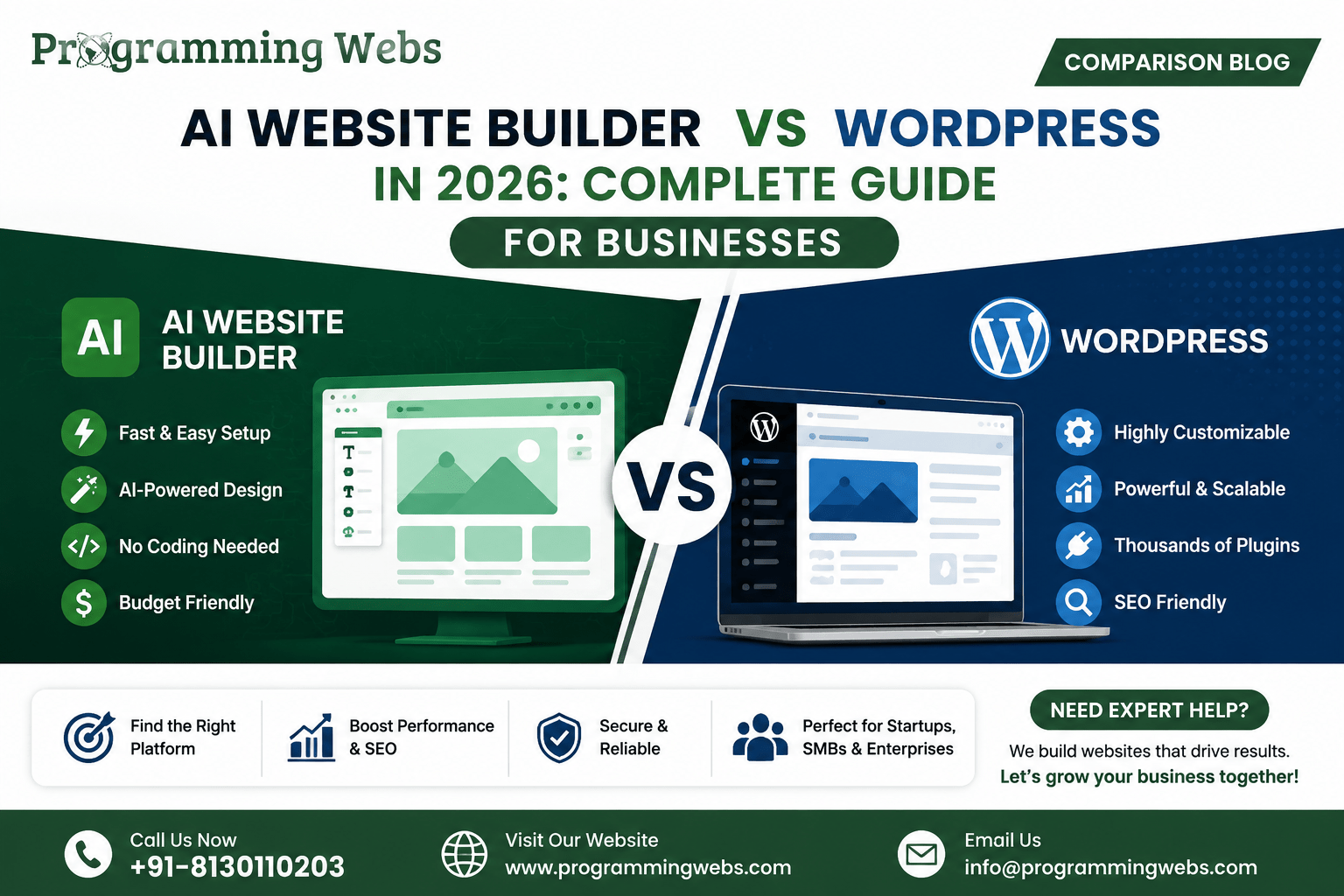
Head-to-Head Comparison: AI Website Builder vs WordPress (2026)
| Factor | AI Website Builder | WordPress | Edge |
| Time to first publish | Hours – guided AI setup | Days – theme, plugins, configuration | AI Builder |
| Coding required | None | None for basics; helpful for advanced | AI Builder |
| Design flexibility | Template-bound; limited deep changes | Unlimited via themes, custom CSS, code | WordPress |
| Plugin / app ecosystem | 50–200 apps (platform-dependent) | 60,000+ plugins in repository | WordPress |
| SEO control | Basic meta + auto sitemap | Full: schema, redirects, technical SEO | WordPress |
| Content ownership | Platform-dependent; export limited | Full ownership – host anywhere | WordPress |
| E-commerce depth | Good for simple catalogues | WooCommerce – unlimited complexity | WordPress |
| Ongoing cost | Fixed monthly (₹500–₹3,000+) | Variable: hosting + plugins + dev | Tie |
| Scalability | Capped by plan tiers | Unlimited – cloud, VPS, enterprise | WordPress |
| AI features (2026) | Built-in – content, images, layouts | Via plugins (e.g. Rank Math AI, AIOSEO) | AI Builder |
| Multilingual support | Varies by platform | WPML, Polylang – full control | WordPress |
| Security ownership | Managed by platform | Self-managed + plugins + hosting | Tie |
| Long-term SEO ceiling | Limited by platform constraints | No ceiling – full technical control | WordPress |
1. Search Engine Optimisation – The Factor That Shapes Long-Term Revenue
This is the most commercially significant difference between the two platforms. SEO compounds – a website that earns organic rankings in year one is generating free, qualified traffic in year three. The platform you choose determines how high that SEO ceiling is.
AI builders provide basic SEO functionality: editable page titles, meta descriptions, auto-generated XML sitemaps, and mobile-responsive designs. That is sufficient for a business that does not rely on organic search for leads.
WordPress, configured with Rank Math or Yoast SEO, provides complete control over every technical SEO variable: JSON-LD schema for FAQ, HowTo, Product, and LocalBusiness types; redirect chains and 404 management; canonical URL configuration; hreflang for multilingual sites; Core Web Vitals optimisation through granular caching and asset management. For businesses investing in SEO services and expecting organic traffic to become a meaningful revenue channel, WordPress is the only choice that does not impose artificial limits on that investment.
GEO insight (2026): Google’s AI Overviews and Perplexity pull from pages with correct structured data and fast server response times. An AI builder site with no schema markup and a 2.8-second LCP is significantly less likely to appear in AI-generated answers than a properly configured WordPress page with FAQ schema and a 1.4-second LCP. The platform choice directly affects your AI search visibility.
2. Design and Customisation – The Gap Is Real, But Context Matters
AI builders have closed the visual quality gap considerably. A 2026 AI-generated website from Wix or Hostinger’s builder looks professional to most visitors. The gap appears when you need something specific – a layout the template does not support, a component that requires custom code, or a design system that needs to be enforced consistently across 50 pages by a non-technical team.
WordPress gives you complete design control through page builders like Elementor (covered in detail in our Elementor vs Divi 2026 guide), custom theme development, and Full Site Editing. Our landing page design service builds conversion-optimised pages in WordPress that can be A/B tested, connected to CRM workflows, and iterated based on analytics data – none of which is possible in most AI builders.
The practical question is not which platform has more design capability – WordPress wins that comparison easily. It is whether the AI builder’s design constraints are constraints you will actually hit within your planning horizon.
3. E-commerce – Where the Platform Choice Has the Highest Consequences
For e-commerce businesses, the platform decision is a revenue decision. We cover this in detail in our WooCommerce vs Shopify 2026 guide, but the core point is this: AI builders with built-in shop functionality work for simple catalogues – 10 to 30 products, straightforward pricing, standard payment gateways. Once you need subscription products, tiered pricing, wholesale accounts, custom checkout flows, or inventory sync with a third-party logistics provider, AI builders cannot keep pace.
WordPress with WooCommerce handles all of that. Our e-commerce SEO services are built around WooCommerce and Shopify – the two platforms that can scale from a startup’s first 50 orders to an enterprise catalogue without a platform migration. AI builders are not in that conversation for serious e-commerce operations.
Real example: A fashion accessories brand started on Wix’s AI builder, sold their first 200 orders, and then hit a wall: no way to configure bundle pricing, no native abandoned cart email with their ESP, and no way to add a loyalty programme. The migration to WooCommerce took four weeks and cost more than the original build would have. The lesson – if e-commerce is your primary model, start on the platform that can scale.
4. Cost – The Full Picture Over 36 Months
AI builders appear cheaper at launch. A Wix Business plan runs around ₹850–₹1,400 per month. Hostinger’s AI Website Builder is available from around ₹300–₹700 per month. These are all-inclusive: hosting, SSL, and the builder itself.
WordPress’s costs are more variable. Shared hosting costs ₹200–₹500 per month; a premium theme runs ₹5,000–₹15,000 as a one-time purchase; essential plugins (SEO, caching, security, forms) add ₹8,000–₹25,000 per year. Initial development – if you are not doing it yourself – adds a setup cost.
Over a 36-month horizon, the total cost of ownership is closer than the monthly headline numbers suggest. The AI builder’s monthly fee accumulates to ₹30,000–₹50,000 over three years. A well-set-up WordPress site with annual plugin renewals and occasional developer support lands in a similar range – and delivers significantly more SEO and marketing infrastructure.
Hidden cost alert: The most expensive hosting scenario is migrating a grown AI builder website to WordPress after 18 months. The migration itself, content restructuring, URL redirect mapping, and SEO recovery period often cost ₹40,000–₹80,000 in combined development and lost organic traffic. If growth is your plan, building on WordPress from the start is almost always more cost-efficient than migrating later.
5. Performance, Core Web Vitals, and Hosting – The Infrastructure Layer
Website performance affects SEO rankings, ad Quality Scores, and conversion rates. This is where hosting becomes part of the platform decision. We cover the hosting choice in detail in our cloud hosting vs shared hosting guide, but the key point for this comparison: AI builders manage their own hosting – you have no control over the server environment, caching configuration, or CDN setup. WordPress lets you choose your hosting environment, which means you can optimise the full stack.
In 2026, Hostinger’s Business plan with LiteSpeed servers and NVMe storage is one of the most cost-effective WordPress hosting configurations available. LiteSpeed Cache – free and purpose-built for LiteSpeed servers – consistently produces WordPress sites with LCP scores under 2 seconds on mobile, which is the threshold Google’s Core Web Vitals guidelines classify as “good”.
Most AI builder platforms deliver acceptable Core Web Vitals scores on simple pages. But as you add content, embed videos, run marketing scripts, and connect third-party tools, the managed hosting environment can become a bottleneck you have no way to resolve.
AIO/SXO note: AI-generated search answers (Google AI Overviews, Perplexity, ChatGPT search) favour pages with fast server response, structured data, and clear content hierarchy. WordPress gives you control over all three. AI builders give you control over none. For businesses whose strategy includes appearing in AI-generated answers, WordPress is the technically superior foundation.
Which Platform Is Right for Your Business Type?
Startups and Pre-Revenue Businesses
If your goal is to have a live, professional website within 48 hours to support investor meetings, initial marketing, or your first product launch – an AI builder is a legitimate choice. The setup cost is low, the maintenance overhead is near-zero, and you can be visible online almost immediately.
The caveat: plan your migration exit from day one. Keep your content in a document editor so it is portable. Do not build deep internal linking on the platform. And as soon as organic search becomes a revenue priority, move to WordPress with proper SEO infrastructure.
Small and Medium Businesses (SMBs)
For an established SMB investing in digital growth, WordPress is almost always the right choice. The ability to run a full local SEO strategy, integrate with Google Ads and Meta Ads landing pages, and build a content library that compounds in organic value over time requires the technical control that only WordPress provides.
Our website development service for SMBs includes SEO architecture, Core Web Vitals optimisation, and integration with your existing tools – delivering a website that is a sales asset, not just an online presence.
E-commerce Brands
WordPress with WooCommerce, or Shopify, are the two platforms worth serious consideration. AI builders are not competitive at any meaningful e-commerce scale. Our Shopify development service and WooCommerce expertise cover both paths – the right choice depends on your catalogue complexity, fulfilment model, and marketing integration requirements.
Service Businesses Running Paid Traffic
If you are allocating budget to Google Ads or Meta Ads and sending that traffic to landing pages, page speed and conversion rate optimisation are critical. Our conversion rate optimisation service and landing page design are both built on WordPress – because the A/B testing, heatmap integration, and granular CTA control required for serious CRO work are not available in AI builders.
Enterprises
Enterprises require custom integrations, role-based content management, multilingual support, and security configurations that AI builders cannot provide. WordPress with a properly configured hosting stack and a custom theme is the standard choice – our portfolio includes enterprise WordPress implementations across finance, healthcare, and education sectors.
Real Business Outcomes: Platform Decisions and Their Results
Case Study 1: Retail Brand – AI Builder to WordPress Migration
A home goods retailer launched on Wix AI in 2024. By late 2025, they had 34 products, were spending ₹40,000 per month on Meta Ads, and could not add a loyalty programme, configure abandoned cart automation with their email platform, or control the schema markup on their product pages.
We migrated the site to WordPress + WooCommerce. We implemented product schema, configured WooCommerce SEO, and connected their email platform. Results after 90 days:
- Organic traffic grew from 1,200 to 3,800 monthly sessions
- Product pages gained star ratings in Google search results (rich results via schema)
- Meta Ads cost-per-purchase decreased by 27% following landing page speed improvement
- Abandoned cart recovery emails began generating ₹22,000/month in additional revenue
Case Study 2: B2B Consultancy – Stayed on AI Builder
A management consulting firm with three partners wanted a professional digital presence to support business development. Five service pages, a contact form, and a blog with one post per month. No paid traffic. No e-commerce.
We assessed their needs and recommended they stay on their existing Hostinger AI Website Builder plan. The SEO ceiling was not a constraint at their content volume. The maintenance simplicity – no plugin updates, no hosting management – was genuinely valuable for a firm with no in-house digital resource.
The right platform is the one that fits your actual situation. We always assess before recommending – and sometimes that assessment confirms the simpler tool is the right tool.
Case Study 3: SaaS Startup – WordPress from Day One
A B2B SaaS startup asked us to build their marketing site at pre-launch. Despite a small initial team, we recommended WordPress because their growth model depended on content marketing – they planned 8 blog posts per month across three audience segments, with social media distribution and email nurture flows. Building that content infrastructure on an AI builder would have hit schema and categorisation limits within 60 days.
Their WordPress site launched with full SEO architecture, custom post types for case studies and use cases, and Rank Math configured for their keyword cluster strategy. At 6 months post-launch, they ranked on page 1 for 14 target keywords and generated 40% of their demo requests from organic search.
Related Resources from ProgrammingWebs
These guides and services are directly relevant to the decisions covered in this article:
Platform comparison series: WooCommerce vs Shopify in 2026 – choosing your e-commerce foundation
Builder comparison: Elementor vs Divi in 2026 – which WordPress page builder is right for you
Infrastructure: Cloud hosting vs shared hosting in 2026 – the hosting layer under your platform
Our services: WordPress development | Website development | Shopify development
SEO: SEO services | WordPress SEO | E-commerce SEO | Shopify SEO | Local SEO
Paid growth: Google Ads management | Meta Ads management | Landing page design
Optimisation: Conversion rate optimisation | Website maintenance and optimisation
Company: About ProgrammingWebs | Portfolio | Pricing | Contact
Frequently Asked Questions
Is WordPress better than an AI website builder in 2026?
For most growth-oriented businesses, yes. WordPress offers full SEO control, complete content ownership, unlimited plugin integrations, and a scalable hosting path that AI builders cannot match. AI builders are better for speed-to-launch when your primary goal is a professional online presence with minimal maintenance overhead. The right answer depends on whether organic search, e-commerce depth, or marketing tool integration is part of your business model.
Can AI website builders rank on Google?
Yes, for low-competition keywords and local queries where domain authority and content quality are the primary ranking factors. For competitive keywords, national rankings, or searches where featured snippets and AI Overviews are in play, AI builders’ limited schema support and reduced technical SEO control create a structural disadvantage compared to a well-configured WordPress site.
Which platform is better for a startup with no technical background?
An AI builder is the pragmatic starting choice for a pre-revenue startup that needs to launch immediately and has no development resource. The important caveats: choose a platform that allows data export, do not build deep content on it if SEO is in your growth plan, and budget for a WordPress migration within 12 to 18 months if organic traffic becomes a revenue priority.
How much does a WordPress website cost in India in 2026?
A professionally built WordPress website for an SMB or e-commerce brand typically costs ₹25,000–₹80,000 for initial development, depending on complexity. Ongoing costs include hosting (₹500–₹3,000/month depending on traffic), annual plugin renewals (₹8,000–₹20,000/year), and periodic maintenance. Compare this to an AI builder at ₹500–₹1,500/month – the WordPress setup cost is higher, but the SEO and marketing ceiling is incomparably higher over a 3-year horizon.
Can I migrate from an AI website builder to WordPress without losing SEO?
Yes, with proper planning. The migration process involves exporting all content, rebuilding the site structure in WordPress with equivalent or improved URL paths, implementing 301 redirects for every changed URL, and submitting the updated sitemap to Google Search Console. A properly managed migration preserves existing rankings and typically improves them within 60 to 90 days due to WordPress’s superior technical SEO capability. Poorly managed migrations – missing redirects, changed URL structures – can cause significant ranking drops.
Which is better for WooCommerce: AI builder or WordPress?
WordPress is the only serious choice for WooCommerce. WooCommerce is a WordPress plugin – it runs exclusively on WordPress. AI builders have their own e-commerce modules, but none of them approach WooCommerce’s extensibility, payment gateway breadth, inventory management depth, or marketing integration capability. For any business planning to scale its online store, WooCommerce on WordPress is the platform to build on.
Does the platform choice affect Google Ads performance?
Yes, significantly. Google Ads Quality Score incorporates landing page experience, which includes page load speed, mobile usability, and content relevance. WordPress landing pages, optimised through our conversion rate optimisation service, consistently achieve faster load times and better Quality Scores than AI builder pages of equivalent content – primarily because WordPress gives full control over page weight, caching, and server configuration.
Is WordPress future-proof?
WordPress powers 43% of the global web as of 2026 and has an active core development team, a commercial ecosystem generating billions in annual revenue, and enterprise-level implementations across media, government, and technology sectors. Full Site Editing, continued performance improvements, and expanding AI tooling within the ecosystem suggest WordPress is more future-proof in 2026 than it was five years ago – not less.
About This Guide
This article was written by the web strategy team at ProgrammingWebs based on direct project experience building, migrating, and optimising websites across both AI builders and WordPress. Platform feature assessments reflect capabilities as of June 2026. Cost figures are based on publicly available pricing for Indian customers. ProgrammingWebs does not receive referral or affiliate payments from any AI website builder platform or WordPress tool mentioned in this guide.
Ready to build a website that ranks, converts, and grows with your business?
ProgrammingWebs builds WordPress websites for SMBs, startups, and e-commerce brands – with SEO, paid ads, and conversion infrastructure included from day one.
View all services → programmingwebs.com/services/
Start a project → programmingwebs.com/contact/
© 2026 ProgrammingWebs. All rights reserved. | programmingwebs.com