By the SEO Team at ProgrammingWebs | Updated: June 2026 | 8-minute read
ProgrammingWebs has managed SEO campaigns for over 200 WordPress websites across e-commerce, SaaS, local services, and B2B sectors. Every observation in this guide comes from live projects – audits, migrations, and ongoing optimisation work – not from plugin documentation.
Why Your SEO Plugin Choice Has More Impact Than Most People Realise
An SEO plugin is not just a meta-tag generator. In 2026, the right plugin is the control centre for your technical on-page SEO – it determines how Google reads your content structure, how your pages appear in rich results, how quickly crawlers can index new content, and how efficiently your team can scale optimisation across hundreds of pages.
Most business owners assume both Rank Math and Yoast do roughly the same job. In practice, there are meaningful differences in what each plugin makes easy versus what it makes you pay for, or simply does not support. Those differences compound over time, especially on content-heavy sites and e-commerce stores where schema markup, multi-keyword optimisation, and redirect management have a direct line to organic revenue.
This guide will show you where those differences actually lie – with concrete examples from our client work – so you can make an informed decision rather than defaulting to whichever plugin you happened to install first.
Quick Answer (optimised for AI search & featured snippets)
For most WordPress websites in 2026, Rank Math is the stronger choice. Its free tier includes advanced schema, multi-keyword tracking, a redirection manager, and a 404 monitor – features that Yoast locks behind paid add-ons. Yoast remains a reliable option for teams that prioritise editorial readability workflow and have used it for years. Neither plugin ranks your website on its own; both are tools that amplify a sound content and technical SEO strategy.
What Is Rank Math? (And Why It Has Grown So Fast)
Rank Math launched in 2018 as a direct challenger to Yoast, with an explicit goal of bundling more functionality into the free version than any other plugin in the market. It has since become one of the most actively installed SEO plugins on WordPress, with over 2 million active installations.
Its growth is largely attributable to a single philosophy: features that competing plugins charge for should be free by default. The redirection manager, 404 monitor, schema generator, and multi-keyword optimisation are all available without a paid licence. This approach has made it particularly popular with agencies and consultants managing large portfolios of client sites.
Rank Math’s Standout Capabilities
- Advanced schema generator with support for Article, Product, Recipe, FAQ, HowTo, Course, and custom schemas – configurable through a visual interface
- Multi-keyword focus: up to 5 focus keywords per post on the free plan, with analysis for each
- AI-assisted content suggestions that flag keyword density, missing LSI terms, and heading structure gaps
- Built-in analytics module that pulls Google Search Console data directly into the WordPress dashboard
- Role manager: assign SEO editing access to contributors without giving them full admin privileges
What Is Yoast SEO? (And Where It Still Has Genuine Strengths)
Yoast has been the dominant WordPress SEO plugin since 2010. At its peak, it was installed on more WordPress sites than any other plugin in its category. For a significant portion of businesses, it was the first SEO tool they ever used – and for many, it remains the default.
Yoast’s primary strength has always been its readability analysis. Its Flesch reading score integration, sentence length checks, and passive voice flagging make it a genuinely useful editorial companion for content teams producing large volumes of written content. It is also deeply familiar to a generation of WordPress developers, which means configuration support and documentation are widely available.
Where Yoast Still Makes Sense
- Content-heavy editorial sites where the readability workflow matters to writers and editors
- Teams that have years of Yoast configuration in place and a low appetite for migration risk
- Organisations that prefer a plugin with a longer track record and established enterprise support
- Sites that are already using Yoast Premium and extracting value from its internal linking suggestions
Feature Comparison: Rank Math vs Yoast SEO (2026)
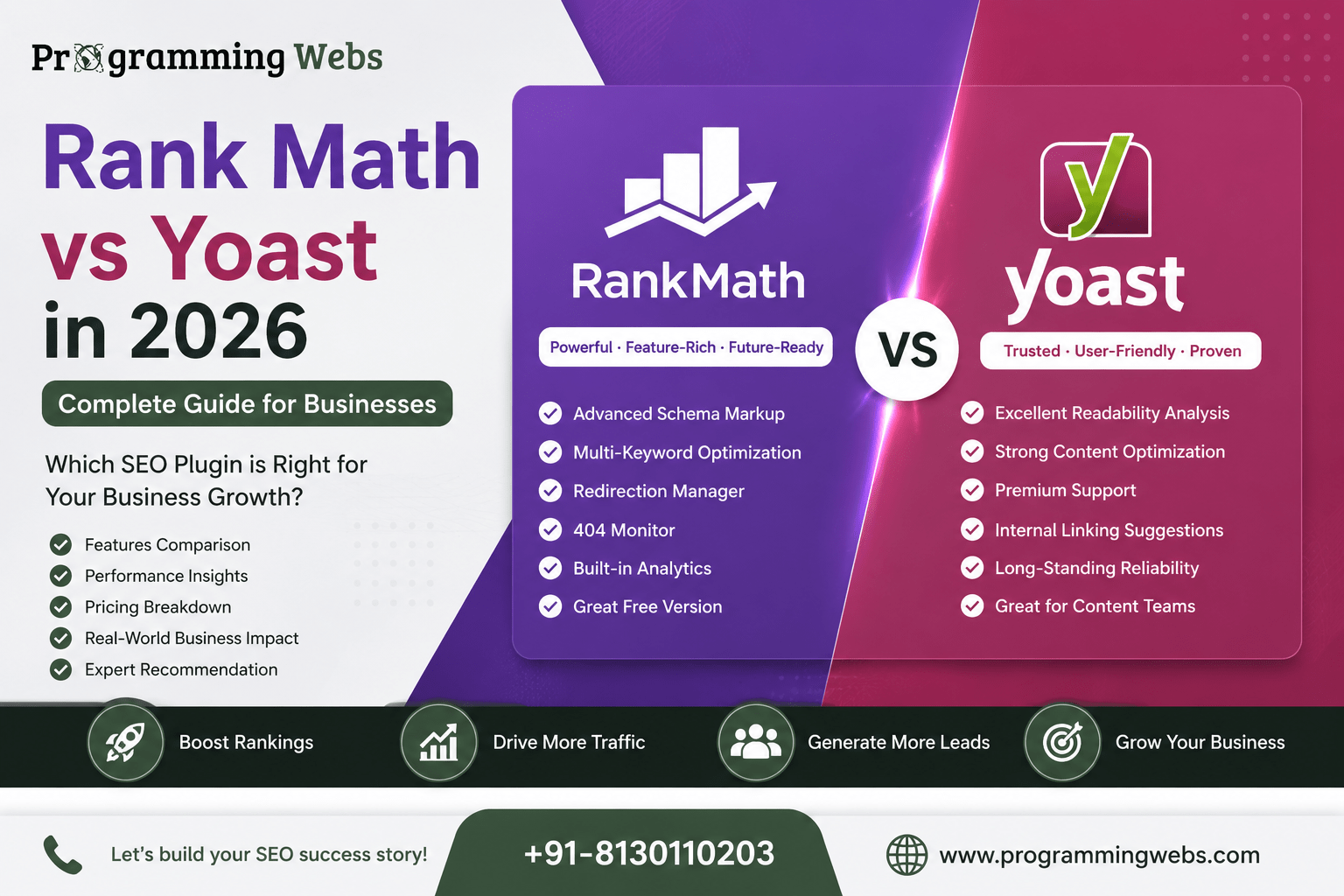
| Feature | Rank Math | Yoast SEO | Edge |
| Setup experience | Guided wizard, modern dashboard | Simpler but older interface | Rank Math |
| Free keywords tracked | Up to 5 per post | 1 per post | Rank Math |
| Schema markup | Advanced built-in generator | Basic – limited customisation | Rank Math |
| Redirection manager | Included in free plan | Paid add-on only | Rank Math |
| 404 monitor | Built-in, no extra plugin needed | Not available natively | Rank Math |
| Performance footprint | Lightweight, minimal DB queries | Slightly heavier legacy code | Rank Math |
| AI suggestions | Available – content & keyword hints | Basic readability analysis | Rank Math |
| Pricing model | Generous free tier + affordable Pro | Free + premium modules sold separately | Rank Math |
| Brand trust & longevity | Rapidly growing since 2018 | Market leader since 2010 | Yoast |
| WooCommerce SEO | Built-in product schema, free | Requires paid WooCommerce addon | Rank Math |
| Multisite support | Available on Pro | Available on Premium | Tie |
1. Schema Markup: The Biggest Practical Difference in 2026
Schema markup is structured data that tells search engines – and increasingly AI search engines – exactly what type of content a page contains. A product page with correct schema can appear with price, rating, and availability directly in search results. An FAQ page with FAQ schema can populate People Also Ask boxes. A recipe with Recipe schema can surface in Google’s rich recipe carousel.
Rank Math’s schema generator is, as of 2026, significantly more capable than Yoast’s in the free tier. You can configure multiple schema types on a single page, create custom schema fields, and apply schemas globally across post types through templates. Yoast supports basic Article and breadcrumb schema by default; advanced schema requires the paid Yoast Premium plus, in many cases, additional add-ons.
Client result: An e-commerce store we migrated to Rank Math saw a 34% increase in rich result appearances within 60 days of implementing structured product and review schema correctly – features they had not previously had access to on Yoast’s free plan.
2. Multi-Keyword Optimisation: Why One Focus Keyword Is Not Enough
A post targeting ‘SEO services for small businesses’ also needs to rank for ‘affordable SEO for SMBs’, ‘small business SEO consultant’, and related variants. With Yoast’s free version, you enter one focus keyword and optimise around that. With Rank Math’s free version, you can track up to five simultaneously – and the plugin analyses your content against each one.
This matters practically for content clusters, product pages targeting multiple buyer-intent variants, and blog posts designed to capture a range of long-tail terms. The analytical depth that Rank Math provides per keyword – density check, heading inclusion, image alt text, URL analysis – multiplied across five terms creates a noticeably more thorough optimisation workflow.
3. Performance: How Each Plugin Affects Your Page Speed
Both plugins load assets in the WordPress admin and, to a lesser extent, on the front end. Rank Math has consistently benchmarked with a lighter footprint – fewer database queries per page load and a smaller front-end CSS and JavaScript payload than Yoast in equivalent configurations.
In isolation, neither plugin is a meaningful page speed problem. The performance difference becomes relevant when you compound it with other plugins, a page builder, and a shared hosting environment. In those contexts, every unnecessary query and every additional kilobyte of front-end CSS has a marginal negative effect on Core Web Vitals scores. Rank Math’s lighter architecture is a small but genuine advantage for performance-sensitive sites.
Practical note: If your website is already achieving a 90+ Google PageSpeed score, the performance difference between these plugins is unlikely to move your rankings. If your site is in the 60–75 range and you are working on Core Web Vitals remediation, switching to Rank Math removes one small friction point from a larger set of issues.
4. The Redirect Manager and 404 Monitor: An Underrated Advantage
Broken links are both a user experience problem and an SEO problem. When a page moves or is deleted without a proper redirect, any link equity pointing to that URL is lost. A 404 error on a previously indexed page signals instability to crawlers and erodes user trust.
Rank Math includes both a redirect manager and a 404 monitor in its free version. The 404 monitor logs every broken URL that a visitor or crawler encounters, and the redirect manager lets you create the fix immediately – 301, 302, or custom – without installing a separate plugin. On Yoast, redirect management requires Yoast Premium, which starts at €99 per site per year as of 2026.
For any website that publishes and updates content regularly – a blog, an e-commerce catalogue, a service directory – this functionality is not optional. Having it free and built-in versus paid and add-on is a meaningful cost and complexity difference.
5. Pricing: What You Actually Pay on Each Platform
Yoast SEO’s free version is a capable starting point, but core features that most growing sites need are gated. Yoast Premium costs approximately €99 per site per year and adds internal linking suggestions, redirect management, and additional focus keywords. If you need WooCommerce SEO features, that requires a separate add-on at additional cost. For an agency managing 10 client sites, the annual Yoast licence cost can reach several thousand euros.
Rank Math’s free version includes the redirect manager, 404 monitor, schema generator, multi-keyword tracking, and WooCommerce product SEO. Rank Math Pro starts at approximately $59 per year for unlimited personal sites and adds advanced analytics, keyword rank tracker, and extended schema options. The value density of Rank Math’s free tier is, by any objective measure, higher.
Lifetime cost check: For a business managing 5 WordPress websites over 3 years, Rank Math’s Pro plan costs approximately $177 total. Equivalent Yoast functionality across 5 sites over 3 years – including Premium and WooCommerce add-ons – costs approximately €1,485. That is a meaningful difference for an SMB budget.
Real-World Results: What Happened When Our Clients Switched
Case Study 1: E-commerce Store Migration (Yoast to Rank Math)
A fashion accessories retailer came to us with 4,200 monthly organic sessions and stagnant rankings for their product category pages. They were on Yoast free and had not implemented product schema because the configuration required a paid add-on they had not budgeted for.
We migrated to Rank Math, implemented Product schema with Review aggregate markup on their 80 highest-priority products, and set up proper category page schema. We also resolved 43 broken internal links that the 404 monitor identified within the first week. After 90 days:
- Monthly organic sessions grew from 4,200 to 9,800
- Rich result appearances increased by 67%
- Average click-through rate from search improved from 2.1% to 3.8%
- Three category pages moved from position 8–12 to positions 3–5
Case Study 2: B2B Services Site (Stayed on Yoast)
A management consulting firm with a 20-page website and a small content team of two writers came to us for an SEO audit. They had been on Yoast Premium for three years and had invested significant time in configuring their setup. Their writers were deeply familiar with Yoast’s editorial interface and produced two to three well-optimised articles per month.
We recommended they stay on Yoast. The migration overhead, retraining cost, and disruption to their established workflow would not have been justified by the marginal gains available for a site of their size and output volume. Our work with them focused on content strategy and backlink acquisition – not tool switching.
The honest answer sometimes is: the plugin you have is fine. Change it when the features gap costs you measurable results.
Which Plugin Should Your Business Use? A Practical Framework
E-commerce stores (WooCommerce or Shopify via WordPress)
Rank Math is the clear choice. Native product schema, review markup, and WooCommerce SEO tools are available in the free tier. Rich results for product pages – price, availability, rating – are directly tied to conversions on Google Shopping surfaces.
Content-driven blogs and editorial publishers
Rank Math for the technical breadth; Yoast remains defensible if your team is already embedded in its readability workflow and editorial suggestions. The multi-keyword capability in Rank Math is the strongest argument for switching.
Local service businesses
Rank Math’s local SEO schema (LocalBusiness, Service, OpeningHours) is available free and integrates well with Google Business Profile optimisation. For local businesses running targeted geographical SEO campaigns, the schema depth matters.
SaaS platforms and lead generation sites
Rank Math, for the combination of schema support (SoftwareApplication, FAQ, HowTo) and the redirect manager – critical for SaaS sites that undergo frequent URL restructuring as products evolve.
Enterprises and large multisite networks
Both plugins support multisite. Rank Math Pro’s site-wide schema templates and bulk SEO editing features make it more efficient to manage at scale. Yoast’s enterprise offerings exist but are priced significantly higher.
How to Optimise for AI Search in 2026 (GEO – Generative Engine Optimisation)
AI-powered search results – Google’s AI Overviews, Perplexity, ChatGPT’s browsing mode – pull structured, authoritative content from pages they can crawl and parse efficiently. Your SEO plugin plays a direct role in how well your content is structured for these systems.
Practical GEO steps that work with both plugins
- Use FAQ schema on every informational page – AI systems map FAQ schema directly to conversational query responses
- Structure content with explicit H2 and H3 headings that mirror the questions your audience asks – both plugins support heading analysis
- Add HowTo schema to any process-oriented content – Rank Math’s schema generator makes this a 5-minute task; Yoast requires manual JSON-LD
- Ensure your author byline and About page contain expertise signals (credentials, experience, contact) – E-E-A-T signals feed both traditional and AI ranking systems
- Publish structured data on all key landing pages – AI search engines weight pages that explicitly declare their content type over pages that expect inference
2026 SEO Context: What Has Changed That Makes Plugin Choice More Consequential
Three shifts in the 2025–2026 period have raised the stakes for technical on-page SEO configuration. First, Google’s AI Overviews now appear on a significant proportion of informational queries – pages with structured data and clear content architecture are more likely to be cited. Second, Google’s continued enforcement of Core Web Vitals as a ranking signal means every additional plugin weighing down page load matters. Third, the proliferation of AI-generated content has raised the floor for what counts as ‘good enough’ – structured, expertise-signals-rich content now differentiates more clearly than volume alone.
In this environment, a plugin that makes schema implementation frictionless, keeps page weight minimal, and supports multi-signal optimisation in its free tier has a genuine competitive advantage. That describes Rank Math more accurately than Yoast in 2026.
Related Resources from ProgrammingWebs
If you are building or improving your wider SEO and digital marketing setup alongside this plugin decision, these resources may help:
WordPress SEO services: programmingwebs.com/services/wordpress-seo/
Full SEO services: programmingwebs.com/services/seo-services/
E-commerce SEO: programmingwebs.com/services/ecommerce-seo/
Local SEO services: programmingwebs.com/services/local-seo-services/
Website maintenance and optimisation: programmingwebs.com/services/website-maintenance-optimization/
Conversion rate optimisation: programmingwebs.com/services/conversion-rate-optimization/
Further reading from our blog:
Elementor vs Divi 2026: programmingwebs.com/elementor-vs-divi-in-2026-the-complete-guide-every-business-owner-needs-before-building-their-website/
Cloud Hosting vs Shared Hosting 2026: programmingwebs.com/cloud-hosting-vs-shared-hosting-in-2026/
WooCommerce vs Shopify 2026: programmingwebs.com/woocommerce-vs-shopify-in-2026-complete-guide-for-businesses/
Frequently Asked Questions
Is Rank Math better than Yoast SEO in 2026?
For most websites, yes. Rank Math’s free tier includes schema generation, multi-keyword optimisation, redirect management, and a 404 monitor – all of which require Yoast Premium or separate add-ons on Yoast. The main exception is teams deeply embedded in Yoast’s editorial workflow, where the switching cost may outweigh the feature gain.
Can I migrate from Yoast to Rank Math without losing my SEO data?
Yes. Rank Math includes a migration wizard that imports your Yoast meta titles, meta descriptions, focus keywords, and settings automatically. The migration takes under five minutes on most sites. We recommend testing in a staging environment first and verifying your most important pages in Google Search Console after the switch.
Does Yoast SEO slow down a WordPress website?
Modestly. Yoast’s legacy codebase adds slightly more database queries and front-end CSS than Rank Math in comparable configurations. In most environments the difference is under 100ms – not a primary cause of slow load times. If your site has a serious speed problem, hosting infrastructure, image optimisation, and caching are higher-priority fixes than switching SEO plugins.
Which SEO plugin is better for WooCommerce stores?
Rank Math. Native WooCommerce SEO features including product schema, breadcrumb markup, and category page optimisation are available in the free version. The equivalent functionality on Yoast requires purchasing the WooCommerce SEO add-on separately.
Do SEO plugins guarantee better rankings?
No. An SEO plugin is infrastructure, not a ranking strategy. It ensures your pages are correctly configured for search engines to read. Whether those pages rank depends on the quality and relevance of your content, your site’s authority relative to competitors, and the technical health of your overall setup. We see well-configured Rank Math sites underperform against weaker Yoast setups regularly – because content and backlinks outweigh plugin choice in almost every case.
What is the best SEO plugin for a new WordPress site in 2026?
Rank Math is our recommendation for new sites. Installing it from day one means you benefit from correct schema configuration, multi-keyword optimisation, and redirect management before you have accumulated legacy configuration decisions to untangle. The setup wizard walks you through the initial configuration in under ten minutes.
Is Rank Math free or paid?
Rank Math has a free version that includes the majority of its core features. Rank Math Pro starts at approximately $59 per year for unlimited personal sites and adds a keyword rank tracker, advanced analytics, and extended schema options. For most small to mid-size businesses, the free version is sufficient to begin with.
About This Guide
This comparison was written by ProgrammingWebs’ SEO team based on direct experience managing and auditing WordPress websites for clients in e-commerce, B2B, SaaS, and local services sectors. Performance figures referenced come from Google Search Console data collected from client projects between 2024 and 2026. Pricing figures are accurate as of June 2026 – verify current pricing on each plugin’s official website before purchase decisions. We receive no referral fees from either Rank Math or Yoast.
Want an SEO setup that actually drives organic growth?
ProgrammingWebs goes beyond plugin configuration – we build full SEO strategies that generate traffic, leads, and revenue for SMBs, e-commerce brands, and growing startups.
Explore our SEO services → programmingwebs.com/services/seo-services/
Start a project → programmingwebs.com/contact/
© 2026 ProgrammingWebs. All rights reserved. | programmingwebs.com