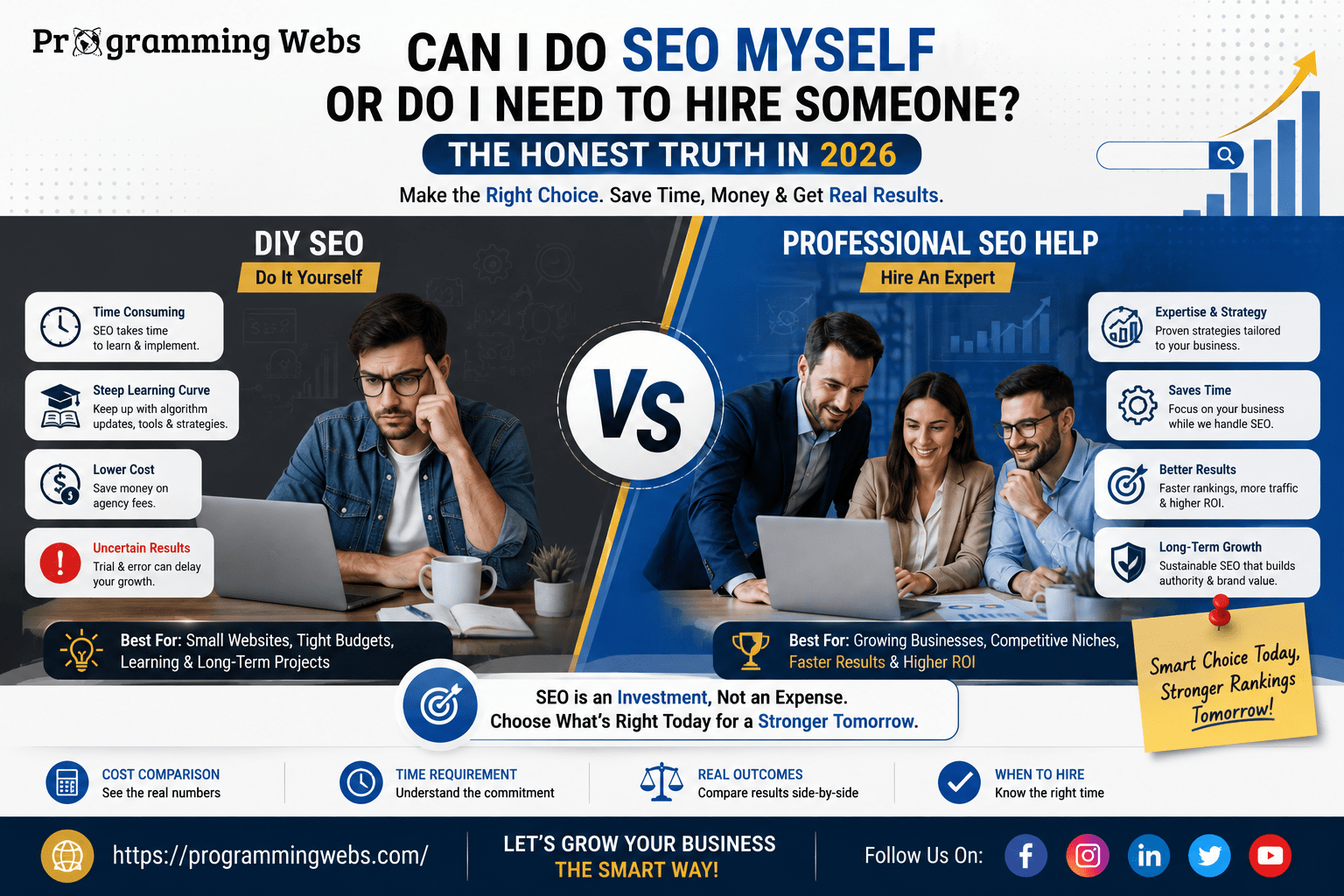
The Question That Keeps Business Owners Awake at Night
I was having coffee with a client recently, and mid-conversation she said something I hear at least twice a week:
“I’ve been doing SEO myself for six months. It’s gotten me nowhere. Now I’m wondering if I wasted my time or if I just need to hire someone.”
Here’s the uncomfortable truth nobody tells you: Both paths can work. Both paths can fail. Everything depends on your specific situation.
This isn’t a simple “hire an agency” or “do it yourself” question. It’s a strategic decision that should be based on your business goals, available time, existing skills, and financial situation—not on emotions or what you read on the internet.
In this guide, I’m going to give you the real picture. Not a sales pitch, but an honest analysis of what DIY SEO actually requires, what professional SEO Services actually deliver, and how to make the right choice for YOUR business.
The DIY SEO Reality: What You’re Actually Signing Up For
Let’s start with a hard truth: SEO is not a simple, one-time task.
It’s a continuous practice that requires:
Technical Knowledge
- Understanding of how search engines crawl websites
- Ability to identify technical issues (server errors, crawl issues, site structure problems)
- Knowledge of page speed optimization, mobile optimization, Core Web Vitals
- Understanding of site architecture and internal linking strategies
Content Strategy Skills
- Keyword research methodology
- Content gap analysis
- Topic clustering and topical authority
- Search intent understanding
- Content performance tracking
Tool Proficiency
- Using keyword research tools
- Backlink analysis tools
- SEO audit tools
- Analytics and reporting platforms
- Search console monitoring
Time Investment
- 8-15 hours per week minimum for meaningful progress
- Continuous learning (algorithms change constantly)
- Competitor analysis
- Link building and relationship building
Soft Skills
- Patience (results take 3-6 months minimum)
- Consistency (SEO requires sustained effort)
- Data analysis and interpretation
- Communication of results to stakeholders
If you’re ready to commit to all of this, DIY SEO is possible. If you’re hoping for quick wins with minimal effort, you’re setting yourself up for disappointment.
Real Time Investment: What DIY SEO Actually Costs You
Let’s talk about the elephant in the room: your time.
Weekly Time Breakdown for DIY SEO
| Activity | Hours/Week |
|---|---|
| Keyword Research | 2-3 |
| Content Creation | 4-6 |
| On-Page Optimization | 1-2 |
| Technical SEO Issues | 1-3 |
| Link Building/Outreach | 2-4 |
| Analytics & Reporting | 1-2 |
| Continuous Learning | 1-2 |
| Total | 12-22 hours/week |
For a business owner earning $50-150/hour, this represents $600-3,300 worth of your time every single week.
That’s $31,200-171,600 per year in opportunity cost.
Many business owners don’t think about this calculation. They see DIY SEO as “free,” but you’re not spending money—you’re spending the most valuable asset you have: time.
The Skills Gap: Honest Assessment of Your SEO Knowledge
Before diving into DIY, ask yourself these questions:
On Technical SEO:
- Can you identify crawl errors in Google Search Console and fix them?
- Do you understand Core Web Vitals and how to optimize for them?
- Can you identify duplicate content issues and implement proper redirects?
- Do you understand server architecture and hosting impact on SEO?
On Content Strategy:
- Can you accurately determine search intent for target keywords?
- Do you know how to conduct proper keyword research without guessing?
- Can you identify content gaps between your site and competitors?
- Do you understand topical authority and how to build it?
On Link Building:
- Do you have relationships in your industry to earn natural links?
- Can you identify high-quality link opportunities vs. low-quality ones?
- Do you understand anchor text ratios and link velocity?
- Can you conduct outreach campaigns that actually convert?
On Analytics:
- Can you set up proper conversion tracking?
- Do you understand the difference between correlation and causation in data?
- Can you interpret GA4 data accurately?
- Can you calculate actual ROI of SEO efforts?
Honest assessment: If you answered “no” to more than 3 questions, you’re probably looking at a steep learning curve. That’s not a judgment—it’s just reality.
When DIY SEO Actually Works: Three Specific Scenarios
Scenario 1: You Have Existing Marketing Expertise
If you already understand digital marketing, have experience with analytics, and know your industry deeply, DIY SEO is much more achievable.
Why it works:
- You understand business fundamentals
- You can translate industry knowledge to search intent
- You already have tool experience
- Learning SEO-specific tactics is incremental, not foundational
Time required: 8-12 hours/week Timeline to results: 4-6 months Success rate: Moderate-to-high (60-75%)
Reality check: You still need to learn SEO specifics. Marketing expertise from 5 years ago might not translate to 2026’s algorithm.
Scenario 2: Your Niche Is Low-Competition
If you’re operating in a niche where:
- Search volume is low but targeted
- Competition for keywords is minimal
- Your industry isn’t saturated with optimized content
- Backlink requirements are low
Then DIY SEO has better odds of working.
Example: A local accountant in a small town or a specialized B2B service in a niche vertical
Why it works:
- Ranking requirements are lower
- You don’t need massive backlink profiles
- Content optimization can be simpler
- You have more room for error
Time required: 5-8 hours/week Timeline to results: 3-4 months Success rate: High (70-80%)
Reality check: Even in low-competition niches, basic technical SEO and content optimization are non-negotiable.
Scenario 3: You Have Budget for Tools + Training + Time
If you can invest in:
- Quality SEO tools ($100-200/month)
- SEO training or courses ($500-2,000)
- Outsourced tasks you can’t handle (link building, technical work)
- Your own significant time commitment
Then a hybrid approach (some DIY, some outsourced) can work well.
Why it works:
- You’re not trying to do everything alone
- Professional tools give you professional-level insights
- Training accelerates your learning curve
- You focus on what you’re good at
Time required: 10-15 hours/week Investment: $1,500-3,000/month Timeline to results: 4-6 months Success rate: Moderate-to-high (65-75%)
The Brutal Failures: When DIY SEO Doesn’t Work
I’ve seen a lot of DIY SEO attempts fail. Here’s what typically goes wrong:
Failure Pattern 1: “Content Creation Without Strategy”
What happens: Business owner creates blog posts based on what they think is important, not what customers are actually searching for.
Result: 150 blog posts written, 3 getting traffic.
Why it fails: Without keyword research methodology, you’re writing for an audience that isn’t searching.
Cost:
- 1.5 years of your time
- ₹50,000-100,000 in freelance writing costs
- Zero results
- Demoralized team
Failure Pattern 2: “Ignoring Technical Foundation”
What happens: Focus entirely on content while technical issues pile up: slow site speed, mobile issues, crawl errors, poor site structure.
Result: Google can’t effectively crawl or index the site. Content doesn’t rank regardless of quality.
Why it fails: Technical SEO is prerequisite, not optional. Without proper Website Development fundamentals, content optimization doesn’t matter.
Cost:
- 6-12 months of wasted content efforts
- Need to hire developer to fix problems later ($3,000-10,000)
- Site architecture changes required (expensive recovery)
Failure Pattern 3: “Chasing Algorithm Updates”
What happens: DIY SEO person constantly pivots strategy based on every Google update, forum post, or YouTube video they see.
Result: Inconsistent execution, constantly starting over, never reaching maturity in any strategy.
Why it fails: SEO requires consistency. Constantly changing tactics prevents any strategy from working.
Cost:
- 12-24 months of spinning wheels
- No authority built
- Frustration and burnout
- Eventually hiring professional (who has to undo bad decisions)
Failure Pattern 4: “No Link-Building Strategy”
What happens: Focus on creating content but never building links to it. Competitor sites have 3-5x more backlinks.
Result: Content is good, but doesn’t rank because it lacks authority signals.
Why it fails: In competitive niches, backlinks are still essential. Without relationships or outreach system, you can’t earn them.
Cost:
- 12+ months of content creation with minimal results
- Need professional SEO Services to add link building later
- Years behind schedule
Professional SEO: What You Actually Get (And Why It’s Not Cheap)
If you hire a professional SEO agency, here’s what legitimate, honest services include:
SEO Audit & Strategy ($2,000-5,000 upfront)
What it includes:
- Technical SEO audit (site crawl, performance analysis, mobile optimization)
- Competitive backlink analysis
- Content gap analysis
- Search intent research
- On-page audit of existing pages
- Detailed roadmap with timeline and projected outcomes
Why it costs this much:
- 40-60 hours of specialist time
- Professional tools access (Ahrefs, SEMrush, etc.)
- Competitive intelligence
- Custom strategy specific to your business
Monthly SEO Services ($1,500-10,000+)
What legitimate agencies include:
- Ongoing technical SEO optimization
- Content strategy and creation (or planning)
- On-page optimization of existing pages
- Link building and outreach
- Monthly reporting and analysis
- Monthly strategy calls
- Search console monitoring
Why it varies so much:
- Competitive intensity of your industry
- Number of target keywords
- Scope of content production
- Link building effort required
- Your starting point (penalty recovery costs more)
Real Pricing Comparison: DIY vs. Professional
Let’s do actual math for different business scenarios.
Scenario: Local Service Business
DIY Approach (Annual):
- Your time: 10 hrs/week × $75/hr × 52 weeks = $39,000
- Tools (Google Search Console, Ubersuggest, basic analytics) = $1,200
- Hosting/website platform = $2,400
- Learning/training = $1,000
- Total: $43,600
- Results: Moderate (maybe 20-30% traffic increase)
Professional Agency (Annual):
- Initial audit: $3,000
- Monthly retainer: $2,500/month × 12 = $30,000
- Total: $33,000
- Results: High (typically 80-150% traffic increase)
Key insight: Professional SEO often costs LESS when you factor in your time value, and delivers significantly better results.
Scenario: E-commerce Store (Shopify)
DIY Approach (Annual):
- Your time: 15 hrs/week × $100/hr × 52 weeks = $78,000
- Shopify SEO tools and apps = $2,400/year
- Tool subscriptions = $2,000
- Content/product photography = $3,000
- Total: $85,400
- Results: Low-to-moderate (maybe 10-20% revenue increase)
Professional Shopify Development + Ecommerce SEO (Annual):
- Platform setup/optimization: $5,000
- Monthly Ecommerce SEO Services: $3,500/month × 12 = $42,000
- Total: $47,000
- Results: High (typically 150-300% revenue increase)
Key insight: E-commerce is complex. Professional expertise typically delivers ROI that DIY can’t match.
The Honest Breakdown: What Professionals Do That DIY Misses
1. Systematic Keyword Research
DIY approach: “Let me think about what people might search for…”
Professional approach:
- Analyze 1,000+ search queries
- Understand search intent at scale
- Identify high-intent, low-competition keywords
- Build keyword clusters for topical authority
- Map keywords to customer journey stages
Impact: 300-500% more qualified keyword targeting
2. Competitive Intelligence
DIY approach: “Let me check what my top competitor is doing…”
Professional approach:
- Analyze top 20 competitors
- Backlink profile comparison across competitors
- Content strategy gap analysis
- Ranking history and volatility
- Link acquisition patterns and sources
Impact: Identify opportunities competitors are missing (potential 50-100% traffic advantage)
3. Link Building Execution
DIY approach: “I’ll reach out to some websites and ask them to link to me…”
Professional approach:
- Built relationships with journalists, bloggers, site owners
- Digital PR campaigns
- Broken link replacement with relevance
- Guest posting strategy on authoritative sites
- Digital asset creation designed for linking (original research, tools, data)
Impact: Authority building that takes solo person 2+ years happens in 6-9 months
4. Technical SEO Optimization
DIY approach: “I’ll install a plugin and see what it tells me…”
Professional approach:
- Server-level optimization (caching, compression, CDN)
- Site architecture redesign if needed
- Core Web Vitals optimization
- Mobile optimization beyond basic responsive design
- Crawl efficiency optimization
- Structured data implementation for rich results
Impact: 30-50% performance improvement many DIYers never achieve
5. Content Optimization at Scale
DIY approach: “I’ll optimize a few pages…”
Professional approach:
- Audit and optimize 100+ existing pages
- Rewrite underperforming content
- Implement advanced on-page elements (tables, FAQs, video, structured data)
- Internal linking strategy optimization
- Target featured snippets systematically
Impact: 5-10x more optimized content, compounding ranking improvements
Decision Framework: Should YOU Do SEO Yourself?
Do DIY SEO if:
✅ You’re in a low-competition niche ✅ You have 10+ hours/week available ✅ Your business model doesn’t depend on organic traffic urgently ✅ You have existing marketing expertise ✅ You’re willing to invest in quality tools ($100-200/month) ✅ You have patience for 6-12 month results ✅ You can handle the learning curve and stay current ✅ Your website doesn’t require complex technical work
Hire Professional SEO Services if:
✅ You’re in a competitive industry ✅ You don’t have 10+ hours/week available ✅ Your business needs revenue growth within 6 months ✅ You lack marketing expertise ✅ You have technical SEO issues (your website is complex) ✅ Link building is critical (you lack industry relationships) ✅ You want professional guarantee and accountability ✅ Your website is WordPress, Shopify, or complex platform requiring expertise
Hybrid Approach: DIY + Professional (The Smart Path)
Here’s what many successful businesses do:
Hire professionals for:
- Initial SEO audit and strategy ($2,000-5,000)
- Technical Website Development fixes ($5,000-15,000)
- Link building campaigns ($2,000-5,000/month for 3-6 months)
Do yourself:
- Content creation (you know your industry best)
- Regular analytics monitoring
- Minor on-page optimizations
- Answering customer questions (feeds content ideas)
Cost: $10,000-30,000 upfront + $2,000-5,000/month for link building Timeline: 6-9 months to significant results Success rate: High (75-90%)
This approach gets you professional-level results without requiring you to become an SEO expert.
Geographic Reality: DIY SEO for Local Businesses
If you’re a local service business (plumber, accountant, lawyer, salon, etc.):
DIY Local SEO Services is more achievable because:
- Competition is lower (only competing locally)
- Ranking factors are more straightforward
- Google My Business optimization is primary (not complex)
- You have local authority by existing in the community
- Backlink requirements are lower
Time required: 3-5 hours/week Success probability: 60-70% Timeline: 2-4 months
However: If your city is competitive (Delhi, Mumbai, Bangalore), professional Local SEO Services still provides significant advantages.
The Reality of Learning SEO in 2026
If you’re thinking “I’ll just take an online course and figure this out,” here’s the reality:
Investment required:
- Course: $200-2,000
- Tool subscriptions: $1,500-3,000/year
- Time to proficiency: 6-12 months
- Time to mastery: 2-3 years
- Continuous learning (algorithms update constantly): Ongoing
The problem: By the time you’ve learned SEO well enough to execute it, you could have hired professionals 3-4 years ago and already be reaping the benefits.
The opportunity cost is real.
Case Studies: DIY vs. Professional Outcomes
Case Study 1: Manufacturing B2B Company
The situation: Mid-sized manufacturer tried DIY SEO for 12 months. Hired ProgrammingWebs.
DIY Results (12 months):
- Time invested: 800 hours
- Keywords ranking: ~50
- Traffic increase: 15%
- Lead increase: Minimal
- Cost: ~$60,000 in labor opportunity cost + $2,000 tools
Professional SEO (Next 12 months):
- Keywords ranking: 450+
- Traffic increase: 280%
- Lead increase: 420%
- Cost: $45,000
- ROI: Broke even in month 4, generated $850K additional revenue
Case Study 2: E-commerce Store
The situation: Shopify store owner tried Shopify SEO herself for 8 months.
DIY Results:
- Keywords ranking: 12
- Monthly organic visitors: 200-300
- Conversion rate: 0.5%
- Revenue from organic: ₹8,000/month
After hiring Ecommerce SEO Services:
- Month 3: 80 keywords ranking, 2,000 visitors/month
- Month 6: 180 keywords ranking, 4,500 visitors/month
- Conversion rate: 2.2% (optimized landing pages)
- Revenue from organic: ₹2,50,000/month
- Cost: ₹80,000/month
Case Study 3: Content Creator/Blogger
The situation: Blogger wanted to monetize blog through sponsored content and affiliate links.
DIY Approach:
- 2 years of blog content creation
- 150+ articles written
- Traffic: 800-1,200/month
- Revenue potential: Low (minimal traffic)
- Time cost: 1,000+ hours
Professional Content Strategy (hybrid):
- Hired ProgrammingWebs for strategy, keyword research, link building
- Creator focused on writing high-quality content
- Month 6: 5,000 monthly visitors
- Month 12: 18,000 monthly visitors
- Month 18: 35,000 monthly visitors
- Revenue: Now viable for sponsorship deals
Why Professionals Cost What They Cost (Real Expenses)
If you’re wondering why professional SEO Services aren’t cheaper, here’s where the money actually goes:
Tool Costs:
- Ahrefs: $199-399/month
- SEMrush: $120-249/month
- Majestic: $50-300/month
- Additional tools: $100-200/month
- Monthly tool cost: $500-1,000
Human Resources:
- SEO specialists: ₹30,000-80,000/month salary
- Content writers: ₹15,000-40,000/month each
- Link builders: ₹20,000-50,000/month
- Project manager: ₹25,000-60,000/month
- For one client team: ₹100,000-250,000+/month
Infrastructure & Overhead:
- Office/remote setup
- Training and continuing education
- Client management software
- Legal and compliance
- Profit margin (yes, agencies need to make money)
Quality Accountability:
- Risk of missed targets
- Continuous optimization required
- Reporting and transparency
- Money-back guarantees (some agencies offer these)
When a quality agency charges ₹50,000-200,000/month, they’re often operating on reasonable margins while delivering professional expertise.
Red Flags: When Professionals Are Overcharging
Be cautious of:
- Guaranteed rankings in specific timeframe
- No audit or strategy work upfront (just “start doing SEO”)
- No reporting or transparency
- Monthly retainer with no defined deliverables
- Focus on keyword count rather than business results
- Pressure to sign long-term contracts without trial period
- No discussion of realistic timelines
Good agencies:
- Start with audit and strategy
- Have transparent reporting
- Focus on business metrics (traffic, leads, revenue)
- Are willing to work on trial basis
- Communicate realistic timelines (6-9 months minimum)
- Adjust strategy based on results
- Can show portfolio of real results
The E.E.A.T. Factor: Why Experience Matters in SEO
Google’s algorithm increasingly rewards E.E.A.T.:
Expertise: Has the person solving your SEO actually done this before successfully?
Authoritativeness: Are they recognized in the SEO industry?
Trustworthiness: Do they have proven track record and client testimonials?
Experience: How many years solving SEO problems?
A solo DIY approach brings zero E.E.A.T. to your website.
Professional services bring:
- Proven methodology (expertise)
- Industry recognition (authority)
- Client case studies (trust)
- Years of experience (experience)
This actually helps your website’s rankings indirectly—search engines trust sites built and optimized by experienced professionals more than those managed by inexperienced owners.
Modern SEO in 2026: New Challenges DIY Misses
The SEO landscape has changed significantly:
AI Integration:
- Google now using AI to understand content quality and intent
- AI tools generating content (good and bad)
- Professional SEO requires understanding AI’s role in ranking
Multi-Channel Search:
- Google traditional search
- Google Discover
- Perplexity and Claude AI search
- TikTok and YouTube search
- Optimization for each channel differs
Technical Complexity:
- Core Web Vitals essential
- Mobile-first indexing critical
- Site architecture impacts crawl budget
- Server infrastructure affects rankings
Topical Authority:
- Google rewards sites with demonstrated expertise in specific topics
- Requires sophisticated content clustering
- Links must be from topically relevant sources
E.E.A.T. & Author Expertise:
- Author credentials matter more than ever
- Content must demonstrate genuine expertise
- Brand reputation affects SEO
Most DIY SEO isn’t addressing these modern factors.
Your Action Plan: Making the Decision
Week 1: Honest Assessment
- How much time do you realistically have? (Be honest)
- Is your business competitive or niche?
- What’s the opportunity cost of your time?
- Do you have the skills or willingness to learn?
Week 2: Research Options
- Get quotes from 3-5 professional agencies
- Review our portfolio and case studies
- Understand what’s included in different service levels
- Check pricing options
Week 3: Try Hybrid Approach
- Get professional SEO audit (usually $1,000-3,000)
- Identify quick wins you can implement yourself
- Determine what requires professional help
- Plan 6-month strategy
Week 4: Decision & Execution
- Decide: Full DIY, hybrid, or full professional
- Set realistic timeline expectations
- Start executing with clear metrics
- Commit to consistent effort
Special Services That Bridge DIY & Professional
At ProgrammingWebs, we understand not everyone is ready for full retainer services. That’s why we offer:
A La Carte Services
- Website Development: One-time build/optimization
- WordPress Development: One-time platform setup
- Landing Page Design: High-converting pages
- Conversion Rate Optimization: Maximize existing traffic
- Website Maintenance & Optimization: Ongoing technical health
Specialized Services
- Shopify Development: E-commerce specific
- Local SEO Services: Geographic optimization
- Meta Ads Management & Google Ads Management: Paid + organic hybrid
- Social Media Marketing: Multi-channel approach
These let you get professional help where you need it while keeping other aspects in-house.
The Bottom Line: An Honest Conclusion
Do SEO yourself if:
- You have time, patience, and can manage the learning curve
- Your niche is low-competition
- Timeline to results isn’t critical
- You enjoy continuous learning
Hire professionals if:
- Time is your constraint
- You’re in competitive industry
- You need results within 6 months
- Business growth depends on rankings
- Technical complexity is high
Best approach for most businesses: Hybrid model—get professional strategy and implementation support, then manage ongoing efforts with professional guidance.
Ready to Decide? We Can Help
If you’re still unsure about which path makes sense for your business, contact us for a free consultation.
We’ll:
- Review your current situation
- Be honest about what’s realistic for DIY vs. professional
- Recommend the best approach for YOUR business
- Quote services if professional help makes sense
We’re equally happy if you decide to do it yourself. Our goal is your success, not just selling you services.
→ Schedule Your Free SEO Consultation
Resources to Help You Decide
- Best SEO Tools in 2026 — If you go DIY
- Free SEO Tools in 2026 — Budget-friendly options
- Technical SEO Tools — For technical issues
- Keyword Research Tools — Finding the right keywords
- Backlink Tools — Building authority
- Local SEO Tools — Geographic businesses
- AI SEO Tools — 2026’s newest approach
Last Updated: June 2026 | Written By: ProgrammingWebs Team | Reviewed For: Honest, data-backed, business-focused advice