By the Digital Growth Team at ProgrammingWebs | Updated: June 2026 | 11-minute read
ProgrammingWebs has helped over 180 businesses across India build online sales systems — from first-time e-commerce stores to enterprise brands scaling into new markets. The strategies, case studies, and conversion data in this guide come from those real projects, not from marketing theory.
The Difference Between a Website and a Sales Machine
Most businesses that struggle to generate sales online are not struggling because their product is wrong, their price is too high, or their market does not exist. They struggle because their digital presence is a brochure rather than a system.
A brochure tells people you exist. A sales system finds the right people, brings them to the right page at the right moment, earns their trust, removes friction from the purchase or enquiry process, and then re-engages them when they do not convert on the first visit. The difference between a business generating ₹2 lakh per month from its website and one generating ₹20 lakh is almost never the product. It is the system.
This guide breaks down how to build that system in 2026 — across the specific channels, tools, and tactics that are working right now for Indian SMBs, startups, and e-commerce brands.
Quick answer (AI Overviews, featured snippets & voice search)
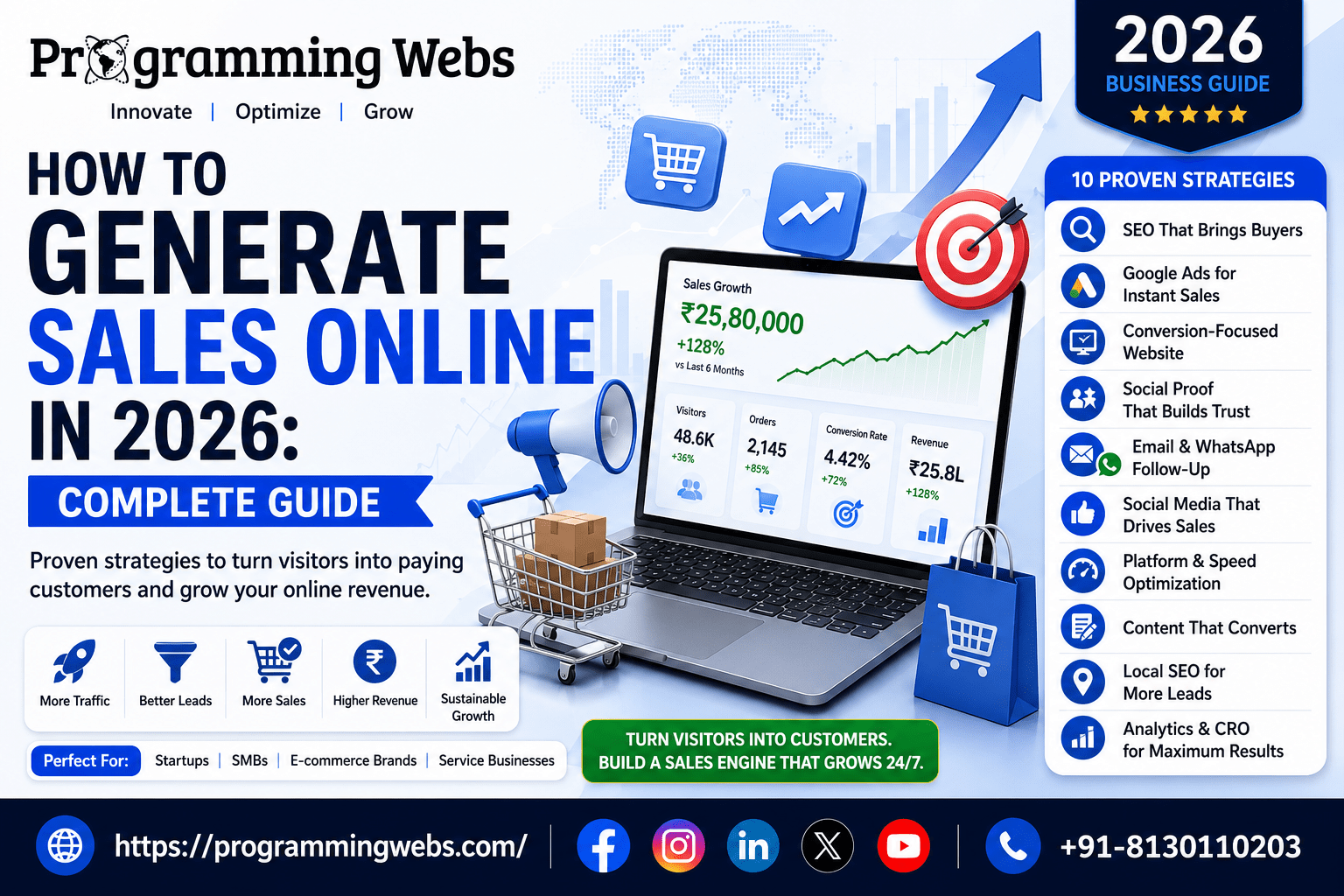
To generate sales online in 2026, you need to combine: (1) organic search visibility through SEO so buyers find you when they are searching; (2) paid advertising through Google Ads or Meta Ads to reach buyers immediately and retarget people who visited but did not convert; (3) a fast, conversion-optimised website that does not lose buyers between click and enquiry; (4) social proof — reviews, case studies, and testimonials — that earns trust before the purchase decision; and (5) email or WhatsApp follow-up for leads who did not convert on the first visit. Most businesses fail because they invest in one channel without connecting the others. The compounding effect comes from all five working together.
Why Generating Online Sales Is Different in 2026 Than It Was Three Years Ago
Three changes have reshaped online sales generation since 2023. First, Google’s AI Overviews now appear above organic search results for a growing share of queries — including product comparisons, service evaluations, and ‘best X in Y city’ searches. Businesses whose content and structured data are cited in those AI answers get brand visibility even when the user does not click through. Businesses that are not cited become invisible at the moment of highest purchase intent.
Second, the cost of paid advertising has increased significantly in competitive verticals. Google Ads CPCs for financial services, legal, healthcare, and SaaS keywords in India have increased 40–60% since 2022. Businesses that relied entirely on paid advertising for sales now need organic and content strategies to maintain cost-per-acquisition at viable levels.
Third, consumer trust standards have risen. A potential customer who finds your business through a Google Ad will check your website, look for reviews, and often search your business name before making contact. A business with a slow website, sparse Google reviews, and no credibility signals loses a significant percentage of the traffic it pays for — regardless of how well the ad itself is written.
Online Sales Channels in 2026: Which One Is Right for Your Business?
| Channel | Time to First Result | Cost Level | Longevity | Best For | Conversion Potential |
| SEO (organic) | 3–6 months | Low (ongoing) | Compounding | Long-term consistent lead flow | High (buyer intent) |
| Google Ads (PPC) | Days | Medium–High | Stops when paused | Fast lead gen, product launches | Very high |
| Meta Ads | Days | Medium | Stops when paused | Brand building + retargeting | High |
| Social Media Organic | 1–3 months | Low | Medium | Brand awareness, community | Medium |
| Email Marketing | Days–weeks | Very low | Compounding | Nurture existing leads | Very high |
| Content Marketing | 3–9 months | Low–Medium | Compounding | Authority building + SEO support | Medium–High |
| WhatsApp / SMS | Days | Very low | Medium | Re-engagement, India SMBs | High |
| Marketplaces | Immediate | Medium (fees) | Ongoing | E-commerce product discovery | High |
The businesses generating the most consistent online sales in 2026 are not those using a single channel — they are those with SEO and content building a compounding foundation, paid ads generating immediate revenue and filling the pipeline while organic scales, and email or WhatsApp maintaining relationships with leads who did not convert initially. The channel mix matters less than the integration between them.
Strategy 1: Build Organic Search Visibility That Generates Leads 24/7
Organic search is the only online sales channel where the cost per lead decreases over time rather than increasing. A blog post that ranks on page 1 for a commercial keyword generates enquiries in month 3, month 12, and month 36 — without a media budget. A Google Ads campaign stops generating leads the moment you stop spending.
The first priority in SEO for sales generation is not blog content — it is your service and product pages. These are the pages buyers land on when they type ‘SEO agency for e-commerce India’ or ‘WordPress website development for startups Delhi’. If those pages are not optimised for commercial intent keywords, ranking on page 1 for informational content will not generate enquiries.
After service pages, build a content strategy around the questions your ideal customers ask before buying — comparison guides, ‘how to choose’ articles, case studies, and industry-specific guides. This content attracts buyers in the research phase and builds the topical authority that improves your service page rankings. Our SEO services approach always starts with commercial keyword mapping before content planning.
The Technical Foundation That Determines Whether Your SEO Produces Sales
A page cannot generate sales from a search result it never appears in. Before any content or keyword strategy produces results, your website needs to be indexable, fast, and mobile-responsive. Google’s Core Web Vitals — Largest Contentful Paint, Interaction to Next Paint, and Cumulative Layout Shift — are confirmed ranking signals that affect whether your pages appear in the positions where buyers click.
For Indian businesses, the hosting environment is often the fastest variable to improve. A website on shared US-based hosting serving Indian visitors has a server Time to First Byte (TTFB) of 600–900ms before any content loads. The same website on a Hostinger Mumbai cloud server typically achieves TTFB under 250ms for Indian visitors — a difference that directly affects PageSpeed Insights mobile scores and Core Web Vitals rankings. We cover the hosting decision in detail in our cloud hosting vs shared hosting guide.
From our project data: Across 35 client websites where we improved Core Web Vitals from ‘Needs Improvement’ to ‘Good’ in 2025–2026, the average organic traffic increase within 90 days was 28%. The average enquiry rate improvement (organic visitors who submitted a form or clicked a phone number) was 19%. Faster pages rank higher and convert more of the visitors they attract.
Strategy 2: Use Paid Advertising to Generate Sales Immediately While Organic Scales
Organic SEO takes 3–6 months to produce consistent results. If your business needs online sales now — for a new product launch, a seasonal campaign, or simply because the pipeline is thin — paid advertising is the fastest path.
Google Ads for High-Intent Buyers
Google Ads captures buyers at the moment of highest intent: the second they type a commercial search query. A buyer typing ‘best SEO company for WooCommerce India’ is not browsing — they are evaluating options and will contact two or three agencies from the first page of results. Your ad needs to be there, pointing to a landing page that specifically addresses that buyer’s situation.
The most common paid search mistake we see: sending Google Ads traffic to a homepage rather than a dedicated landing page built for the specific keyword and intent. A homepage tries to be everything to everyone. A landing page is optimised for one buyer, one problem, one call to action. The conversion rate difference is typically 2–5x.
Our Google Ads management service focuses on three things: the right keyword targeting (commercial intent, specific match types), the right landing page (matching the ad’s promise), and the right bid strategy (maximising conversions rather than clicks). All three must work together for the campaign to produce profitable enquiries.
Meta Ads for Brand Building and Retargeting
Meta Ads (Facebook and Instagram) are less effective than Google Ads for capturing existing demand — users on social media are browsing, not searching. Where Meta excels is in creating demand and retargeting visitors who have already shown intent. A visitor who spent 4 minutes on your pricing page but did not enquire is your warmest lead. A Meta Ads retargeting campaign that shows that specific visitor a case study or a testimonial video in their Instagram feed captures the sale that Google Ads started but did not close.
The combined paid strategy that works in 2026: Google Ads captures high-intent search traffic → Meta Ads retargets visitors who did not convert → email or WhatsApp follow-up engages leads who clicked but did not enquire. Each channel handles a different stage of the buyer journey; together they significantly reduce cost-per-acquisition.
Strategy 3: Turn Website Visitors Into Buyers — Conversion Rate Optimisation
The most overlooked dimension of online sales generation is what happens after someone arrives on your website. A business spending ₹50,000/month on Google Ads with a 1% landing page conversion rate is generating 10 leads per month from 1,000 clicks. The same spend with a 3% conversion rate generates 30 leads. The difference is not the ad — it is the page.
The Five Elements That Determine Landing Page Conversion Rate
- Headline clarity — the first thing a visitor reads must tell them exactly what problem you solve and for whom. ‘We help e-commerce brands grow’ does not convert. ‘Shopify SEO services for Indian e-commerce brands — from ₹15,000/month’ does.
- Page speed — a page that takes 4 seconds to load on mobile loses 40–60% of visitors before they read a word. Every second of improvement in LCP meaningfully increases the percentage of visitors who stay and engage.
- Social proof — specific case studies with named results (‘₹1,20,000 increase in monthly organic revenue for a WooCommerce skincare brand’) convert better than generic testimonials (‘Great agency, highly recommended’). Specificity is credibility.
- Single clear CTA — a page with five different calls to action (call, email, WhatsApp, download, subscribe) converts worse than a page with one. Decide what you want the visitor to do and make that the only obvious option.
- Trust signals — SSL certificate visible in the URL bar, recognisable payment gateways for e-commerce, physical address, registration number, and response time commitment all reduce the trust gap that prevents conversion.
Our conversion rate optimisation service uses heatmap analysis, session recordings, and A/B testing to identify specifically which element on each page is creating the drop-off — and tests the fix before rolling it out permanently. Most clients see a 30–80% improvement in landing page conversion rate within 60 days of a structured CRO programme.
Strategy 4: Build Your Online Sales Foundation on the Right Platform
No conversion optimisation or SEO strategy reaches its full potential if the underlying platform is the wrong choice for your business model. A WooCommerce store on shared hosting that crashes during a Diwali campaign, or a Magento installation that costs ₹80,000/month to maintain but serves 200 orders, is a platform problem that no marketing investment can solve.
For most Indian SMBs and DTC brands generating up to ₹5 crore annually in online revenue, Shopify provides the fastest path to a reliable online sales infrastructure — managed hosting, built-in payment gateways, and a checkout experience that is optimised out of the box. For businesses with complex product catalogues, B2B pricing, or custom checkout workflows, WooCommerce on WordPress provides more flexibility at lower licensing cost. We compare both platforms in detail in our WooCommerce vs Shopify 2026 guide.
For service businesses — agencies, consultancies, healthcare, legal, education — the platform decision is primarily about WordPress website quality and page builder choice. A service business’s website is a credibility tool and a lead capture machine. It needs to load fast, reflect the quality of the service being offered, and make enquiry frictionless. Our Elementor vs Divi guide covers the page builder decision for WordPress-based service websites.
Strategy 5: Win Local Customers With Local SEO and Google Business Profile
For businesses that serve customers in specific cities or regions — restaurants, clinics, law firms, home services, retail stores, local agencies — local search is the highest-intent acquisition channel available. A user searching ‘digital marketing agency Noida’ or ‘best web developer Delhi NCR’ is not researching broadly — they are making a shortlist.
Google’s local pack — the three-business block that appears with a map before organic results — captures the majority of clicks for local service searches. Appearing in that block is not primarily about your website’s domain authority; it is about your Google Business Profile completeness, review recency and volume, and citation consistency across directories.
The businesses we see winning local pack positions in competitive Indian cities in 2026 have: a fully completed GBP profile with services listed and priced, 50+ recent reviews with consistent 4.5+ rating, updated photos uploaded in the past 30 days, and accurate NAP (Name, Address, Phone) data across 80+ directories. Our local SEO service covers the full execution of this programme — including citation building, review acquisition, and local content strategy.
Strategy 6: Drive Consistent E-commerce Sales With Category and Product SEO
For e-commerce businesses, the highest-value SEO investment is not blog content — it is category page and product page keyword optimisation. A category page ranking on page 1 for ‘ergonomic office chairs under ₹15,000 India’ sends 500–2,000 qualified visitors per month directly to a page where they can purchase. A blog post about ‘benefits of ergonomic furniture’ sends similar traffic to a page where they read and leave.
What E-commerce Category Page Optimisation Involves
- Primary keyword in the page title, H1, and first paragraph — written naturally, not stuffed
- Unique category description (minimum 150 words) explaining the product category, key buying criteria, and why to buy from your store — not copied from manufacturers
- Product schema on each product page — enabling star ratings and price to appear in Google search results, which improves click-through rate without improving rankings
- Internal links from blog content to category pages — the informational blog posts that attract top-of-funnel traffic should link to the commercial category pages where purchase happens
- Fast page load on mobile — product pages with LCP above 3 seconds on mobile have measurably higher cart abandonment rates than equivalent pages with LCP under 2 seconds
Our e-commerce SEO service and Shopify SEO service are built around category and product page optimisation — because that is where the revenue is, not in the blog archive.
Strategy 7: Use Social Media to Build Trust That Converts Into Sales
Social media’s primary value in an online sales system is not direct sales — it is trust building. A potential customer who finds your business through Google, checks your Instagram and sees regular content, client results, team photos, and genuine engagement, and then returns to your website to enquire has done so with a significantly higher purchase probability than a visitor who saw only the website.
For B2B service businesses, LinkedIn is the most commercially valuable social platform in India in 2026. Thought leadership content — sharing specific client results, articulating a point of view on industry problems, and engaging with relevant professional conversations — builds the credibility that converts a LinkedIn follower into a sales conversation. Our social media marketing service includes LinkedIn strategy for B2B businesses where this is a primary trust-building channel.
For DTC and e-commerce brands, Instagram and YouTube drive both trust building and direct sales through Instagram Shopping and YouTube Product links. The businesses generating significant revenue from social commerce in 2026 are those that treat content creation as a production function — consistent video content showing product use, customer results, and behind-the-scenes — not a marketing afterthought.
Strategy 8: Content Marketing That Builds Authority and Attracts Buyers in Research Mode
Content marketing for online sales is not about publishing as much content as possible — it is about publishing the right content for buyers at each stage of their decision process. The three content types with the highest commercial value for most businesses are: comparison guides (your service vs alternatives), case studies (specific results with named clients where possible), and ‘how to choose’ guides (establishing the criteria buyers should use — criteria your service meets).
Comparison content in particular has grown in importance as AI Overviews capture more informational queries. A page titled ‘WooCommerce vs Shopify for Indian Fashion Brands’ targets a commercial intent keyword, demonstrates expertise, and maps directly to the decision a specific buyer is trying to make. Google is significantly less likely to answer this specific comparison with an AI Overview than it is to answer ‘what is WooCommerce’ — because the comparison requires expert judgement that AI-generated summaries do not provide satisfactorily.
We have built a content strategy around exactly this type of comparison content — see our Shopify vs WordPress guide, Magento vs Shopify guide, and technical SEO tools guide as examples of the content model that generates both organic traffic and qualified leads.
Strategy 9: Follow Up With Leads Who Did Not Convert on the First Visit
Most visitors who come to your website will not contact you on the first visit — even if they are genuinely interested. Industry data suggests that 96–98% of first-time website visitors leave without converting. The businesses that generate significantly higher online sales are those with systems to re-engage those visitors.
Email Marketing for Lead Nurture
For businesses with a list-building strategy — a lead magnet, a newsletter, a free resource — email is the highest-ROI re-engagement channel. A sequence of 4–6 emails over 14 days after an initial signup, moving from value content to case study to direct offer, consistently produces 5–15% conversion rates from the non-converting visitor pool. The cost per lead from email nurture is typically 60–80% lower than acquiring a new visitor through paid advertising.
WhatsApp Business for Indian Markets
WhatsApp Business API is disproportionately effective in the Indian market relative to most Western markets. Indian buyers are comfortable receiving business communication via WhatsApp, open rates are above 80%, and response times are faster than email. For service businesses, a WhatsApp-based follow-up sequence — triggered when someone downloads a brochure or requests pricing — can double the enquiry-to-conversation rate compared to email alone.
Strategy 10: Build the Social Proof That Closes Sales Your Marketing Opens
In 2026, a business with 8 Google reviews and a 3.9 rating is losing sales to a competitor with 140 reviews and a 4.6 rating — even if the product or service quality is equivalent. Buyers do not have enough information to evaluate service quality directly, so they use reviews as a proxy. The review volume and recency signal to the buyer how many other people have trusted you with a similar problem.
The businesses that generate the most sales from their digital presence treat review generation as a repeatable process, not a passive outcome. After every completed project or service delivery, there is an automatic review request — via email, via WhatsApp, or via a direct link in the invoice. Businesses that do this consistently accumulate 5–10 reviews per month; businesses that do not ask receive 1–2 per quarter.
The review velocity principle: 10 new Google reviews per month for 12 months produces more sales impact than 120 reviews collected in a single campaign, because Google’s algorithm and buyers both weight review recency. A business with a recent surge of reviews looks like it has paid for them. A business with steady monthly review accumulation looks like it is consistently delivering value to customers.
Real Sales Generation Outcomes: Four Businesses, Four Strategies
Case Study 1: D2C Skincare Brand — SEO + CRO System
A direct-to-consumer skincare brand was generating ₹3.2 lakh/month from online sales with a marketing budget of ₹45,000/month on Meta Ads. Their Shopify store had an average mobile LCP of 3.9 seconds and a product page conversion rate of 0.8%. We built an SEO programme targeting 22 commercial category keywords, improved mobile LCP to 1.8 seconds through hosting migration and image optimisation, and redesigned the product page structure with better social proof placement. After 5 months:
- Organic traffic to product pages: increased 180%
- Product page conversion rate: 0.8% → 2.1%
- Monthly online revenue: ₹3.2 lakh → ₹7.8 lakh
- Meta Ads spend maintained — but revenue from organic doubled the total without additional ad spend
Case Study 2: B2B Digital Agency — Google Ads + Landing Page Redesign
A digital marketing agency was spending ₹30,000/month on Google Ads sending traffic to their homepage. Average cost-per-lead was ₹4,200 and lead quality was poor — most were price shoppers who did not convert to clients. We built a dedicated landing page for each service (SEO, Google Ads, website development), configured conversion tracking in GA4, and restructured the ad campaigns to send specific keywords to specific pages. After 60 days:
- Cost-per-enquiry: ₹4,200 → ₹1,800
- Enquiry-to-client conversion rate: 8% → 24%
- Monthly revenue from paid: increased 140% at the same budget
Case Study 3: Local Healthcare Clinic — Local SEO + Review Programme
A physiotherapy clinic in Gurugram had 12 Google reviews and ranked in the local pack only for searches originating within 1km of their address. We executed a local SEO programme covering GBP optimisation, citation building across 80 directories, three neighbourhood-specific location pages, and a WhatsApp-based review request sequence. After 90 days:
- Google reviews: 12 → 68 (average rating: 4.1 → 4.7)
- Local pack top-3 coverage: 1km radius → 4.5km radius
- Phone calls from Google Maps: increased 180%
- New patient appointments booked online: increased 140%
Case Study 4: SaaS Startup — Content Marketing System for Lead Generation
A pre-revenue B2B SaaS startup needed to generate demo requests before their paid marketing budget was approved. We built a WordPress website with a topic cluster content strategy targeting comparison and evaluation keywords their ideal buyers search during the purchase research phase. After 9 months of consistent content publishing:
- Monthly organic traffic: 0 → 5,400 sessions
- Demo requests from organic: 34% of total demo volume
- Content cost-per-demo: 67% lower than paid advertising
- Time to first organic demo: 4 months from site launch
Related Guides and Resources from ProgrammingWebs
These guides are directly relevant to the strategies covered in this article:
SEO strategy: Keyword research tools 2026 — finding the keywords that bring buyers, not just readers
SEO tools: Free SEO tools 2026 | Google SEO tools 2026 | Technical SEO tools 2026
Link building: Backlink tools 2026 | Backlink tools complete guide
Local search: Local SEO tools 2026 — tools that improve your local pack rankings
WordPress SEO: Best WordPress SEO plugins 2026 | Rank Math vs Yoast 2026
Platform choice: Shopify vs WordPress 2026 | AI Website Builder vs WordPress 2026
E-commerce platforms: WooCommerce vs Shopify 2026 | Magento vs Shopify 2026 | Magento vs Shopify data guide
Hosting: Cloud hosting vs shared hosting 2026 | Hosting performance guide | Hostinger vs Bluehost 2026
Page builders: Elementor vs Divi 2026
Our services: SEO services | Local SEO | E-commerce SEO | Shopify SEO | WordPress SEO
Development: Website development | Shopify development | WordPress development | Landing page design
Paid growth: Google Ads management | Meta Ads management | Social media marketing
Optimisation: Conversion rate optimisation | Website maintenance
Company: About ProgrammingWebs | Portfolio | Pricing | Contact
Frequently Asked Questions
How do I generate sales online for a new business with no website traffic?
Start with two parallel strategies: (1) Google Ads targeting commercial intent keywords to generate immediate enquiries while you build organic visibility — this gives you revenue data and customer feedback from day one; and (2) a content and SEO foundation targeting the specific search queries your buyers use, built correctly from the start so it compounds over time. Most new businesses need 90 days of paid advertising before organic search begins contributing meaningfully. The mistake is stopping paid advertising the moment organic kicks in — the two channels amplify each other rather than replace each other.
What is the fastest way to increase online sales for an existing business?
The fastest improvement almost always comes from conversion rate optimisation on your existing traffic — not from acquiring more visitors. If your website receives 2,000 visitors per month and converts 1% to enquiries, improving conversion to 2.5% doubles your leads without increasing your marketing budget. The specific improvements to test first: faster page load time (especially on mobile), a clearer headline that states specifically what you do and for whom, stronger social proof (specific case studies rather than generic testimonials), and a single prominent CTA rather than multiple competing options.
How long does SEO take to generate online sales?
For a new website in a moderately competitive market, the typical timeline is: months 1–2 (technical foundation, keyword mapping, initial content); months 3–4 (first page-2 rankings for long-tail keywords, some traffic); months 4–6 (first page-1 rankings, measurable organic enquiries); months 6–12 (consistent page-1 presence for multiple commercial keywords, compounding lead flow). The timeline is shorter for businesses in less competitive markets or those with existing domain authority, and longer for highly competitive sectors like legal, financial services, or healthcare in major metros.
Is Google Ads or SEO better for generating online sales?
Neither is universally better — they serve different timelines and purposes. Google Ads generates sales within days but stops the moment you stop spending. SEO takes months to produce results but generates sales indefinitely at decreasing cost-per-lead over time. The most effective online sales systems use both: Google Ads provides immediate revenue and pays for the business while SEO scales, and SEO eventually reduces dependence on paid advertising as organic becomes the dominant channel. Businesses that use only Google Ads are always one budget cut away from losing their lead flow. Businesses that use only SEO leave revenue on the table during the months before organic kicks in.
How do I generate e-commerce sales from organic search?
E-commerce organic search sales come primarily from category page and product page rankings, not blog content. Optimise your category pages for commercial intent keywords (‘ergonomic office chairs India’, ‘wireless headphones under ₹3,000’), add unique product descriptions that cannot be scraped from manufacturer sites, implement Product and AggregateRating schema to enable star ratings in Google search results, and build internal links from informational blog content to your commercial category and product pages. The blog supports the category pages; the category pages drive the sales.
How much should I spend to generate online sales?
There is no universal answer, but a useful framing: your marketing investment should be evaluated against customer lifetime value and cost-per-acquisition. If your average client is worth ₹50,000 in lifetime revenue and a Google Ads lead costs ₹2,500 with a 20% close rate, your cost-per-client from Google Ads is ₹12,500 — leaving ₹37,500 in margin per client. Whether that is profitable depends on your other costs, not on the absolute marketing spend. Most Indian SMBs with less than ₹10 lakh/month in revenue benefit from a minimum of ₹15,000–₹25,000/month in marketing investment to build sustainable online sales infrastructure.
How do I generate online sales without a large budget?
Prioritise in this order: (1) Complete your Google Business Profile fully and implement a review request process — free and high-impact for local searches; (2) optimise your existing pages for commercial keywords using Google Search Console data — no new content required; (3) improve your website’s mobile page speed using free tools like PageSpeed Insights and Cloudflare’s free tier; (4) build 3–5 pieces of strong comparison or case study content targeting commercial intent keywords. These four actions, executed consistently, generate measurable online sales improvements without paid advertising budget.
About This Guide
This guide was written by the digital growth team at ProgrammingWebs based on direct strategy and implementation experience across 180+ client engagements between 2023 and 2026. Revenue figures, conversion rates, and timeline data cited in case studies are drawn from Google Analytics 4, Google Ads, and Google Search Console reports from those client projects. ProgrammingWebs is a full-service digital marketing and IT services agency based in India, specialising in online sales generation for SMBs, startups, e-commerce brands, and enterprises.
Ready to build an online sales system that generates consistent revenue?
ProgrammingWebs builds end-to-end online sales infrastructure for SMBs, startups, e-commerce brands, and enterprises — combining SEO, paid ads, website development, CRO, and content to generate measurable, consistent online revenue.
View all services → programmingwebs.com/services/
Start a project → programmingwebs.com/contact/
© 2026 ProgrammingWebs. All rights reserved. | programmingwebs.com