By the Growth Strategy Team at ProgrammingWebs | Updated: August 2026 | 11-minute read
ProgrammingWebs has built and optimised lead generation funnels for over 150 client businesses — from local service providers to SaaS startups to enterprise e-commerce brands. The strategies, case studies, and conversion data in this guide are drawn from those real projects.
Why Most Businesses Do Not Have a Lead Generation Problem — They Have a System Problem
When a business owner says ‘we need more leads’, the instinct is to run more ads, publish more content, or post more on social media. Sometimes that works. More often, it produces more activity without more results — because the root problem is not the volume of traffic or content. It is the absence of a structured lead generation funnel.
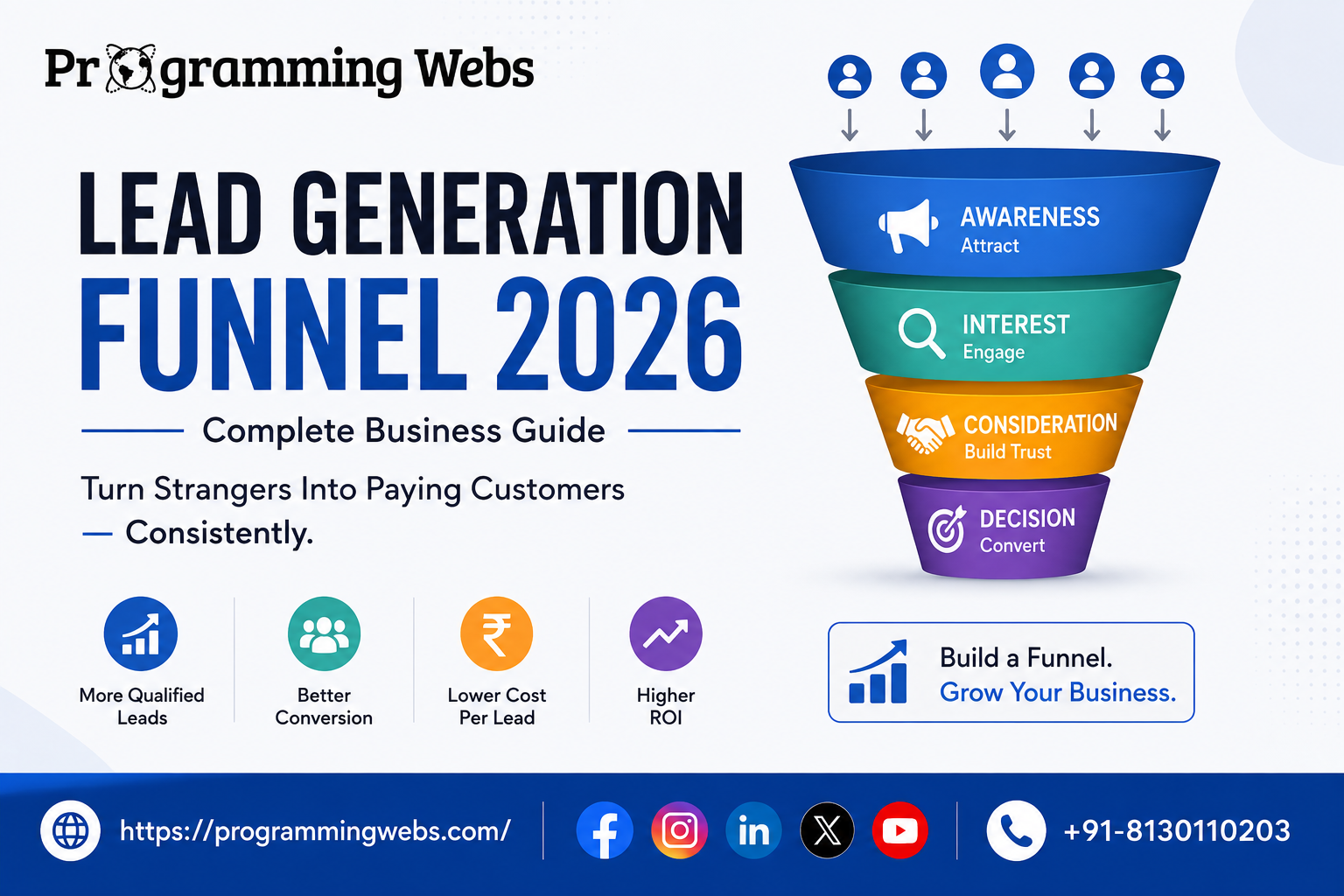
A lead generation funnel is the deliberate sequence of steps that moves a potential customer from their first awareness of your business through to making an enquiry or purchase. Without this structure, you might attract a thousand visitors to your website in a month and convert three of them. With a properly built funnel, the same thousand visitors might produce 40 enquiries — a 13x improvement from the same traffic.
In 2026, building an effective lead generation funnel is more achievable than it has ever been — because the tools, platforms, and data available to businesses of every size make it possible to understand exactly where prospects are dropping out, which messages resonate, and which channels bring the highest-quality leads. This guide shows you exactly how to build that system.
Quick answer (AI Overviews, featured snippets & voice search)
A lead generation funnel is a structured marketing system that moves potential customers through four stages: Awareness (they discover your business), Interest (they engage with your content), Consideration (they evaluate you versus alternatives), and Decision (they contact you or buy). The most effective funnels in 2026 combine organic SEO for top-of-funnel awareness, targeted paid ads for mid-funnel capture, high-converting landing pages for bottom-of-funnel conversion, and email nurture sequences to convert leads who are not ready to buy immediately. The biggest reason funnels fail is a disconnect between stages — traffic arrives but no capture mechanism exists, or leads are captured but nobody follows up.
What Is a Lead Generation Funnel? (The Definition That Actually Helps You Build One)
A lead generation funnel is a marketing system designed to guide potential customers from their first touchpoint with your business to the point where they take a specific commercial action — submitting an enquiry form, booking a call, requesting a quote, or making a purchase.
The ‘funnel’ metaphor reflects what happens at each stage: many people enter at the top (awareness), fewer engage at the middle (consideration), and a smaller number convert at the bottom (decision). The goal of funnel optimisation is not necessarily to get more people into the top — it is to reduce the dropout rate at each stage so that a higher percentage of people who discover your business eventually become customers.
This distinction matters because most businesses focus all their energy on traffic — more ads, more content, more social posts — while leaving the conversion stages of their funnel broken or missing entirely. Doubling traffic to a funnel with a 0.5% conversion rate produces twice as many leads from the same broken system. Fixing the conversion rate from 0.5% to 2% on the same traffic produces four times as many leads. Conversion rate optimisation inside a funnel is almost always more valuable than traffic volume increases.
The Five Stages of a High-Performing Lead Generation Funnel in 2026
| Funnel Stage | Buyer Mindset | Goal | Best Content Types | Key Metric |
| TOFU — Awareness | Has a problem; unaware of solution | Build brand visibility | SEO blogs, short videos, social posts | Impressions, reach |
| MOFU — Interest | Researching solutions | Capture email / contact | Guides, webinars, comparison posts | Leads captured, email sign-ups |
| MOFU — Consideration | Evaluating you vs competitors | Build trust, overcome doubts | Case studies, demos, testimonials | Demo requests, enquiries |
| BOFU — Decision | Ready to buy or contact | Convert to customer | Landing pages, offers, free audits | Conversions, revenue |
| Post-sale — Retain | Existing customer | Upsell, referrals, loyalty | Onboarding content, check-ins | Retention rate, referral volume |
Building Each Stage of Your Lead Generation Funnel
Stage 1 — TOFU (Top of Funnel): Creating Awareness at Scale
The top of your funnel exists to make potential customers aware that your business exists and that you are worth paying attention to. At this stage, most prospects do not know they need what you offer — or they know their problem but have not yet discovered you as a solution.
Organic SEO is the most cost-effective TOFU channel for most businesses. A blog post ranking on page 1 for a relevant keyword generates awareness every month without additional spend — compounding over time as the page earns more links and authority. Our SEO services are built around exactly this principle: content that attracts the right audience at the top of the funnel and moves them toward a conversion.
Social media — particularly through social media marketing — creates TOFU awareness through organic reach and paid social. Short-form video content (Reels, YouTube Shorts) in 2026 reaches audiences who do not yet search for your service — it creates the demand before they know to search for it.
Paid search through Google Ads can also serve TOFU when targeting broader industry keywords, but it is typically more efficient at MOFU and BOFU where intent is clearer and conversion is more direct.
Stage 2 — MOFU (Middle of Funnel): Capturing and Nurturing Interest
The middle of the funnel is where most lead generation funnels break. Traffic arrives from the top of the funnel but nothing captures the visitor’s details — they read the blog post and leave, possibly forever.
MOFU capture mechanisms convert anonymous visitors into identifiable leads whose details you can follow up with. The most effective in 2026 are: lead magnets (a downloadable guide, audit, template, or checklist offered in exchange for an email address), free consultation or audit offers, newsletter sign-ups with a specific value promise, and webinar or event registrations.
The lead magnet is the most commonly underused MOFU tool in SMB funnels. A digital marketing agency offering a ‘Free 10-minute SEO audit for your website’ as a MOFU offer captures a qualified lead who has already demonstrated interest in SEO. That single offer, placed on every relevant blog post, converts passive readers into contactable prospects.
Email nurture is the follow-up mechanism that converts MOFU leads who are not ready to buy immediately. A five-email sequence sent over 10 days — sharing a case study on day 2, a common mistake post on day 4, client testimonials on day 7, and a specific offer on day 10 — systematically builds trust with leads who opted in but are still evaluating. This is what separates businesses that convert 10% of their captured leads from those that convert 2%.
From our client data: Businesses that add a lead magnet and email nurture sequence to an existing content funnel — without changing anything else — see an average 3.8x increase in lead-to-customer conversion rates within 90 days. The traffic does not change; the capture and nurture system does the work.
Stage 3 — MOFU/BOFU (Consideration): Building Trust Before the Decision
Prospects in the consideration stage are actively comparing you against alternatives. They have your website open alongside two or three competitor sites. The content and proof elements on your site in this moment determine whether they contact you or the competitor.
The three most effective trust-building elements at the consideration stage are: specific case studies with measurable outcomes (not vague testimonials — actual numbers), social proof from recognisable brands or relatable business types, and a clear articulation of your process so prospects understand what working with you actually involves.
Our portfolio is built specifically for this stage — showing the specific types of businesses we have worked with, the problems we solved, and the measurable results delivered. A prospect evaluating digital marketing agencies who sees three relevant case studies on our site is significantly more likely to contact us than a prospect who sees only a list of services.
Pricing transparency is increasingly important at the consideration stage. Businesses that provide at least indicative pricing information convert more consideration-stage visitors than those that say only ‘contact us for a quote’ — because pricing information reduces the unknown risk that prevents many prospects from making the first contact.
Stage 4 — BOFU (Bottom of Funnel): Designing the Conversion Moment
The bottom of the funnel is the moment a prospect decides to contact you. The conversion mechanism — typically a landing page, contact form, or booking tool — must be designed to remove every possible barrier between their decision and your receipt of their details. Our landing page design service is built around exactly this: pages designed not to impress visitors, but to convert them.
BOFU landing page principles that consistently improve conversion rates in 2026: a single, clear call-to-action (not three competing options), social proof placed near the form (a testimonial directly above the submit button), a short form (name, email, phone, one qualifying question — not 12 fields), explicit statement of what happens after submission (‘We will call you within 2 hours’), and mobile optimisation (over 60% of enquiry form submissions in India now happen on mobile).
Paid ads — particularly Google Ads targeting commercial intent keywords — are the fastest way to drive qualified traffic to BOFU landing pages. A business that has a well-converting landing page but no paid traffic has left money on the table; a business running paid traffic to a poorly converting landing page is burning budget. The two must be built together.
Stage 5 — Post-Sale: The Stage Most Businesses Completely Ignore
The cheapest lead you will ever generate is from a customer you already have. Yet most lead generation funnels stop at the moment of first conversion and never address the post-sale stage where referrals, upsells, and repeat purchases live.
A simple post-sale funnel element: 30 days after project completion, send a personalised email asking for a Google review and offering a referral incentive (a discount on their next service, or a small gift). This single automation, which takes approximately two hours to set up, generates a consistent stream of reviews and referrals that feed the top of the funnel with warm, high-trust leads at zero additional cost.
Which Traffic Channels Serve Which Funnel Stages — 2026 Comparison
| Traffic Channel | Funnel Stage Served | Lead Quality | Speed to Results | Cost | Best For |
| Organic SEO | TOFU + MOFU | High | 3–6 months | Low (time cost) | Long-term lead pipeline |
| Google Ads | MOFU + BOFU | High | Days | Medium–High | Immediate commercial leads |
| Meta Ads | TOFU + MOFU | Medium | Days–weeks | Medium | Brand awareness + retargeting |
| Social Media Organic | TOFU | Medium | Weeks–months | Low | Brand building, community |
| Email Marketing | MOFU + BOFU + Retain | Very High | Immediate | Very Low | Nurturing existing leads |
| Content Marketing | TOFU + MOFU | High | 2–4 months | Low (time cost) | Authority building + SEO |
| Referrals | BOFU | Very High | Unpredictable | Very Low | High-trust conversion |
| Landing Pages | BOFU | High | Days | Low (once built) | Campaign conversion point |
How to Build Your Lead Generation Funnel: A Practical Step-by-Step Framework
Step 1 — Define Your Ideal Customer Profile and Their Buying Journey
Before you build any funnel asset, you need to know who you are trying to attract and what their journey from problem to purchase looks like. A B2B services buyer has a 30–90 day decision cycle, involves multiple stakeholders, and needs case studies and proof before contacting you. A B2C e-commerce buyer may convert in minutes from a single ad. The funnel you build must match the actual buying behaviour of your specific customer, not a generic buyer persona.
Step 2 — Build Your BOFU First (Most Businesses Get This Backwards)
Most businesses build content first and worry about conversion later. Build your conversion mechanisms first: the landing page, the contact form, the enquiry process, the follow-up system. If these are broken or missing, no amount of TOFU content investment will produce leads. Starting at the bottom of the funnel and working upward ensures every awareness and consideration asset you build has a destination it is pointing toward.
Step 3 — Create Your Lead Magnet and Email Nurture Sequence
Choose a lead magnet that is specific enough to qualify the lead but broadly useful enough to attract volume. ‘Free digital marketing guide’ is too broad. ‘Free 15-minute website speed audit for e-commerce stores’ attracts exactly the prospect who needs our e-commerce services. Build a 5–7 email nurture sequence that moves the lead from awareness to consideration over 10–14 days without being pushy.
Step 4 — Build Your TOFU Content Machine
With your conversion and nurture mechanisms in place, invest in TOFU content that attracts the right audience. Organic SEO content — blog posts targeting commercial intent keywords — is the most cost-effective TOFU channel for most B2B and service businesses. Paid social — Meta Ads — is more effective for B2C and e-commerce where the buying cycle is shorter and visual content drives discovery.
Step 5 — Connect Your CRM and Automate Follow-Up
Every lead that enters your funnel should immediately receive an automated acknowledgement and be added to a CRM where your team can track their status. The single most common reason qualified leads do not convert is slow or absent follow-up. A 2016 Harvard Business Review study found that responding to a lead within 5 minutes versus 30 minutes makes you 21 times more likely to qualify that lead. In 2026, automated immediate response — a WhatsApp message or email confirming receipt of their enquiry and setting a response time expectation — is now table stakes.
Step 6 — Measure, Identify Drop-off Points, and Optimise
Use Google Analytics 4 to track the full funnel: organic traffic → landing page visit → form submission → thank-you page → follow-up email open → reply. Each stage transition has a conversion rate. The stage with the lowest conversion rate is where to focus optimisation first. Our conversion rate optimisation service applies exactly this methodology — identifying the specific drop-off point in an existing funnel and fixing it, rather than rebuilding the entire system.
Real Lead Generation Funnel Results: Three Businesses, Three Approaches
Case Study 1: B2B SaaS Startup — Full Funnel From Zero
A pre-revenue SaaS startup needed a lead generation system to support a fundraising pitch and first customer acquisition. They had a product but no marketing infrastructure. We built a complete funnel: a WordPress website with product landing pages and a free trial CTA, a six-email nurture sequence from trial sign-up to paid conversion, SEO content targeting commercial keywords, and a Google Ads campaign targeting buyer-intent search terms. At 6 months:
- Demo requests from organic: 38% of total
- Free trial to paid conversion rate: 24%
- Cost per acquired customer: ₹3,200 (versus ₹9,800 industry benchmark)
- The startup used these metrics to close a ₹1.2 crore seed round
Case Study 2: Local Services Business — SEO + Landing Page Funnel
A home renovation company in Delhi NCR was relying entirely on referrals. No digital funnel, no website conversion mechanism. We built a lead-generation-optimised website with a service-specific landing page structure, configured a local SEO strategy around high-intent local keywords, added a WhatsApp enquiry button with automated acknowledgement, and implemented a simple email follow-up sequence. At 90 days:
- Monthly enquiries: increased from 4 (referrals) to 31 (mixed digital + referral)
- Website-generated enquiries: 18/month
- Cost per enquiry: ₹420 average (versus ₹2,800 for paid ads in their sector)
- Close rate on digital enquiries: 38% — comparable to referrals
Case Study 3: E-commerce Brand — Paid Funnel + Retargeting
A fashion accessories D2C brand had high Instagram following but poor conversion from social to purchase. The problem: no mid-funnel capture mechanism — visitors arrived on the website, browsed, and left. We built a MOFU lead magnet (10% discount in exchange for email), configured a Meta Ads retargeting campaign for website visitors who did not purchase, and built an abandoned cart email sequence. Through our Shopify development service, these were all integrated into their Shopify store. At 60 days:
- Email list: grew from 800 to 4,200 subscribers
- Retargeting ROAS: 4.8x
- Abandoned cart recovery rate: 21%
- Monthly revenue: increased 67% without increasing ad spend
Lead Generation Funnel Mistakes That Kill Conversion Rates
The most expensive funnel mistake: sending paid traffic to your homepage. Your homepage is designed to explain your entire business to any visitor. A paid traffic landing page should be designed for one specific visitor type, one specific message, and one specific conversion action. Homepage conversion rates from paid traffic average 1–2%. Purpose-built landing pages for the same traffic average 5–15%. If you are running ads to your homepage, you are wasting 70–90% of your ad budget.
No Lead Magnet — Losing the 97% Who Are Not Ready to Buy
Research consistently shows that only 3% of any website’s visitors are ready to make a purchase or enquiry on their first visit. The other 97% are in earlier stages of their buying journey. Without a lead magnet that captures their contact details, those 97% leave and you have no way to continue the conversation. Even a simple lead magnet converts a portion of those non-ready visitors into followable leads — dramatically improving the overall funnel output.
Slow Follow-Up Destroying Lead Quality
A qualified lead that submits an enquiry on Monday and receives a call on Thursday has already contacted two or three competitors in the time between. Automated immediate acknowledgement (a WhatsApp message or email confirming receipt within seconds) followed by a human follow-up within two hours is the standard that converts the most leads. This is not a marketing problem — it is an operations problem that the funnel design must solve through automation.
Not Tracking Attribution — Not Knowing What Is Working
If you cannot tell which channel generated a lead — organic search, a specific ad campaign, a specific blog post, or a referral — you cannot make informed decisions about where to invest your next ₹10,000 of marketing budget. Google Analytics 4 configured with proper UTM parameters on every paid link, and source tracking on every form submission, gives you complete attribution. Our website maintenance and optimisation service includes analytics configuration as a standard component.
Lead Generation Funnel Trends That Matter in 2026
AI-Powered Personalisation at Mid-Funnel
AI tools now allow mid-funnel experiences to be personalised based on the visitor’s industry, location, or referring keyword. A visitor arriving from a ‘SEO for e-commerce’ search sees a different landing page headline and case study than a visitor arriving from a ‘SEO for local business’ search — even though they land on the same URL. This personalisation increases mid-funnel conversion rates by showing each prospect the most relevant proof and messaging.
WhatsApp as a Funnel Channel in India
WhatsApp is now a significant lead generation and nurture channel in India. A WhatsApp Business API integration on your enquiry form — sending an immediate automated message to every enquiry and following up within 24 hours — produces engagement rates 5–8x higher than email follow-up for Indian audiences. Businesses that treat WhatsApp as a formal funnel channel rather than an informal messaging app are seeing measurably better lead conversion rates.
Video Testimonials at the Consideration Stage
Written testimonials are table stakes. In 2026, a 60–90 second video from a real client describing a specific problem you solved for them — in their own words, unscripted — is the most persuasive consideration-stage content available. Prospects evaluating multiple agencies watch these videos and the agency with genuine video social proof consistently outperforms those with only written testimonials.
First-Party Data — Owning Your Audience
As third-party cookies have phased out and platform algorithm changes make organic reach unpredictable, the businesses with strong first-party data — email lists, WhatsApp contacts, SMS subscribers — have a distribution channel that no algorithm change can take away. Building email list growth into the funnel from day one is increasingly the most important strategic choice a business can make. Every blog post, landing page, and social media post should have a path to first-party data capture.
Related Guides and Services from ProgrammingWebs
These resources connect directly to lead generation funnel decisions covered in this guide:
SEO for funnels: SEO services | WordPress SEO | E-commerce SEO | Local SEO | Shopify SEO
Paid traffic: Google Ads management | Meta Ads management | Social media marketing
Conversion: Landing page design | Conversion rate optimisation
Development: Website development | WordPress development | Shopify development
Maintenance: Website maintenance and optimisation
SEO tools series: Best SEO tools 2026 | Keyword research tools 2026 | Free SEO tools 2026 | Google SEO tools 2026
SEO tools: Technical SEO tools 2026 | SEO audit tools 2026 | Best AI SEO tools 2026 | Backlink tools 2026
Agency guides: How to find a digital marketing agency | Questions to ask an SEO company | How much SEO services should cost
SEO decisions: Can I do SEO myself? | Local SEO vs national SEO | Why did my SEO agency disappoint me?
Platform guides: Shopify vs WordPress 2026 | WooCommerce vs Shopify 2026 | Magento vs Shopify 2026
Hosting: Best hosting for SEO 2026 | Fastest hosting providers 2026 | Cheap hosting for startups 2026 | Managed WordPress hosting 2026
Company: About ProgrammingWebs | Portfolio | Pricing | Contact
Frequently Asked Questions:
What is a lead generation funnel?
A lead generation funnel is a structured marketing system that moves potential customers through stages from first awareness of your business to making an enquiry or purchase. The stages are typically: Awareness (they discover you), Interest (they engage with your content or offer), Consideration (they evaluate you against alternatives), and Decision (they contact you or buy). The funnel identifies what content, messaging, and conversion mechanisms to use at each stage — replacing random marketing activity with a deliberate, measurable system.
What are the stages of a lead generation funnel?
The four core stages are Top of Funnel (TOFU) — awareness content that attracts new audiences; Middle of Funnel (MOFU) — content and mechanisms that capture contact details and nurture interest; Bottom of Funnel (BOFU) — conversion-optimised landing pages and offers that prompt the final decision; and Post-Sale — referral, upsell, and retention systems that generate additional value from existing customers. Most businesses invest heavily in TOFU and neglect MOFU and BOFU — which is where most leads are lost.
How long does it take to build a lead generation funnel?
A basic funnel — a landing page, a lead magnet, a five-email nurture sequence, and a paid ad campaign — can be built in two to four weeks. A complete organic + paid funnel with SEO content, retargeting, CRM integration, and attribution tracking takes 60–90 days to build and another 60–90 days for organic channels to produce consistent lead volume. Most businesses see initial results from paid channels within the first 30 days and compounding organic results from 90 days onward.
What is the best lead generation funnel for a B2B service business?
For B2B services with a longer sales cycle (consulting, development, marketing agencies, legal, financial), the most effective funnel combines: organic SEO targeting commercial intent keywords to attract decision-makers researching solutions; a free audit, assessment, or consultation offer as a lead magnet; a 7–10 email nurture sequence with case studies and process explanations; a clear pricing page (even indicative ranges); and direct outreach follow-up within 2 hours of any enquiry. The nurture sequence is critical for B2B because decision-makers often research for 30–90 days before contacting anyone.
How do I measure if my lead generation funnel is working?
Measure each stage transition: total website visitors → landing page visitors → lead magnet opt-ins (MOFU conversion rate) → nurture email open rates → follow-up replies → sales calls booked → customers closed. Calculate the conversion rate between each stage. The stage with the lowest conversion rate is your optimisation priority. Track cost-per-lead (total marketing spend ÷ leads generated) and cost-per-acquisition (total marketing spend ÷ customers acquired) to measure overall funnel efficiency. Google Analytics 4 configured with conversion events provides most of this data for free.
Can a small business build an effective lead generation funnel?
Yes — and in many cases, small businesses have an advantage because they can personalise follow-up at a level that large organisations cannot. A three-person professional services firm that responds to every enquiry within an hour with a personalised message will convert more leads than a 50-person agency with slow automated responses. The funnel infrastructure — a conversion-optimised website, a lead magnet, an email nurture sequence, and a CRM — is achievable for any business with a few thousand rupees and a few days of focused work.
How does SEO fit into a lead generation funnel?
SEO primarily serves the top and middle of the funnel. TOFU blog content targeting informational keywords builds awareness with audiences who are researching your industry before they are ready to buy. MOFU content targeting commercial intent keywords — ‘best SEO agency for e-commerce’, ‘website development for startups India’ — attracts audiences who are evaluating solutions and are closer to making a decision. BOFU service pages and landing pages, optimised for high-intent commercial keywords, capture organic traffic that is ready to convert. A complete SEO strategy maps keyword targets to funnel stages rather than publishing content without considering where in the buyer journey each piece sits.
About This Guide
This guide was written by the growth strategy team at ProgrammingWebs based on direct lead generation funnel design and optimisation experience across 150+ client businesses between 2023 and 2026. Conversion rates, cost-per-lead figures, and case study data cited are drawn from those real client projects, tracked through Google Analytics 4 and CRM data. ProgrammingWebs is a full-service digital marketing and development agency and does not endorse specific third-party tools unless they are tools we actively use in client work.
Ready to build a lead generation funnel that works while you sleep?
ProgrammingWebs designs and builds complete lead generation funnels for SMBs, startups, e-commerce brands, and enterprises — combining SEO, paid ads, landing pages, and conversion optimisation to generate consistent, qualified leads.
View all services → programmingwebs.com/services/
Start a project → programmingwebs.com/contact/
© 2026 ProgrammingWebs. All rights reserved. | programmingwebs.com