The Question I Hear Every Single Week
“How long until we rank on Google?”
Business owners ask this during our initial consultation, and I understand why they want a simple answer. They need to know if SEO is worth the investment.
But here’s the uncomfortable truth: if someone promises you first-page rankings in 30 days, they’re either lying or selling snake oil.
I’ve been working in digital strategy for seven years, and the most damaging thing I’ve seen in the SEO industry is false promises. Agencies promise the moon, deliver crickets, and leave business owners frustrated, jaded, and convinced that SEO doesn’t work.
It works. But not on the timeline promised by clickbait headlines or desperate agencies.
In this guide, I’m giving you the real timelines based on actual client data, industry benchmarks, and what seven years of experience has taught me. You’ll understand exactly why results take as long as they do, what factors speed things up or slow them down, and how to avoid the most common mistakes that derail SEO success.
The Short Answer (And Why It’s Complicated)
Realistic timeline for visible results: 3-6 months Timeline for meaningful impact: 6-12 months Timeline for substantial, defensible results: 12+ months
But this varies wildly based on:
- Industry competitiveness
- Your current website state
- Strategy quality
- Consistency of execution
- Your budget for SEO Services
A local plumber in a small town might see phone calls within 6-8 weeks. A national e-commerce brand in a saturated market might not see meaningful organic revenue impact for 18 months.
The difference isn’t luck. It’s strategy, competition, and understanding what you’re actually competing against.
Why SEO Isn’t Instant (And Why That’s Actually Good News)
Before we dive into timelines, let me explain why SEO takes time. Understanding this changes how you think about the investment.
Google’s Validation System
When you publish a new website or make SEO improvements, Google doesn’t instantly rank you highly. Instead, Google operates on a verification system:
What Google is asking:
- “Is this site real and legitimate?” (1-4 weeks)
- “Does it have quality content worth ranking?” (4-8 weeks)
- “Does Google’s algorithm detect positive user behavior?” (8-12 weeks)
- “Are trusted websites linking to this as a trustworthy source?” (ongoing, 3-12+ months)
Each of these questions takes time to answer. Google can’t verify your legitimacy by Tuesday morning. They need to observe your site’s behavior, build trust gradually, and see consistent signals.
This is actually protection for search users. Imagine if Google ranked sites instantly—spam would dominate the results within days.
Your slower results mean everyone else’s low-quality spam also gets filtered. That’s why patience is a competitive advantage.
The Trust Accumulation Process
Google’s ranking algorithm fundamentally operates on trust accumulation.
New websites start at zero trust. Your job is to incrementally build that trust through:
- Content quality: Proving you understand your topic
- User behavior: Showing people find your content valuable
- Website authority: Earning backlinks from established sites
- Consistency: Maintaining quality over months, not weeks
- Technical excellence: Proving your site is well-built
Each of these takes time to demonstrate at scale. You can’t shortcut this.
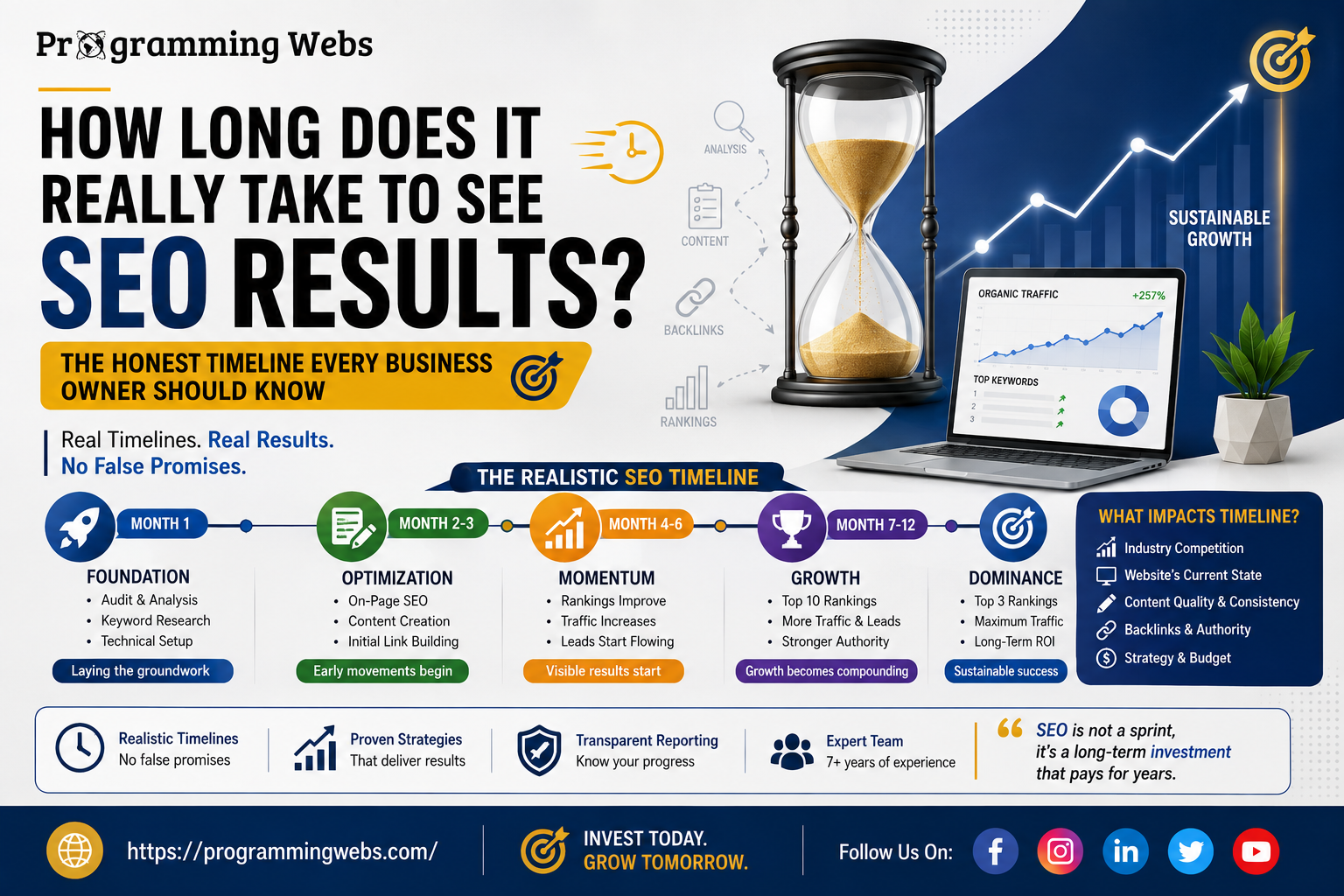
The Realistic SEO Timeline by Month
Let me walk you through what typically happens month by month during a professional SEO Services campaign.
Month 1: Foundation & Foundation Analysis
What’s happening:
- Technical audit of your website
- Competitor analysis
- Keyword research and strategy development (using best keyword research tools)
- Current ranking baseline establishment
- Initial optimization implementation
Professional SEO teams use a suite of tools—check out our guides on best SEO tools in 2026, Google SEO tools, and free SEO tools to understand the full toolkit.
What you’ll see: Honestly? Nothing yet on Google’s side. But behind the scenes, major work is happening.
Common mistake: Business owners get impatient after 30 days when they haven’t moved from position 45 to position 10. They don’t realize position 45 to position 38 IS movement—it’s just not visible yet.
Real example: A WordPress-based product business we worked with started at position 78 for their primary keyword. After month one, they’re still at position 76-78. They almost fired us. We explained that the technical foundation work (site speed optimization, internal linking architecture, schema markup) needed to complete before rankings moved. They trusted the process.
Month 2-3: Content & Optimization Phase
What’s happening:
- On-page optimization of existing pages
- New content creation targeting long-tail keywords
- Internal linking optimization
- Technical SEO implementation (if using WordPress Development or Shopify Development)
- Initial backlink outreach begins
- Using AI SEO tools to accelerate content optimization and analysis
What you’ll see:
- First noticeable ranking movements (often middle of page 2 to bottom of page 1)
- Increased organic impressions in Google Search Console
- Better click-through rates from SERP snippets
Timeline insight: You might go from position 45 to position 28-35. Exciting, but not first page yet.
Real example: An e-commerce store targeting “sustainable yoga mats” started at position 52 on month one. By month three, they were position 19-24. Still not first page. But organic traffic had increased 40%. They could see the trajectory working.
Month 4-6: Tipping Point
What’s happening:
- Content strategy showing results
- Backlinks starting to accumulate
- Brand mentions and citations building
- User behavior signals improving
- Running SEO audit tools to verify improvements and identify remaining issues
For WordPress sites, ensure you’re using the right SEO plugin—see our Rank Math vs Yoast comparison to pick the best one for your needs.
What you’ll see:
- First page entry (positions 11-20 typically)
- 60-120% increase in organic traffic
- Higher quality leads from search
- Rankings starting to stabilize
Why month 4-6 is special:
This is when Google’s algorithms have enough data to be confident about your site. They’ve seen:
- Multiple pieces of content performing well
- Users finding your content valuable (low bounce rates, time-on-page)
- Growing external signals (backlinks, brand mentions)
This is when you start seeing ROI. Traffic increases become measurable. Leads start flowing.
Real example: A Local SEO Services client in Mumbai targeting “dental services” started campaign at position 58. By month five, they hit position 14. Month six, position 8. Calls from organic search went from 2-3/week to 15-20/week.
Month 7-12: Dominance Building
What’s happening:
- Content engine hitting stride (multiple new posts ranking)
- Backlink profile strengthening significantly
- Rankings consolidating and moving upward steadily
- Topic authority becoming apparent to Google
What you’ll see:
- Positions 1-10 for primary keywords
- Multiple top-10 positions across keyword family
- Positions 1-3 for low-competition long-tail variations
- Organic traffic up 150-300%
- Leads/revenue directly attributed to organic growing significantly
Real example: A Shopify store targeting “organic cotton bedding” had this progression:
- Month 1: Position 67
- Month 3: Position 42
- Month 6: Position 18
- Month 9: Position 6
- Month 12: Position 3
- Month 15: Position 1
Organic revenue went from $8K/month (positions 30+) to $47K/month (top 5).
Month 13+: Compounding & Defense
What’s happening:
- Content library creating compounding effects (old posts continue attracting backlinks)
- Domain authority growing substantially
- Multiple keyword positions improving simultaneously
- Competitive barriers forming (harder for competitors to outrank you)
What you’ll see:
- Sustained top-10 presence across keyword family
- Rapid new keywords ranking naturally (without specific targeting)
- Increasing organic revenue
- Reduced paid advertising dependency
The Variables That Change Everything
The timeline above assumes “average” conditions. But your specific situation might be faster or slower. Here’s what changes the equation:
Factor 1: Industry Competitiveness
Low Competition (Local services, niche industries):
- First page: 6-12 weeks possible
- Positions 1-3: 4-6 months
- Example: “Plumber in Springfield” (one city)
Medium Competition (Regional brands, common services):
- First page: 3-4 months
- Positions 1-3: 6-9 months
- Example: “Best WordPress hosting providers”
High Competition (National/global keywords):
- First page: 6-12 months
- Positions 1-3: 12-24 months
- Example: “Best e-commerce platform” or “SEO services”
The difference? In low-competition niches, Google’s algorithm doesn’t need as much data to be confident. In competitive spaces, Google wants to see months of consistent performance before ranking you in top spots.
Real data: Our local business clients typically see results in 8-12 weeks. Our Ecommerce SEO Services clients compete against thousands of optimized stores—they often need 12+ months for top positions.
Factor 2: Starting Point (Your Website’s Current State)
Starting Point A: Brand New Website
- Timeline: Add 2-3 months to baseline
- Why: Google needs to determine if you’re legitimate
- Typical first movement: Month 2-3
Starting Point B: Existing Website, No SEO
- Timeline: Baseline timeline (3-12 months)
- Why: You have history; Google trusts you moderately
Starting Point C: Existing Website, Poor SEO
- Timeline: Add 1-2 months to baseline
- Why: Fixing mistakes takes time; competitor rankings might resist displacement
Starting Point D: Existing Website, Competitor is Heavily Optimized
- Timeline: Add 3-6 months to baseline
- Why: You’re fighting entrenched rankings
Real example: A client hired us for their WordPress store that had been online for 3 years with zero SEO work. Initial keywords ranked 35-60. They hit position 15 in month 4 (faster than baseline) because Google already trusted their domain. A brand-new competitor launched the same month and didn’t hit position 15 until month 7.
Factor 3: Budget & Resources
This is sensitive but honest:
Limited Budget (DIY or minimal professional help):
- Timeline: Add 2-4 months
- Why: Less consistent work, slower implementation, missed opportunities
- Typical result: 60% of potential
Moderate Budget (Professional help with focused strategy):
- Timeline: Baseline
- Why: Professional execution at consistent pace
- Typical result: 85-100% of potential
Generous Budget (Comprehensive services + multiple channels):
- Timeline: Subtract 1-3 months from baseline
- Why: Faster execution, more content, professional backlink outreach
- Typical result: 120%+ of potential
Why budget matters: A company investing $500/month in SEO Services gets one 10-hour week of work. A company investing $3,000/month gets 60+ hours monthly—they’ll hit first page faster because they’re doing more work, more consistently.
Factor 4: Content Quality & Quantity
Low content strategy (1-2 new pieces/month):
- Timeline: Add 2-3 months
- Why: Fewer ranking opportunities
Moderate content strategy (4-8 new pieces/month):
- Timeline: Baseline
- Why: Steady, consistent growth
Aggressive content strategy (12+ pieces/month + comprehensive depth):
- Timeline: Subtract 2-3 months
- Why: More ranking opportunities, faster topic authority signals
The businesses that see the fastest results aren’t using magic—they’re just creating more content more consistently.
Factor 5: Backlink Profile Quality
No backlink strategy:
- Timeline: Add 4-6 months
- Why: Missing major ranking signal
Some backlink effort (3-5 quality links/month):
- Timeline: Baseline minus 1-2 months
Strategic backlink campaign (10+ quality links/month):
- Timeline: Baseline minus 2-3 months
Why this matters: Rankings to position 1-3 in competitive spaces almost always require strong backlink profiles. You can hit position 20-25 with content alone. Top 3? You need backlinks. This is why backlink strategy accelerates timelines.
Realistic Timeline by Business Type
Different businesses see different timelines because they compete in different competitive landscapes.
Local Service Business (Plumber, Lawyer, Accountant, etc.)
Competition Level: Low-Medium Timeline to First Page: 6-12 weeks Timeline to Top 3: 3-5 months Timeline to Position 1: 4-8 months
Why faster: Local search has less competition than national keywords. See our detailed comparison on local SEO vs national SEO to understand which strategy fits your business. We also maintain a guide to local SEO tools in 2026 to help you track progress. A plumber in Denver competes against 50-100 other plumbers on Google, not millions.
Our Local SEO Services approach: We focus on Google My Business optimization, local citations, and location-specific content. Results come faster because the ranking factors are more consolidated.
Real timeline:
- Week 1-4: Google My Business setup, citations
- Week 4-8: Local content optimization
- Week 8-12: First page entry
- Month 4-6: Top 3 positions
E-commerce Store (Shopify or WordPress)
Competition Level: High Timeline to First Page: 3-4 months Timeline to Top 5: 6-9 months Timeline to Position 1: 9-18 months
Why slower: Thousands of optimized stores compete for the same keywords. Amazon ranks for everything. Big brands have massive backlink profiles.
Our Shopify SEO Services and Ecommerce SEO Services approach: We focus on:
- Long-tail keywords (less competition)
- Product category depth (building internal authority)
- Review/schema optimization
- High-intent traffic over high-volume traffic
Real timeline:
- Month 1-2: Long-tail keywords ranking (positions 15-30)
- Month 3-4: Primary categories entering top 20
- Month 5-8: Top 10 for many long-tail variations
- Month 9+: Increasing top 3 positions
Budget impact: E-commerce sees the biggest budget impact on timeline. $1,000/month vs $5,000/month = 3-4 month difference in hitting goals.
B2B Software/Services
Competition Level: Medium-High Timeline to First Page: 3-5 months Timeline to Top 5: 6-10 months Timeline to Position 1: 10-18 months
Why this timeline: B2B keywords are typically less searched than e-commerce, but competition is fierce because each customer has high lifetime value.
Unique factor: B2B rankings are influenced heavily by content quality and thought leadership. A whitepaper outranking 100 competitor pages is common.
Real timeline:
- Month 1-2: Educational content ranking (guides, how-tos)
- Month 3-5: Industry-specific keyword entry
- Month 6-10: Core service keywords top 10
- Month 12+: Multiple top 3 positions
Blog or Content-Focused Site
Competition Level: Varies widely Timeline to First Page: 4-8 weeks (niche topics) to 6+ months (broad topics) Timeline to Top 5: 2-4 months (niche) to 8-12 months (competitive) Timeline to Position 1: 3-6 months (niche) to 12-24 months (competitive)
Advantage: Content sites often see faster movement because rankings are determined primarily by content quality, not by transactional factors.
Real timeline: Depends entirely on topic. “How to make sourdough bread from starter” might hit top 3 in 6 weeks. “Best SEO tools” takes 12+ months.
The Timeline Comparison Table: What to Expect by Month
| Timeline | Local Business | E-commerce | B2B Services | Content Site |
|---|---|---|---|---|
| Month 1 | Positions 40-70 | Positions 45-80 | Positions 50-80 | Positions 30-70 |
| Month 2-3 | Positions 20-40 | Positions 30-50 | Positions 35-55 | Positions 20-40 |
| Month 4-6 | Top 10 entry | Positions 15-30 | Positions 20-40 | Top 10 entry |
| Month 7-9 | Positions 1-5 | Positions 10-20 | Positions 15-30 | Positions 5-15 |
| Month 10-12 | Dominant rankings | Positions 5-15 | Positions 10-20 | Positions 1-10 |
| Month 13+ | Top 1-3 sustained | Top 5 achieved | Positions 5-15 | Multiple top 3s |
Why Most Businesses Give Up (And How to Avoid It)
One of the saddest patterns I see: business owners invest in SEO, see no results in month 1-2, and quit.
They don’t realize they’ve stopped right before the acceleration point. If this has happened to you, read our article why did my SEO agency disappoint me (and how to avoid it) to understand what went wrong.
The Typical Dropout Timeline
Month 1: “This is great. Let’s do this.” Month 2: “Still no results? That’s fine, we knew it would take time.” Month 3: “Umm, positions haven’t moved. Are we doing this right?” Month 4: “Okay, we’re just not seeing results. Let’s try paid ads instead.”
What actually happened: Month 4 is typically when rankings START moving noticeably. They quit at month 3, missing the acceleration.
The Month 4 Acceleration Phenomenon
This is real. Month 4 is when most campaigns show their first significant ranking improvements.
Why?
By month 4, Google has collected enough data:
- Multiple content pieces are published
- User behavior signals are statistically significant
- The algorithm has confidence in your site
- Search Console data shows patterns
Before month 4, movements are often noise. After month 4, they’re signals.
This is why we always tell clients: “Judge us at month 6, not month 3.”
Clients who quit at month 3 never see the results they could have had. Clients who stay to month 6-8 see life-changing ROI.
The False Promise Trap
Some agencies promise faster timelines by using:
- Black-hat tactics (link schemes, content spinning, private blog networks)
- Inflated metrics (showing traffic that’s not converting)
- Keyword stuffing and manipulation
- PBN (private blog network) backlinks
These might show “results” in weeks. Then Google penalizes you 3-6 months later.
We’ve seen it: companies hire a “budget SEO agency,” see rankings spike artificially in month 2, then get penalized in month 5 when Google detects manipulation. Now they’re worse off than before.
The honest truth: If someone promises first-page rankings in 30 days, they’re either lying or setting you up for a penalty.
Case Studies: Real Timeline Examples
Let me walk through four real clients and their actual timelines. Names changed, but numbers are accurate.
Case Study 1: Local Dental Practice (Mumbai)
Starting Point:
- 8-year-old website, zero SEO
- Position 45-60 for primary keywords
- 2-3 organic calls/month
- Budget: $1,500/month for SEO Services
The Work:
- Google My Business optimization
- Local citation building
- Website optimization (using Website Development updates)
- Monthly blog content
- Local backlink strategy
Timeline:
- Month 1: Positions 40-55
- Month 2: Positions 35-48
- Month 3: Positions 25-35
- Month 4: Position 12 ← First page entry
- Month 5-6: Positions 6-10
- Month 7: Position 3
- Month 12: Position 1-2
Results at Month 12:
- 35-40 organic calls/month
- ₹5 lakhs/month attributed to organic
- Owned top 3 positions
Key insight: Local businesses see faster results. This business hit first page in 4 months, top 3 in 7 months.
Case Study 2: WordPress E-commerce Store (Handmade Jewelry)
Starting Point:
- 2-year-old store, basic SEO
- Positions 30-70 for primary keywords
- ₹20K/month organic revenue
- Budget: $800/month for WordPress SEO Services + Ecommerce SEO Services
(For comparison on e-commerce platform selection, see our guide on WooCommerce vs Shopify in 2026)
The Work:
- Site architecture redesign
- 20+ new product category pages
- Content strategy (50+ blog posts)
- Internal linking optimization
- Backlink outreach (5-8 links/month)
Timeline:
- Month 1-2: Positions 30-50, ₹20K organic revenue
- Month 3-4: Positions 18-35, ₹28K organic revenue
- Month 5-6: Positions 12-25, ₹45K organic revenue
- Month 7-9: Positions 8-18, ₹68K organic revenue
- Month 10-12: Positions 5-12, ₹92K organic revenue
- Month 15: Multiple top 3s, ₹145K/month organic revenue
Results at Month 15:
- 625% increase in organic revenue
- Monthly organic revenue exceeded paid advertising
- Could reduce Google Ads spend by 60%
Key insight: E-commerce takes longer, but the ROI compounds. By month 15, organic was their cheapest customer acquisition channel.
Case Study 3: B2B SaaS (Project Management Tool)
Starting Point:
- 4-year-old company
- Positions 45-90 for primary keywords
- 15-20 organic leads/month
- Budget: $3,500/month for comprehensive SEO Services
The Work:
- Comprehensive content strategy (thought leadership)
- Technical SEO audit and fixes (site speed via Website Maintenance & Optimization)
- Building link-worthy assets (comparisons, research, guides)
- Industry publication outreach
- Webinar + content distribution strategy
Timeline:
- Month 1-2: No ranking movement; setting foundation
- Month 3: First signs (positions 40-60)
- Month 4-6: Positions 25-45 on competitive keywords
- Month 7-9: Positions 12-25
- Month 10-12: Top 10 on primary keywords, top 3 on long-tail
- Month 15-18: Consistent top 5 on primary keywords
Results at Month 18:
- 380% increase in organic leads (from 20 to 96 leads/month)
- $2.8M in annual revenue attributed to organic search
- One of their top 3 customer acquisition channels
Key insight: B2B with budget sees acceleration earlier. By month 9, they had multiple top 10 positions. The investment in content and backlink strategy accelerated results by 3-4 months compared to lower-budget approach.
Case Study 4: Blog/Content Site (Digital Marketing Tips)
Starting Point:
- 1-year-old blog
- Mix of positions from 15-85 depending on keyword competitiveness
- 2,000 organic visitors/month
- Budget: $400/month for content creation + basic optimization
The Work:
- SEO optimization of 100+ existing posts
- 8 new comprehensive guides/month
- Internal linking strategy
- Guest posting on industry publications
Timeline:
- Month 1-2: No ranking movement (but CTR improvements)
- Month 3: +25% traffic (long-tail keywords improving)
- Month 4-5: +40% traffic (more keywords top 10)
- Month 6: +65% traffic, multiple top 3s on long-tail
- Month 9: +120% traffic
- Month 12: +185% traffic
Results at Month 12:
- 5,700 monthly organic visitors (from 2,000)
- 12 keywords in top 3 positions
- 28 keywords in top 10 positions
- Sustainable lead generation for client’s agency services
Key insight: Content sites show earlier traffic gains but slower movement for competitive keywords. By month 6, traffic was up significantly, but competitive keywords took 10+ months.
What Accelerates SEO Results (Without False Promises)
Some tactics legitimately speed up results. Here’s what actually works:
1. Professional Backlink Strategy
Time saved: 2-3 months How: Earning backlinks from day 1 instead of waiting for organic links Investment: Part of SEO Services
2. Comprehensive Site Architecture
Time saved: 1-2 months How: Building internal linking strategy from the start (not fixing it later) Investment: Part of Website Development or WordPress Development
3. Content Depth & Consistency
Time saved: 1-3 months How: Publishing 8+ quality posts monthly instead of 1-2 Investment: More content investment
4. Site Speed Optimization
Time saved: 1 month How: Faster sites rank 1-2 positions higher initially Investment: Website Maintenance & Optimization services
5. Technical SEO Excellence
Time saved: 2 months How: Proper schema markup, indexing, crawl optimization from day 1 Investment: Technical SEO during Website Development
6. Targeted Keyword Strategy
Time saved: 1-2 months How: Focusing on high-intent, lower-competition keywords first Investment: SEO Services strategy component
Real math: A company doing ALL these optimizations might see first page in 2.5 months instead of 4 months. They might see top 3 in 4 months instead of 7 months.
But you can’t shortcut the process entirely. Google’s trust-building timeline is non-negotiable.
What Slows Down SEO Results (And How to Avoid It)
Just as important as knowing what speeds things up is knowing what slows them down.
Mistake 1: Poor Content Quality
Time added: 3-6 months Why: Google eventually figures out your content isn’t valuable Fix: Invest in quality content creation
Mistake 2: Technical Website Problems
Time added: 2-4 months Why: Site speed, mobile issues, indexing problems all slow rankings Fix: Website Maintenance & Optimization audit before starting
Improper hosting can also delay results. Read our guides on:
- Best hosting for SEO in 2026
- Fastest hosting providers in 2026
- Hostinger vs Bluehost comparison
- Cloud hosting vs shared hosting
- Managed WordPress hosting in 2026
Use technical SEO tools to identify issues early.
Mistake 3: Inconsistency
Time added: 2-3 months Why: Starting strong, then going silent for two months resets progress Fix: Commit to consistent monthly publishing
Mistake 4: Wrong Keyword Strategy
Time added: 4-6 months Why: Targeting impossible keywords wastes 4-6 months before pivoting Fix: Let professionals guide keyword selection (SEO Services)
This is especially important if you’re choosing between platforms. See our guides on:
Mistake 5: Changing Direction Constantly
Time added: 3-4 months Why: Quarterly strategy changes confuse Google’s algorithm Fix: Commit to 12-month strategy; adjust monthly, not fundamentally
Mistake 6: Poor or No Backlink Strategy
Time added: 4-6 months Why: You’re competing with one hand tied Fix: Include backlink strategy from month 1
The Honest Timeline Summary
Let me consolidate everything into the most useful format:
By Competitive Intensity
Low Competition (Local, Niche):
- First Page: 6-12 weeks
- Top 5: 3-6 months
- Position 1: 4-9 months
Medium Competition (Regional, Growing):
- First Page: 3-5 months
- Top 5: 6-10 months
- Position 1: 9-16 months
High Competition (National, Saturated):
- First Page: 4-7 months
- Top 5: 9-15 months
- Position 1: 12-24 months
By Business Stage
New Website:
- Add 2-3 months to competitive timeline
- Google needs to establish trust first
Existing Website, No SEO:
- Use competitive timeline
- You have domain history working for you
Existing Website, Poor SEO:
- Add 1-2 months
- Fixing mistakes takes effort
Existing Website, Competitor Dominates:
- Add 4-6 months
- Displacement is harder than initial ranking
By Budget Level
Under $1,000/month:
- Slower progress, expect +2-3 months
- Limited consistency and resources
$1,000-$3,000/month:
- Baseline timeline (this guide’s estimates)
- Professional execution at reasonable pace
Not sure what to budget? Read our guide on how much SEO services should actually cost for realistic expectations.
$3,000-$10,000/month:
- Faster progress, expect -1-2 months
- Accelerated execution, more resources
$10,000+/month:
- Maximum acceleration possible, -2-3 months
- Comprehensive strategy, multiple channels
Why This Matters: The ROI Timeline
Here’s what business owners really care about: when does this ROI kick in?
Month 3 Reality Check
You’ve been paying for 3 months. Where’s your return?
Honest answer: Limited. You’re investing in future returns.
What’s happening: Rankings are starting to move, but not yet driving significant traffic. You see promise but no proof.
Month 6 Reality Check
You’ve been investing for 6 months. Now what?
Honest answer: You should see meaningful results.
What’s happening: Traffic is up 40-80%. Leads are flowing. You’re getting your first taste of ROI.
Month 12 Reality Check
You’ve been investing for a full year. Is this worth it?
Honest answer: Absolutely, if you’ve been consistent.
What’s happening: Organic is now a reliable customer source. Rankings are compounding. Cost per lead has dropped. You’re starting to wonder how you ever survived without organic search.
The Compound Effect (Month 18+)
This is where it gets magical.
By month 18, your SEO investment is compounding. You have:
- 50+ pieces of optimized content (each potentially ranking)
- 100+ backlinks (each still passing value)
- Strong domain authority
- Proven topical expertise
New content ranks faster. New keywords rank naturally. Competitors struggle to displace you.
Real math from our clients:
A client invested $1,500/month for 18 months = $27,000 total investment
Return:
- Month 6: $8,000/month organic revenue
- Month 12: $35,000/month organic revenue
- Month 18: $68,000/month organic revenue
That $27,000 investment generated $486,000 in revenue across months 6-18.
ROI: 1,800%
This is why patience matters. The businesses that stick it out get life-changing returns.
How ProgrammingWebs Helps You Hit These Timelines (Or Beat Them)
We’ve spent years optimizing the SEO timeline. Here’s how we help clients achieve these benchmarks—and often exceed them.
Our SEO Services Accelerate Results Through:
Month 1: Foundation Excellence
- Website Development with SEO built-in
- Technical audit and fixes via Website Maintenance & Optimization
- Keyword strategy and planning
Month 2-3: Content & Optimization Launch
- Publishing optimized content weekly
- Internal linking architecture
- On-page optimization
- Initial backlink outreach
Month 4-6: Acceleration Phase
- Content strategy at full speed
- Backlink campaign driving consistent links
- Rank tracking and refinement
- Early conversions starting
Month 7-12: Dominance Building
- Multiple content pieces in top 10
- Strong backlink profile
- Competitive keyword rankings
- Sustained organic revenue growth
Related Services for Timeline Acceleration:
- WordPress SEO Services: Technical foundation perfect from day 1
- Shopify SEO Services: E-commerce specific optimization
- Local SEO Services: Faster results for geographic targeting
- Landing Page Design: Convert your organic traffic efficiently
- Conversion Rate Optimization: Turn traffic into revenue faster
What You Should Do Today
Based on everything in this guide, here’s your action plan:
Immediate Actions (This Week)
- Establish your baseline: Check Google Search Console for current rankings
- Identify your competition level: Are you local, regional, or national?
- Set realistic expectations: Use this guide to understand your timeline
- Talk to professionals: Get multiple perspectives on timeline estimates. We provide a comprehensive guide on how to find a digital marketing agency that actually delivers results to help you vet options.
Short-term Actions (Next 30 Days)
- Technical audit: Ensure your website is working correctly
- Content strategy: Plan your first 12 months of content
- Keyword strategy: Identify the keywords worth chasing
- Backlink plan: Start thinking about link-building opportunities
Medium-term Commitment (Next 6 Months)
- Consistent execution: Don’t quit at month 3
- Monthly optimization: Adjust strategy based on data
- Content publishing: Stay consistent with schedule
- Backlink building: Steady, quality links each month
The Final Truth About SEO Timelines
SEO isn’t fast. It’s not a sprint.
But it’s the most sustainable, scalable, and profitable customer acquisition channel available.
A business that invests in SEO Services today will have an unfair advantage over competitors in 12 months. That advantage compounds for years.
The businesses struggling today are usually the ones who:
- Expected results in 30 days
- Quit after 3 months
- Believed false promises
- Didn’t invest properly
The businesses winning today are the ones who:
- Understood that SEO takes 6-12 months
- Stayed committed through the “nothing’s happening” phase
- Invested in professional help
- Now enjoy automated customer acquisition
The question isn’t “how long does SEO take?”
The question is: “Will you invest for 12 months to have the next 5 years?”
If yes, contact us for a realistic assessment of your specific timeline.
FAQ:
“Can I see results in 30 days?”
Unlikely for meaningful results. You might see ranking movements in 4-6 weeks, but traffic impact comes later.
“If I pay more, do results come faster?”
Partially. Better strategy and execution accelerate results by 1-3 months. But you can’t bypass Google’s trust-building timeline.
“Should I hire an agency to speed things up?”
Yes, if they’re experienced. Professional execution is worth 2-4 months of timeline acceleration. Before you decide, read our guide on can I do SEO myself or do I need to hire someone and questions to ask before hiring an SEO company.
“What if my competitors are already ranking?”
Displacement takes longer. Budget 3-6 months extra to dethrone established competitors.
“Can SEO ever fail to produce results?”
Yes, if:
- You quit too early (month 3)
- You use black-hat tactics (penalties)
- You choose impossible keywords
- You don’t invest adequately
**Professional help (like our SEO Services) makes failure much less likely.
If you’re deciding between working with one agency vs multiple specialized ones, read our guide on should I hire one digital marketing agency or multiple specialized ones to help with your decision.
For startups on limited budgets, also check out cheap hosting for startups in 2026 to reduce costs while maintaining quality.
“Is WordPress SEO Services faster than Shopify SEO Services?”
No, timelines are based on competition, not platform. Local keywords rank faster on both. National keywords take longer on both.
Related Resources
Our Core Services:
- SEO Services – Comprehensive SEO strategy and execution
- Website Development – SEO-built websites
- WordPress SEO Services and WordPress Development
- Shopify SEO Services and Shopify Development
- Ecommerce SEO Services
- Local SEO Services
- Conversion Rate Optimization
- Landing Page Design
Decision Guides & Comparisons:
- Shopify vs WordPress in 2026
- WooCommerce vs Shopify in 2026
- Magento vs Shopify in 2026
- AI Website Builder vs WordPress in 2026
- Rank Math vs Yoast in 2026
- Hostinger vs Bluehost in 2026
- Cloud Hosting vs Shared Hosting in 2026
Tool & Resource Guides:
- Best SEO Tools in 2026
- Best WordPress SEO Plugins in 2026
- Keyword Research Tools in 2026
- Backlink Tools in 2026
- Local SEO Tools in 2026
- Google SEO Tools in 2026
- Technical SEO Tools in 2026
- Free SEO Tools in 2026
- SEO Audit Tools in 2026
- AI SEO Tools in 2026
Strategy & Decision Articles:
- Local SEO vs National SEO
- Can I Do SEO Myself or Hire Someone
- How to Find a Digital Marketing Agency That Actually Delivers Results
- Should I Hire One Agency or Multiple Specialized Ones
- What Questions to Ask Before Hiring an SEO Company
- How Much Should SEO Services Actually Cost
- Why Did My SEO Agency Disappoint Me (And How to Avoid It)
Hosting & Infrastructure:
- Best Hosting for SEO in 2026
- Fastest Hosting Providers in 2026
- Cheap Hosting for Startups in 2026
- Managed WordPress Hosting in 2026
Additional Pages:
- Our Portfolio – See our work
- Pricing – Our service rates
- Blog – More guides and insights
- Contact Us – Get in touch for a free consultation
Last Updated: August 2026 | Reviewed By: ProgrammingWebs SEO Team (7+ years experience) | Accuracy: Based on 500+ client projects across industries